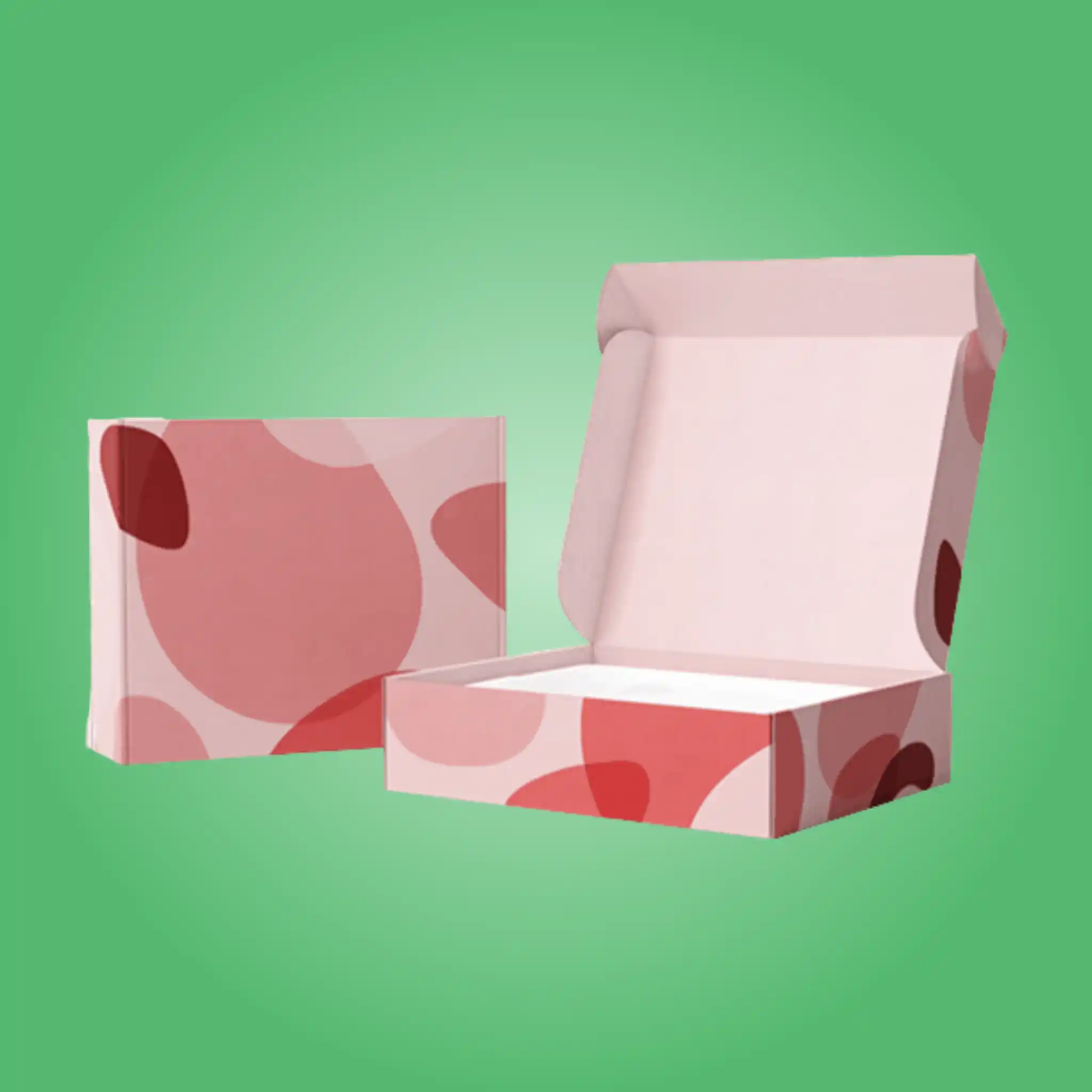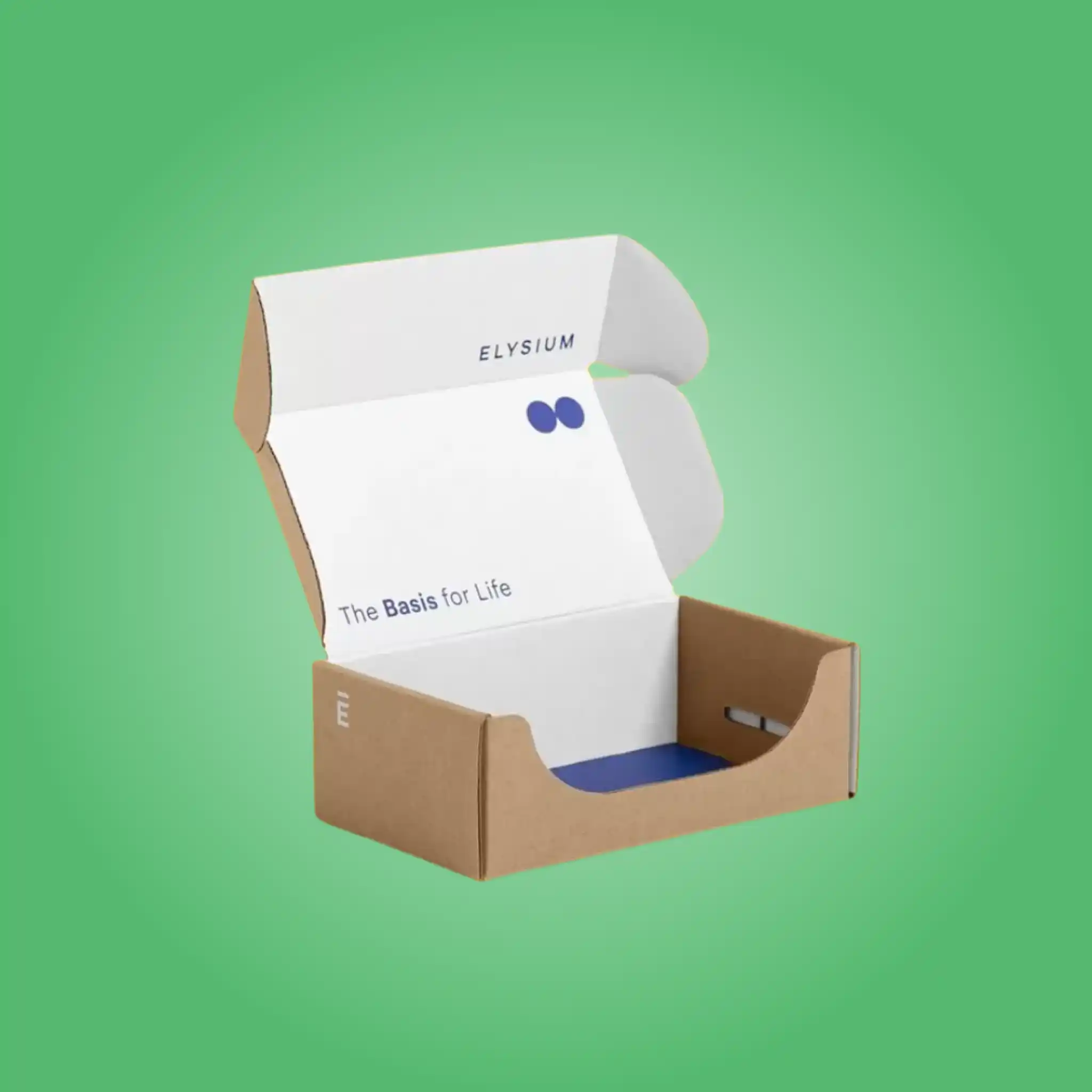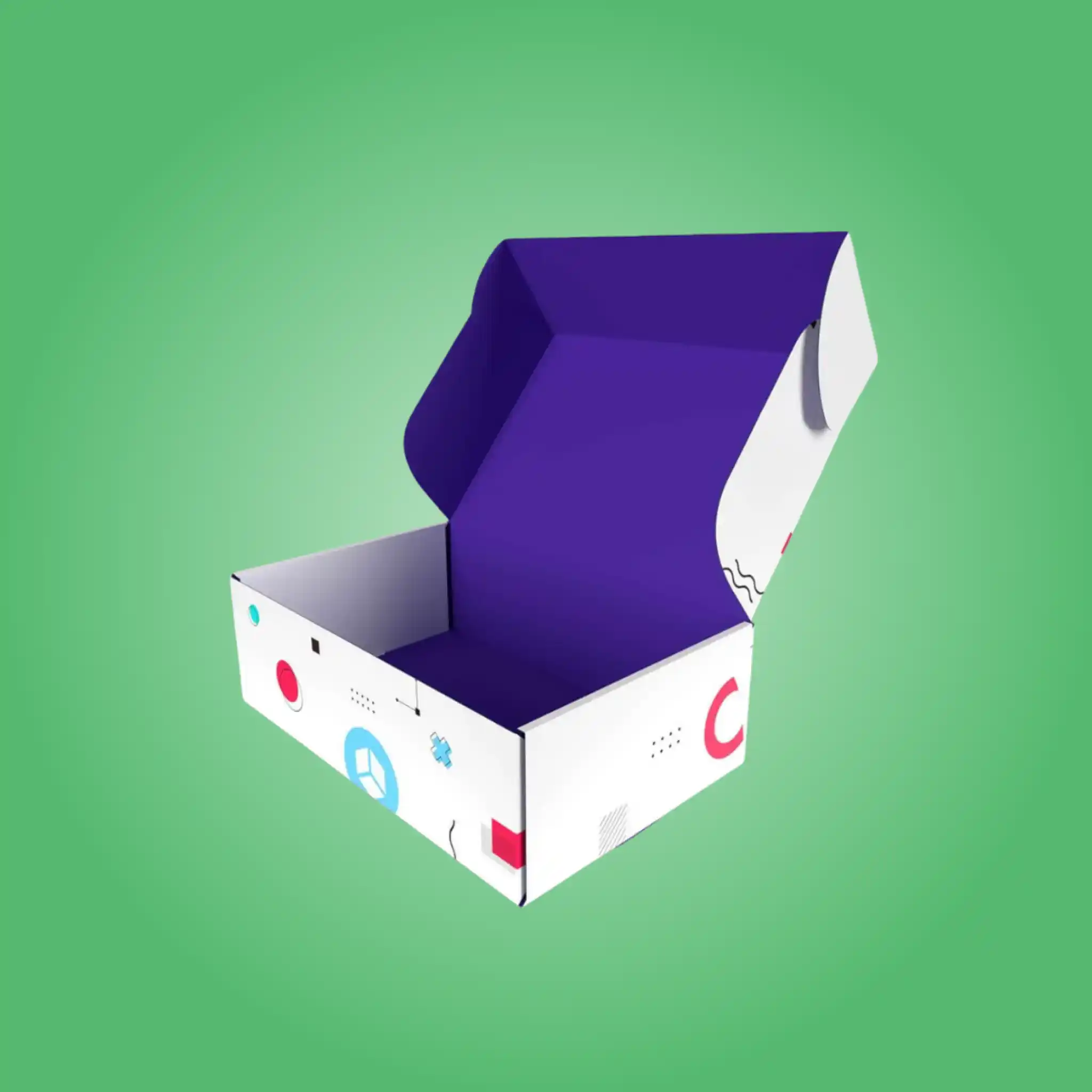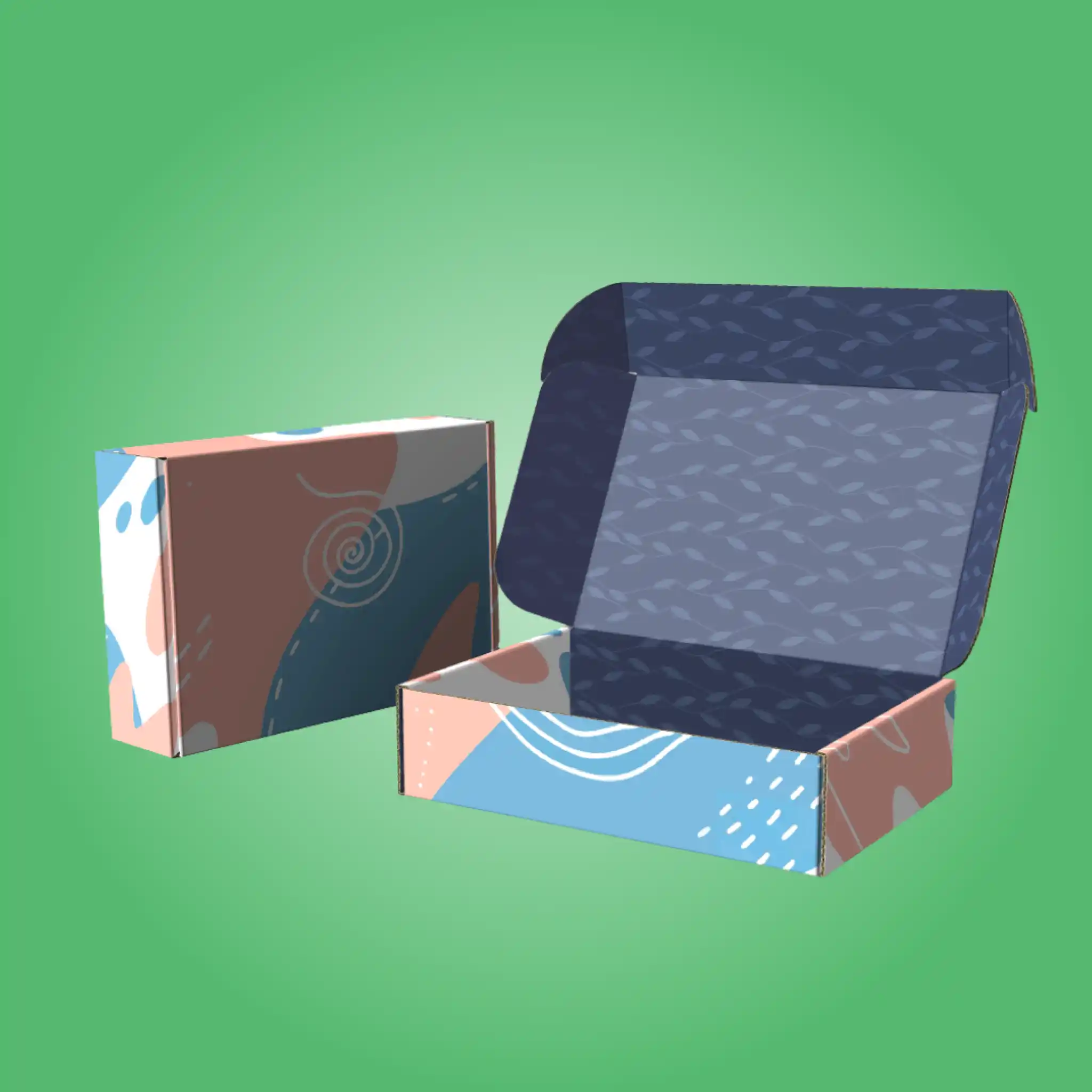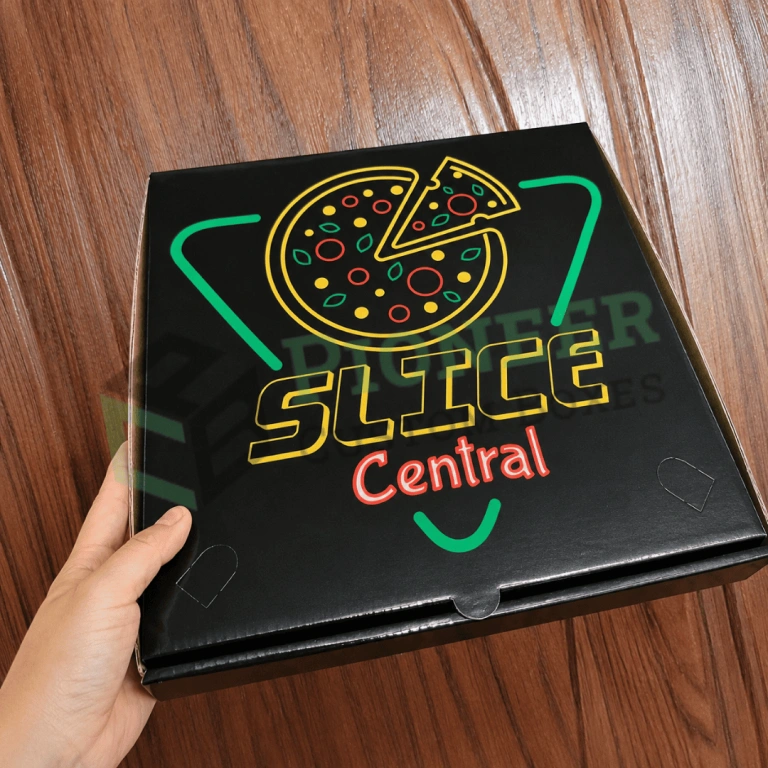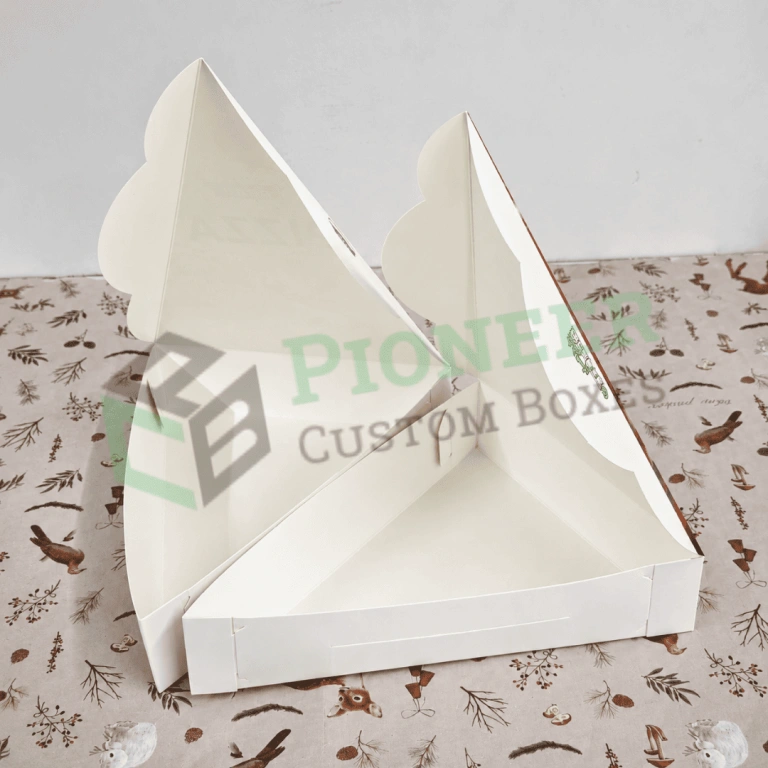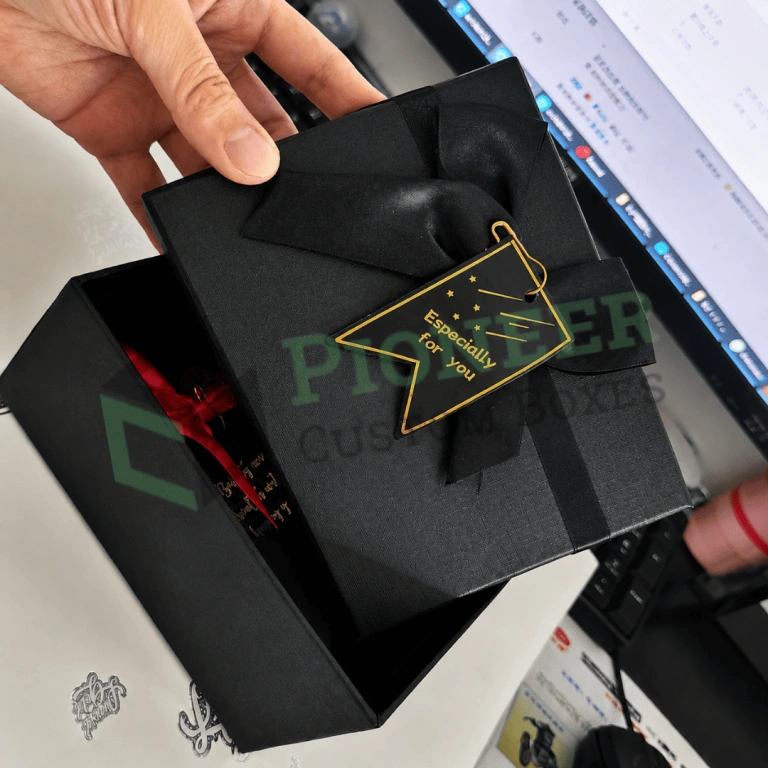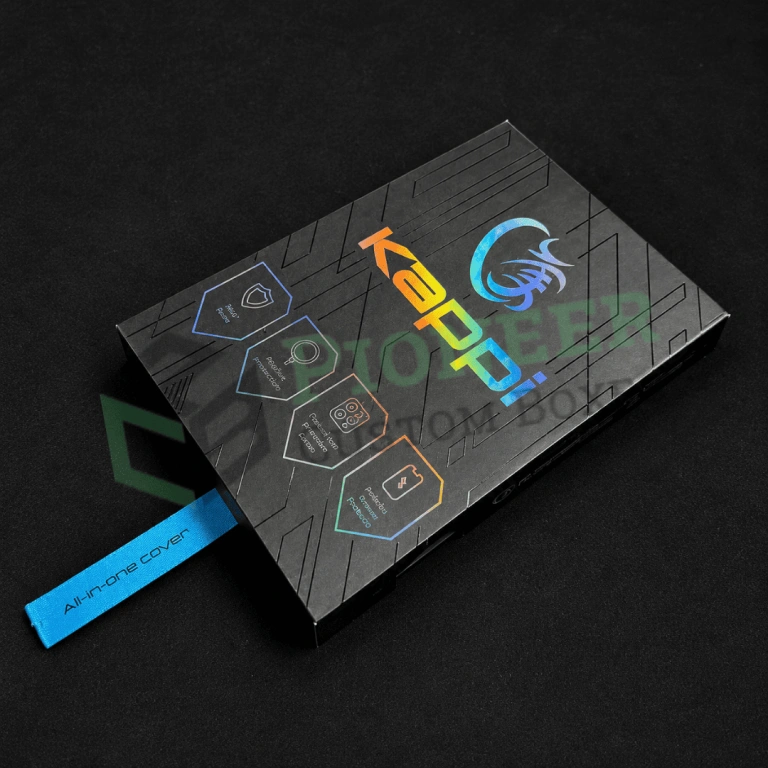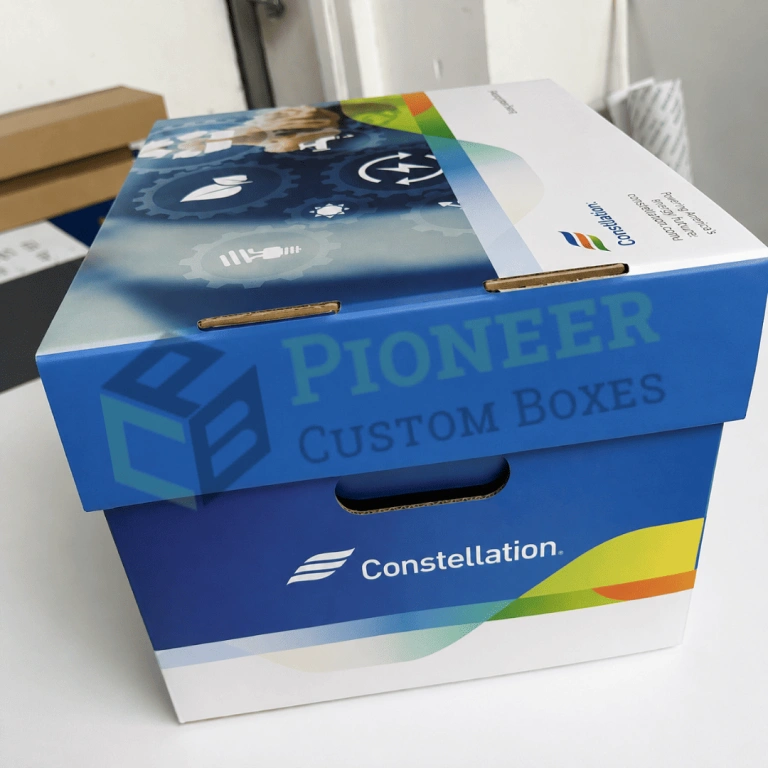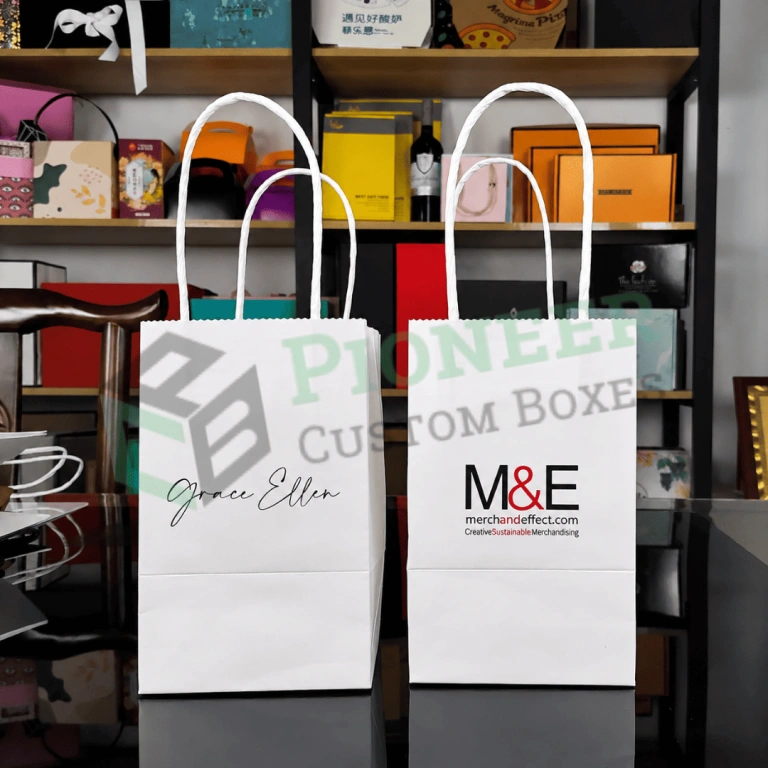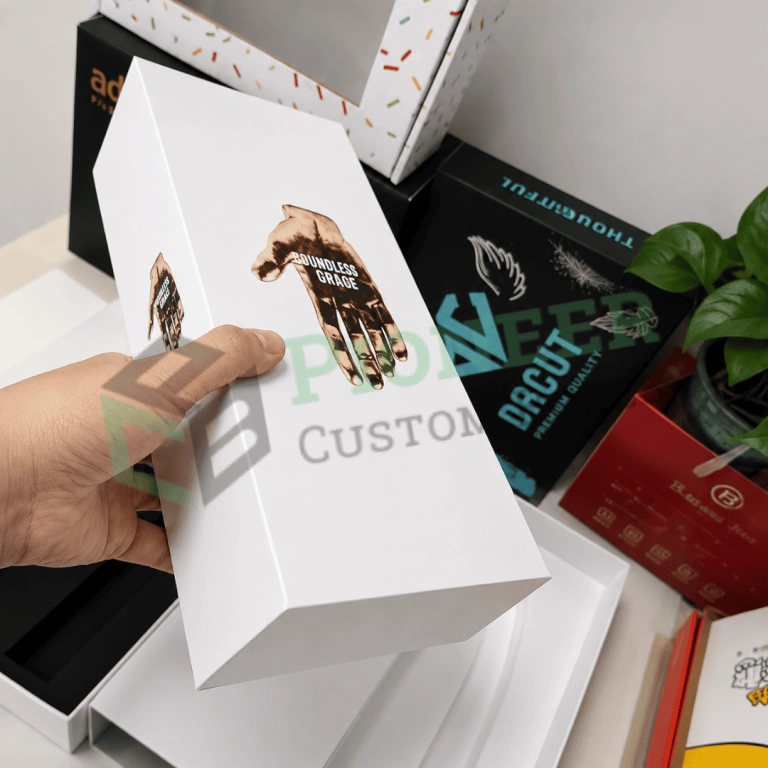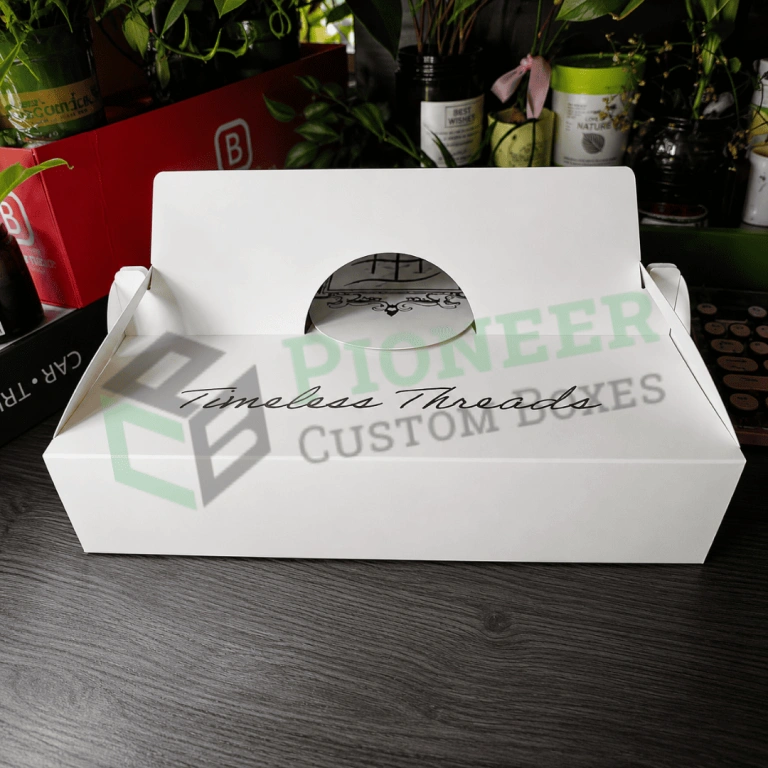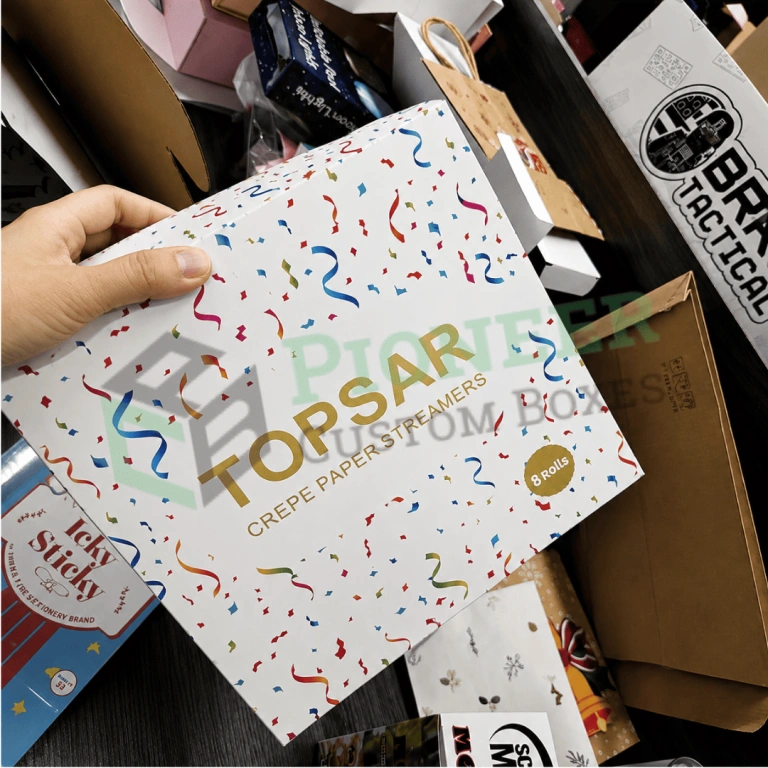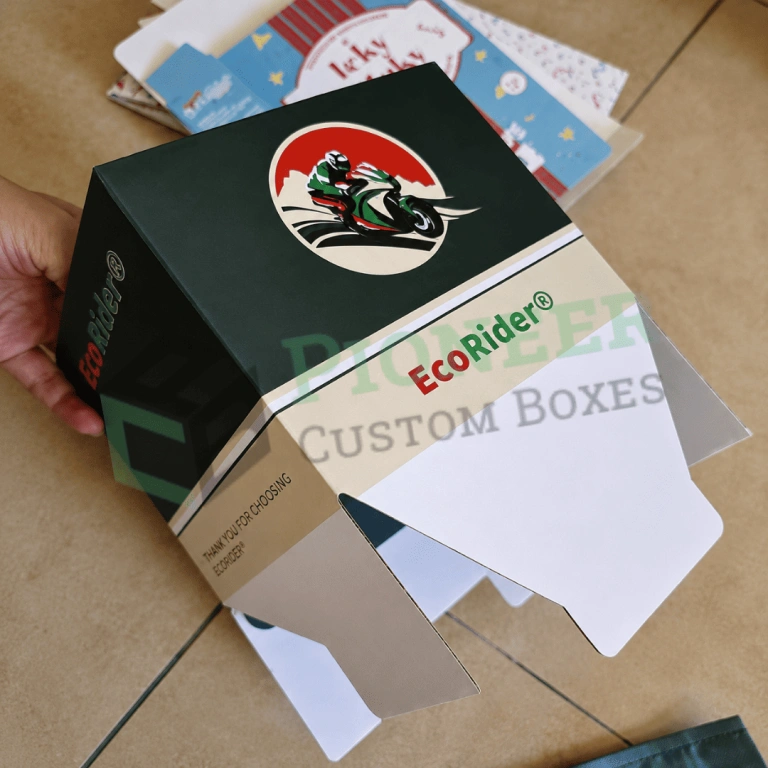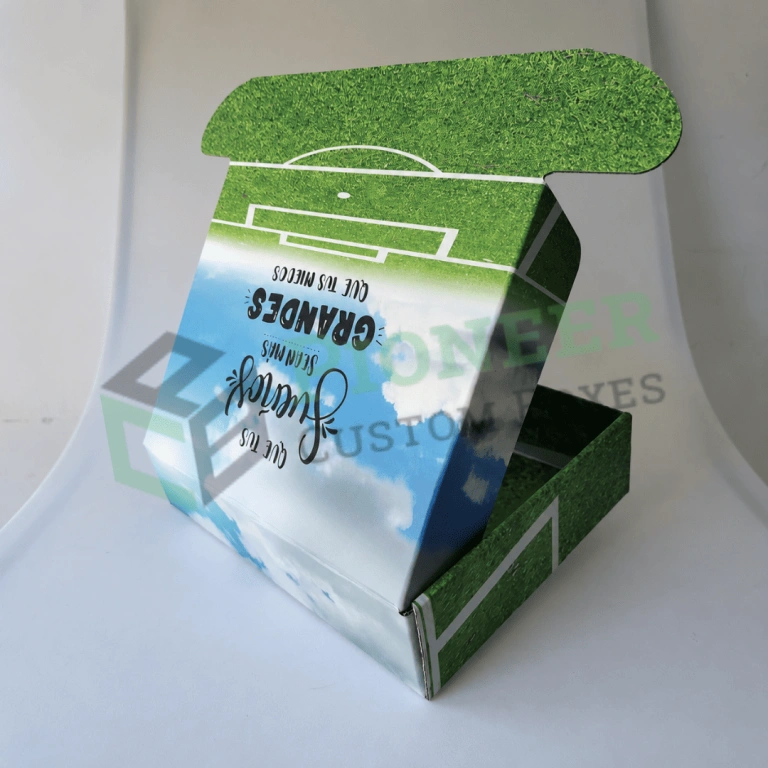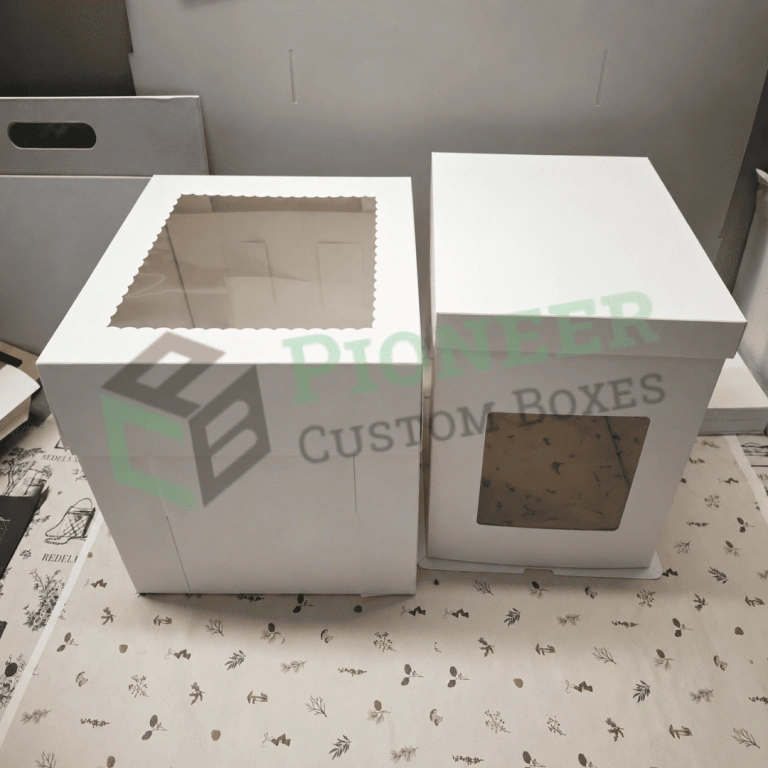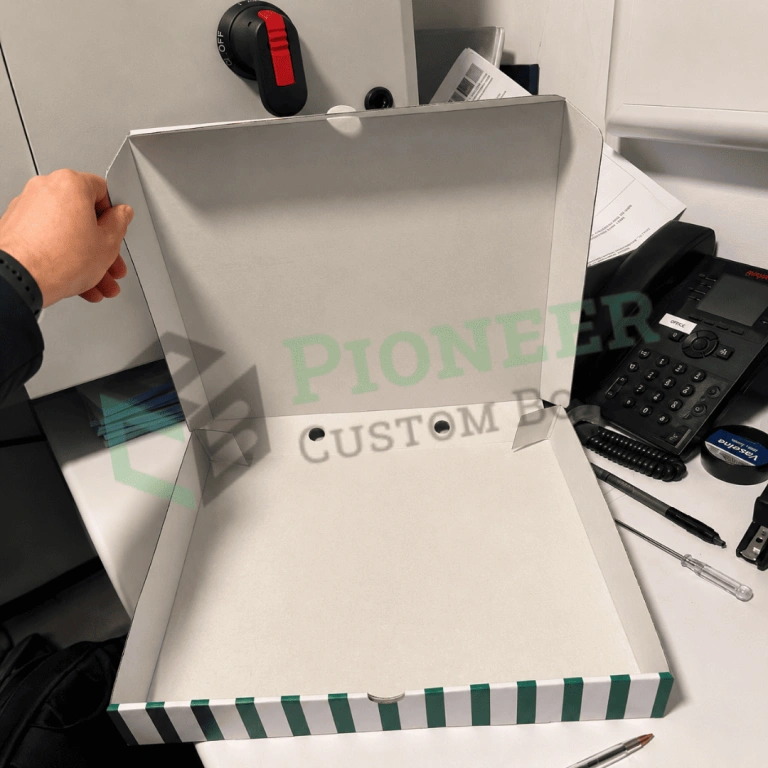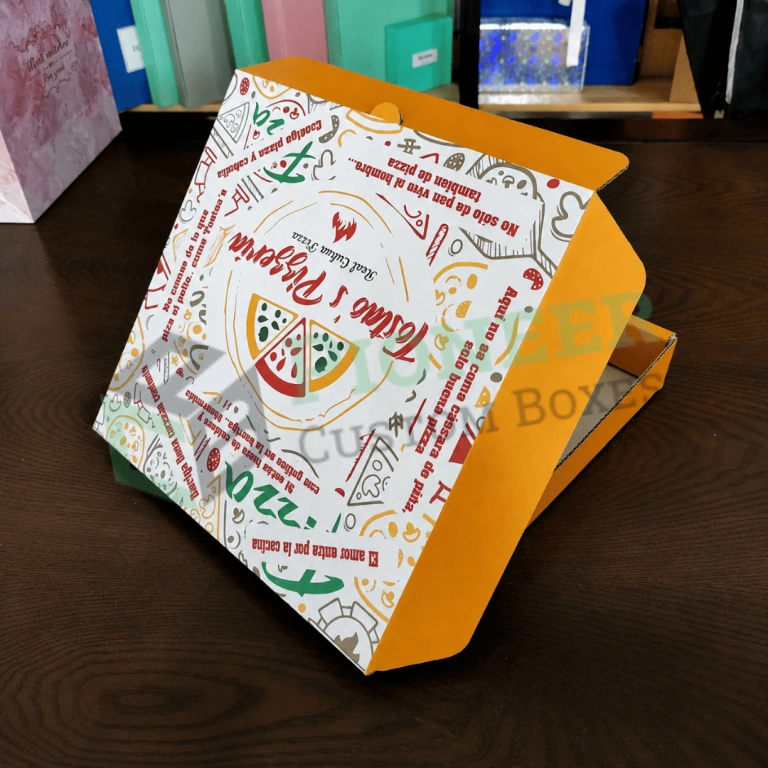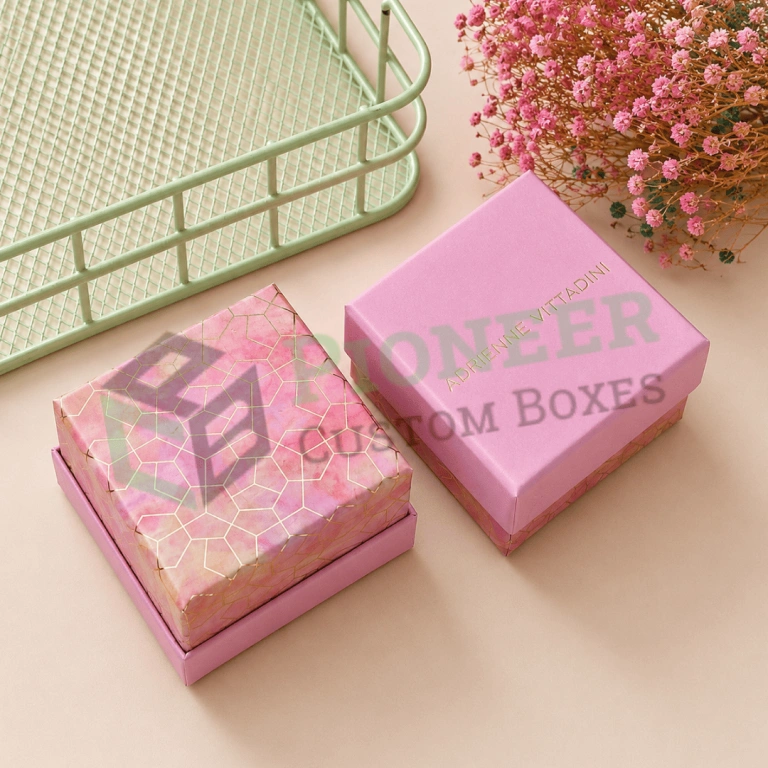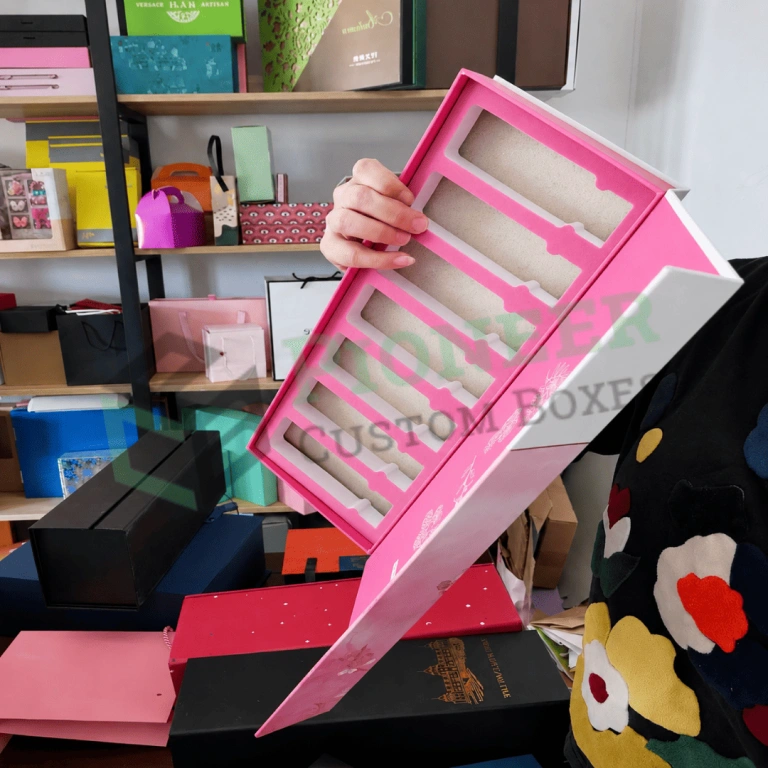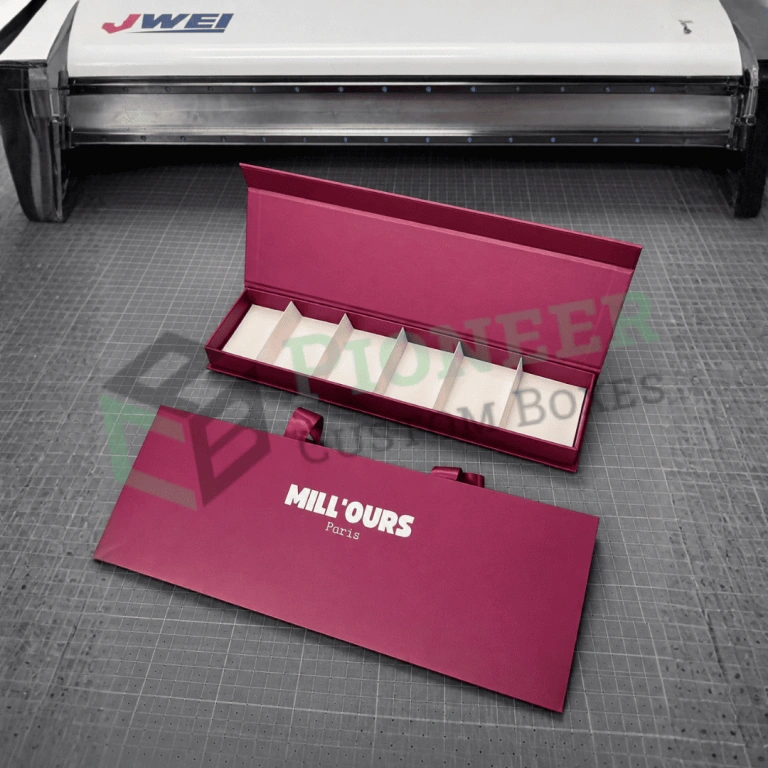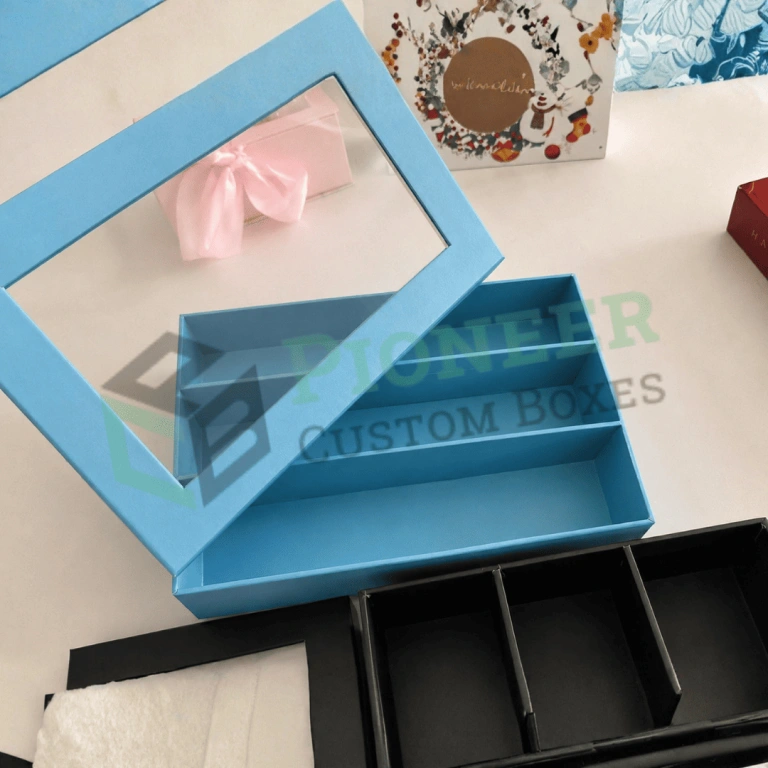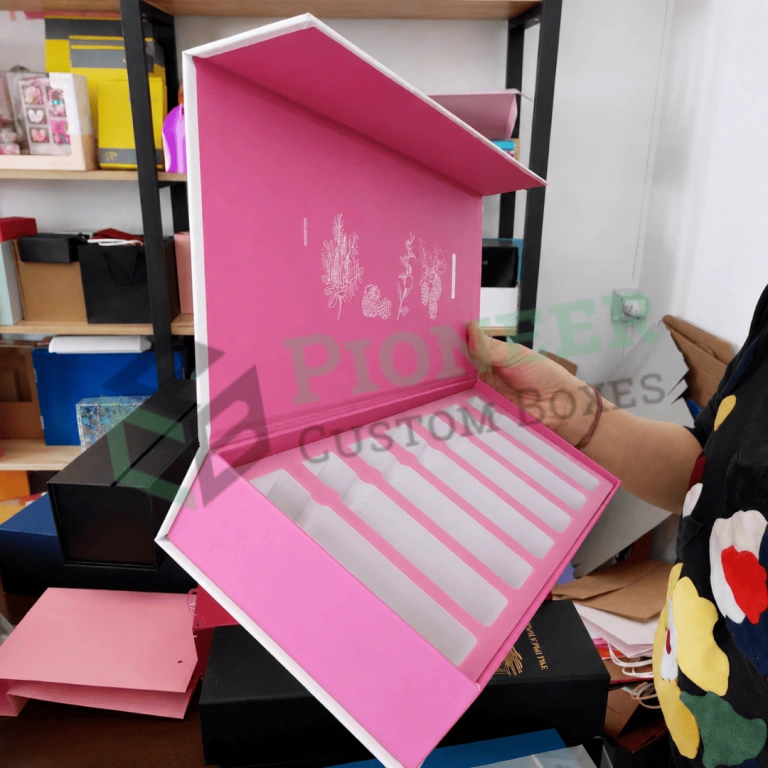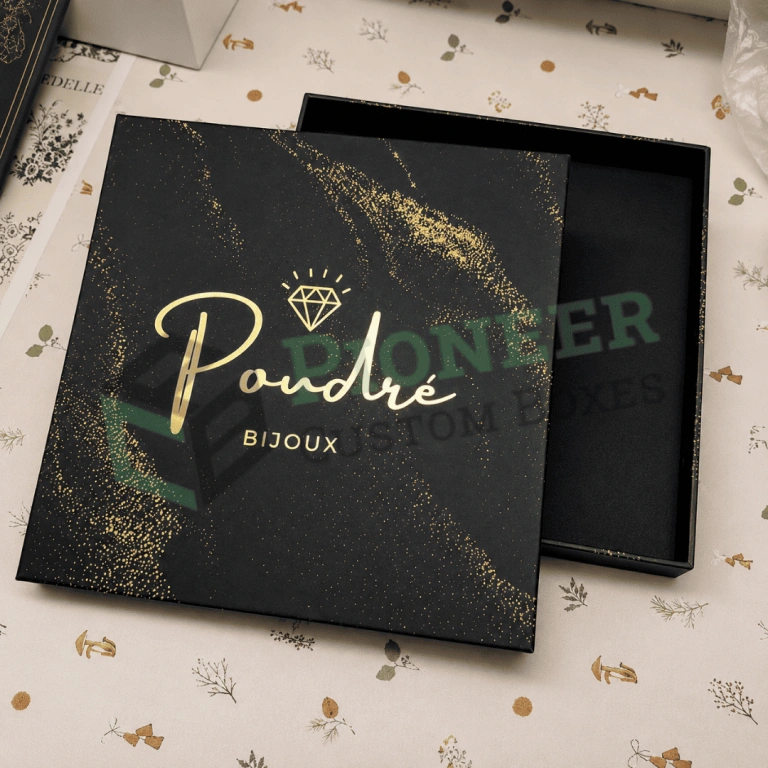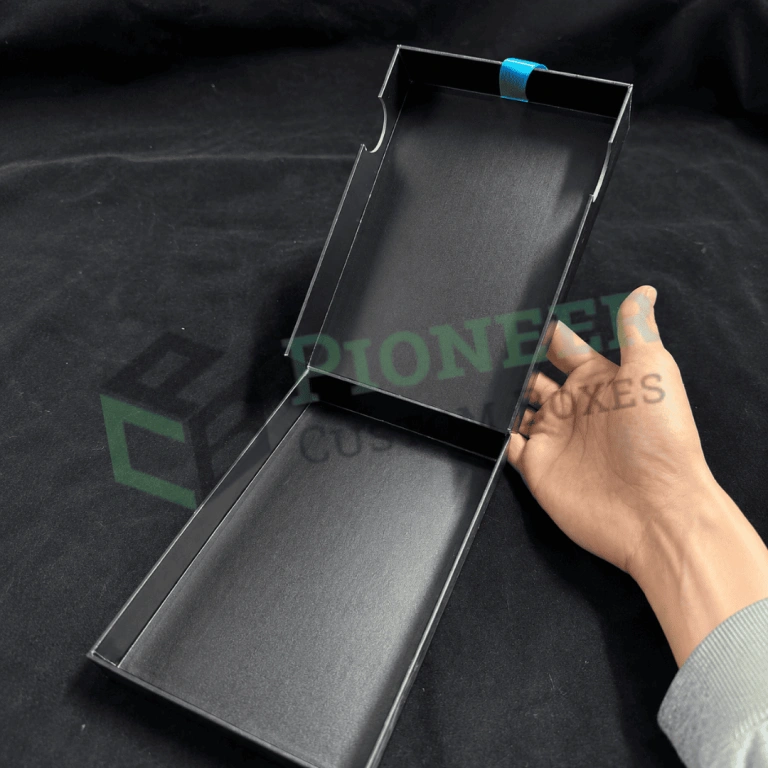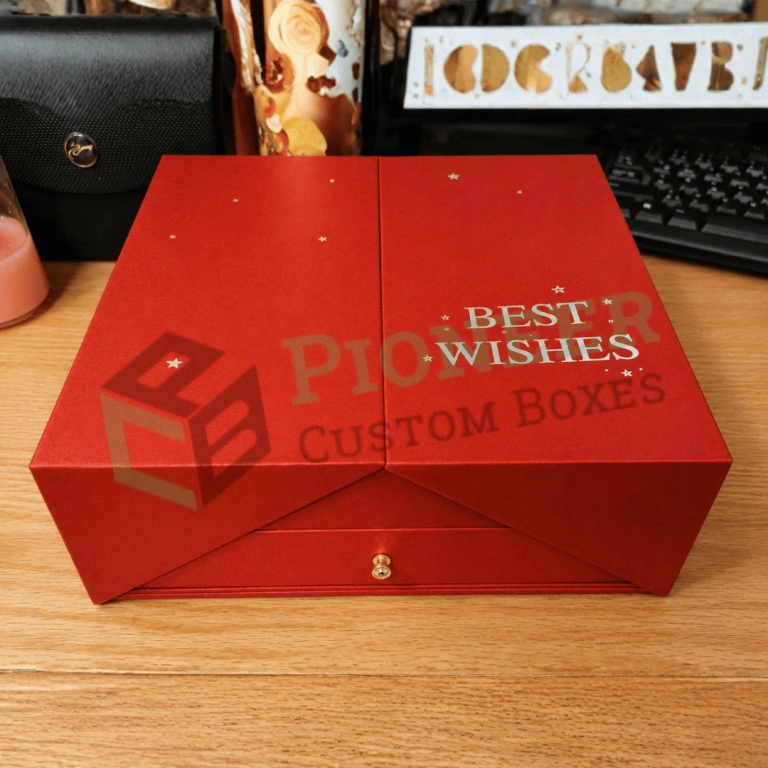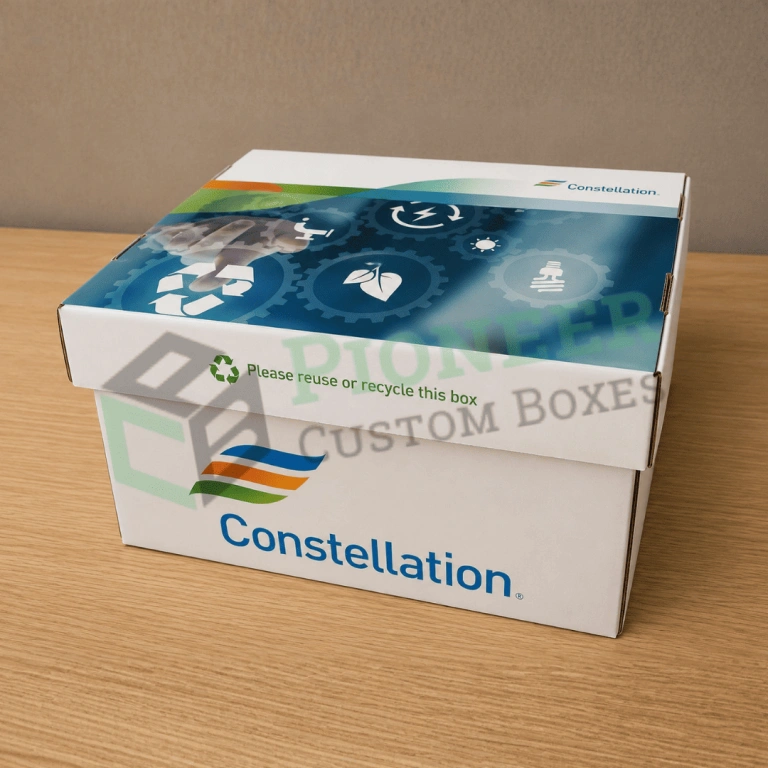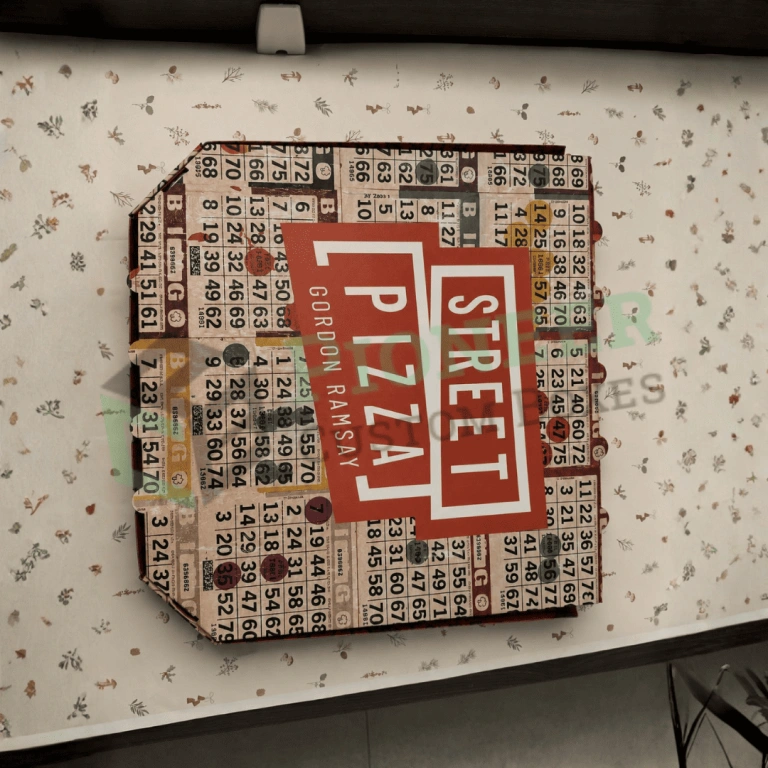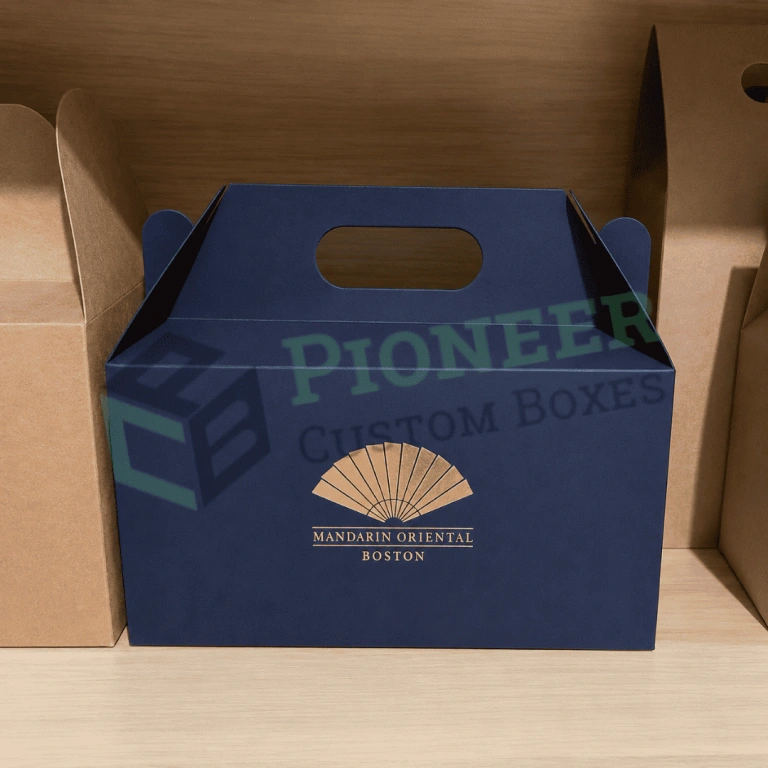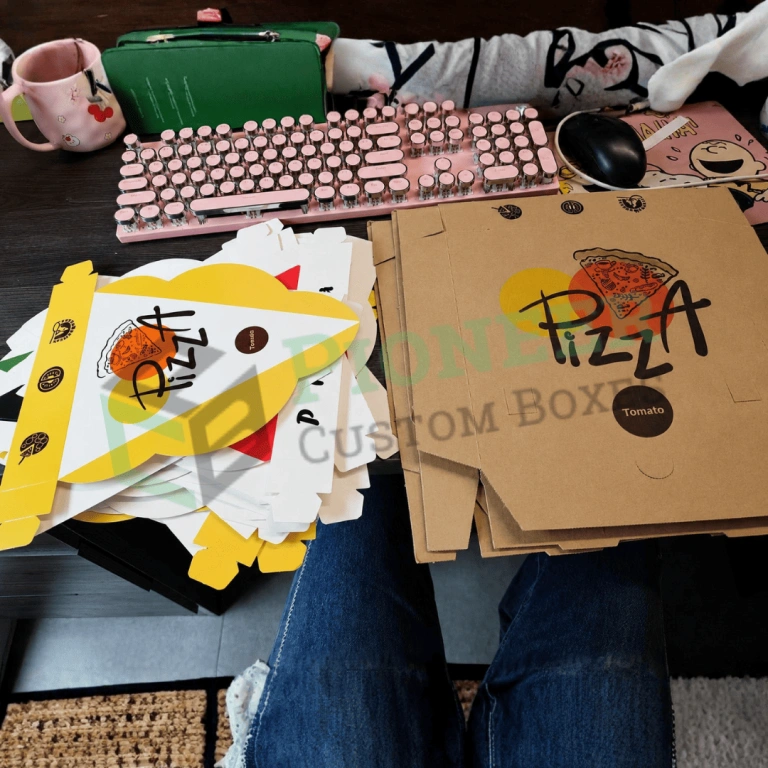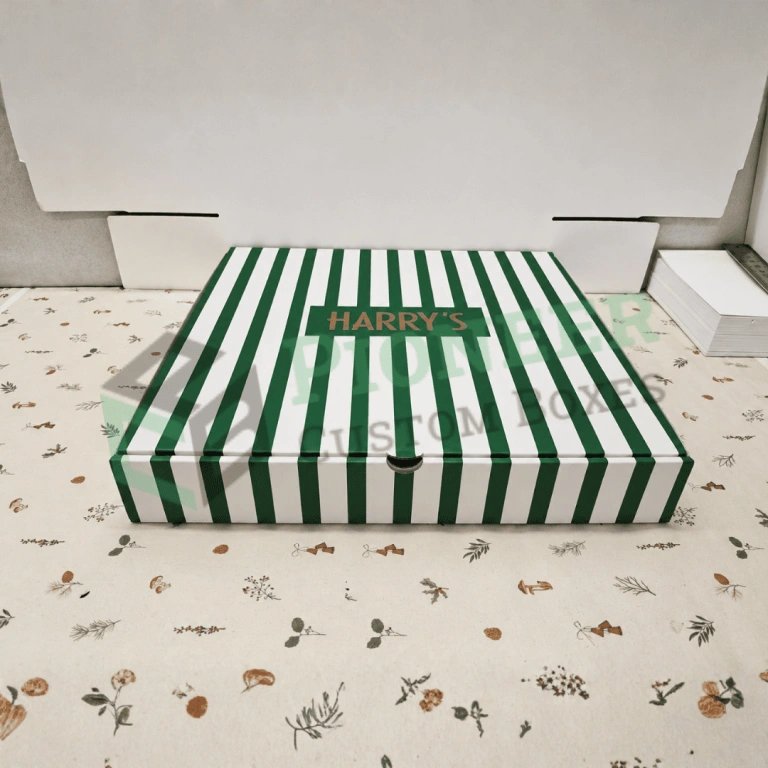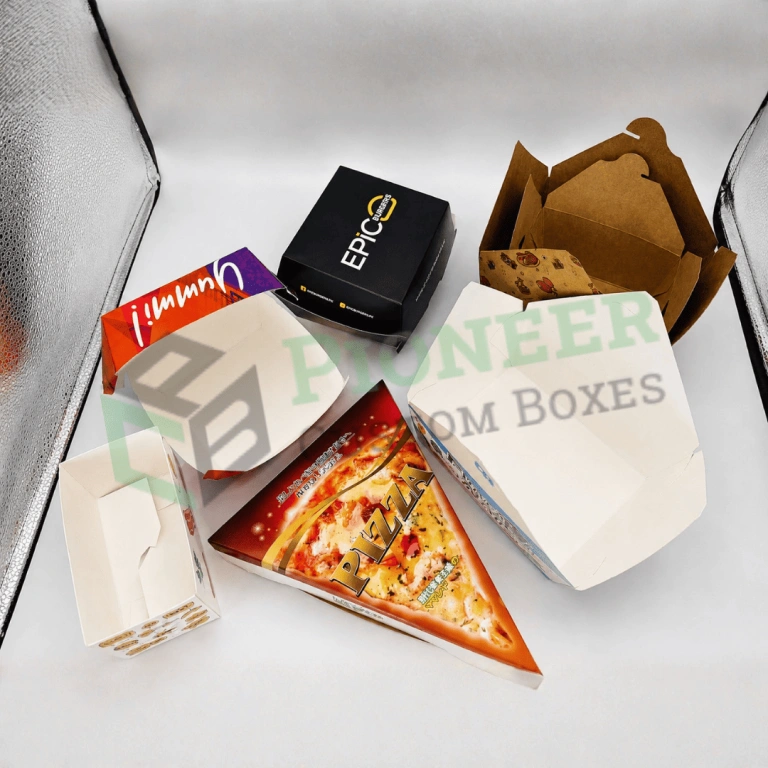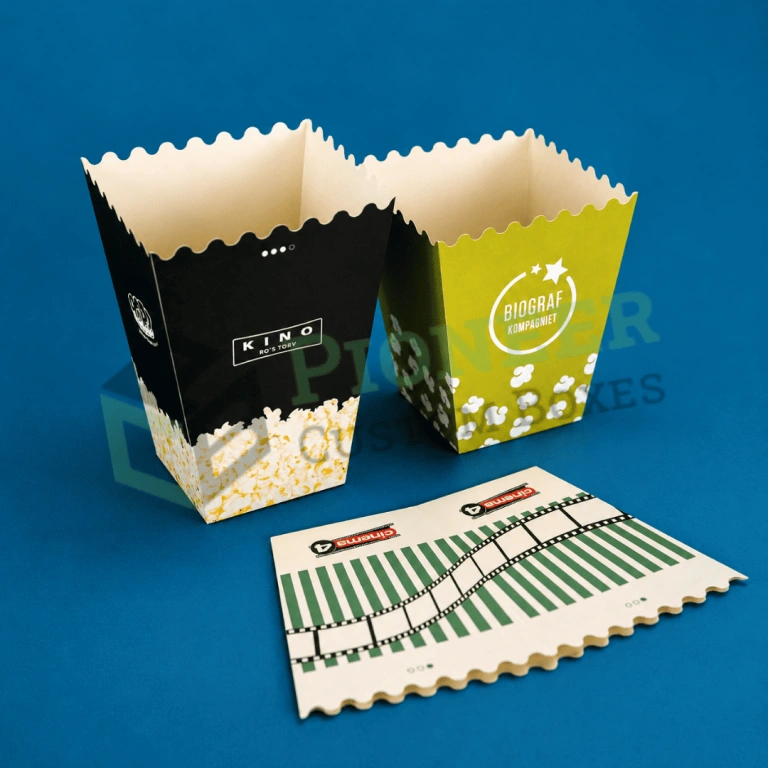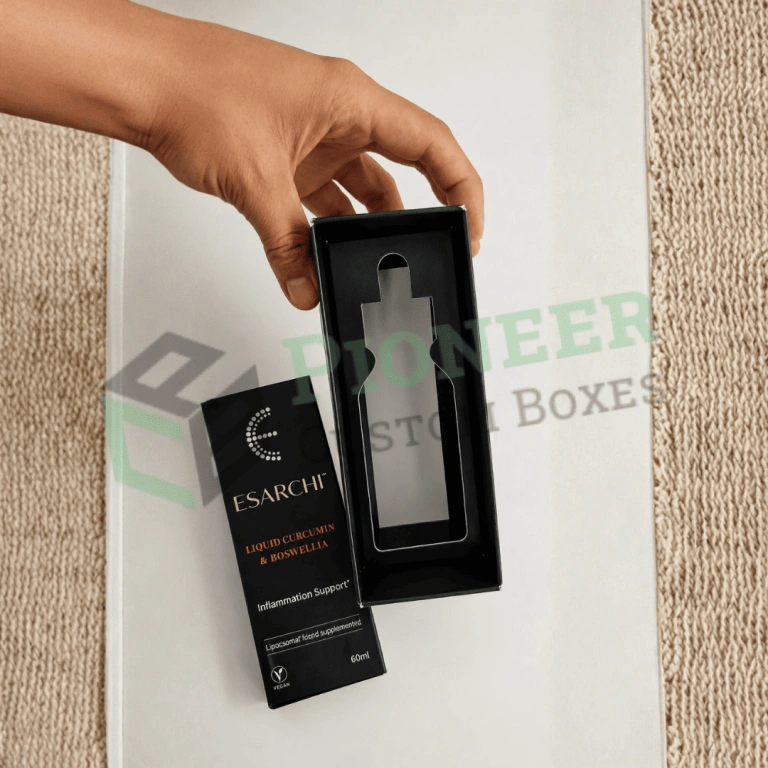
Roll end tuck front boxes from Pioneer Custom Boxes help subscription, beauty, apparel, gifting, food and ecommerce brands present products with a full lid opening and a printed interior. Choose E-flute, B-flute, kraft or SBS board, custom sizes, fitted trays, dividers, foil, coatings, free design support, no MOQ and free USA shipping.
A roll end tuck front box opens like a book rather than a bag. The lid is hinged along the back edge, it rolls up and over, and a tuck flap on the front holds it closed. The customer lifts the lid and sees the entire contents laid out at once, still in position.
That single behavior is why subscription businesses, gift brands and direct-to-consumer companies keep choosing this structure. A tuck end carton makes the customer tip the product out. A roll end tuck front presents it.
The structure is also stronger than it looks. The rolled edges create a double thickness of board along the side walls, which stiffens the whole box and resists crushing. That is why the format works in corrugated for shipping as well as in paperboard for retail.
Pioneer Custom Boxes manufactures roll end tuck front boxes in the United States with zero minimum order quantity, free dielines, free design support and free shipping nationwide. We cut our own dies and run our own presses, so the box is built around what you are actually sending.
The box is cut from a single blank with no glue at all in the simplest version. Side panels roll inward and lock, forming double-walled sides, and the base is created by those same rolled panels rather than by separate flaps.
The lid extends from the back panel, folds forward over the opening, and a front tuck flap slides down into the front face to hold it shut. Some versions add small side wings on the lid that tuck inside the walls, which stops the lid twisting and gives a more finished appearance.
Because the side walls are double thickness, the box holds its shape under pressure without the extra board of a corrugated shipper. That structural efficiency is what lets the format work as both a presentation box and a shipping box in one piece.
Assembly takes a few seconds and needs no tape or glue. Your team folds the blank into shape, and the rolled edges lock the structure. For higher volumes we can pre-glue certain versions so assembly is faster still.
Two structural options are worth knowing. A dust flap version closes the ends more completely for products that need protection from dust and light. A thumb notch cut into the front panel makes the lid easier to lift, which matters more than it sounds on a gift box someone opens carefully.
Buyers usually compare this style against a standard tuck carton or a die-cut mailer, and each comparison has a clear answer.
Against a tuck end carton, the roll end wins on presentation and on strength. The lid opens fully rather than through a slit, the contents stay arranged, and the double-walled sides resist crushing. It uses more board, so it costs more per unit.
Against a die-cut mailer, the two are close relatives, and the roll end tuck front is essentially the retail-facing member of that family. A mailer usually has side wings and a tuck flap designed for shipping, while a roll end tuck front is designed to be looked at as well as shipped.
Against a rigid lid-and-base box, the roll end ships flat and assembles in seconds, where a rigid box arrives assembled and takes real volume in transit. The rigid box feels more expensive in the hand. The roll end costs a fraction as much and reaches a similar impression once printed well.
Every die is cut to your measured contents. These formats show what we produce most often, weighted toward subscription and gift applications where this structure earns its place.
| Application | Typical Size (inches) | Material | Note |
|---|---|---|---|
| Small subscription box | 8 x 6 x 2 | E-flute | Printed interior |
| Standard subscription box | 10 x 8 x 3 | E-flute | Most common format |
| Large subscription box | 12 x 9 x 4 | E-flute | Divider insert |
| Beauty and skincare set | 9 x 6 x 2.5 | E-flute or 24pt | Multi-cavity insert |
| Apparel single item | 12 x 9 x 2 | E-flute | Tissue and belly band |
| Corporate gift set | 12 x 10 x 4 | E-flute | Fitted tray |
| Candle and home fragrance set | 9 x 9 x 4 | E-flute | Collar inserts |
| Food and hamper box | 11 x 8 x 5 | B-flute | Heavier contents |
| Stationery and print goods | 10 x 7 x 1.5 | 20pt SBS | Slim retail format |
| Electronics accessory kit | 8 x 6 x 2 | E-flute | Foam or pulp tray |
| Retail display version | 10 x 8 x 3 | 24pt SBS | Shelf-facing artwork |
Send your contents, their combined weight and how the box ships, and we return a free dieline sized precisely to them within one business day.
This structure usually holds several items rather than one, which changes how sizing works compared with a standard carton.
Start by laying your contents out as they should appear when the lid opens. That arrangement, not the individual products, sets the internal footprint. Most brands discover at this point that a slightly different layout uses a noticeably smaller box.
Depth is decided by the tallest item plus clearance for the lid to close without pressing down. Where one item is much taller than the rest, consider whether it can lie flat, because a single tall product forces depth on the whole box and depth is what drives shipping cost.
Every dimension we quote is internal, measured to the inside faces. Board has real thickness, and on E-flute that thickness is meaningful, so sending external dimensions produces a box your contents will not fit.
Leave room for the insert. A tray or divider adds material thickness on every wall it touches, and brands that size the box to bare contents find the insert will not seat once it exists. We design the box and the insert together on one dieline for exactly this reason.
For subscription businesses, size to your largest planned month rather than your average. Changing box size between months costs you tooling and breaks the visual consistency subscribers notice.
Material choice on this structure is decided by whether the box ships alone or travels inside something else.
E-flute is the default for roll end tuck front boxes and accounts for most of what we produce in this style. The fluted layer adds genuine crush resistance while the outer liner still prints well, so one box can be both the presentation piece and the shipping container. Subscription and direct-to-consumer brands almost always land here.
B-flute is thicker and stronger, and it steps in when contents are heavy or the box ships through rougher handling. Food hampers and multi-bottle sets usually need it. It prints acceptably though not as finely as E-flute, so photographic artwork is better handled with litho lamination.
For retail versions that sit on a shelf rather than traveling alone, heavy paperboard gives a smoother printing surface and a cleaner folded edge. It has no crush resistance to speak of, so this option belongs inside an outer shipper if it moves through a parcel network.
Natural brown kraft suits sustainable and artisan positioning, and it costs less than bleached stock. Inks print warmer and white will not read as white, so kraft designs use one or two bold colors. Many subscription brands print the exterior in one kraft-friendly color and save the full-color work for the printed interior.
A white outer liner over a kraft structure gives accurate color reproduction on the outside while keeping the kraft look inside. It costs slightly more than plain kraft and considerably less than fully bleached board, and it is often the right compromise for brands that need photographic exterior artwork.
The interior deserves a decision of its own. Because this structure opens fully, the inside of the lid is the first thing a customer sees, and it is genuinely valuable printed space rather than an afterthought.
| Material | Typical Spec | Strengths | Best For | Relative Cost |
|---|---|---|---|---|
| E-flute corrugated | 32 ECT typical | Impact absorption, prints well | Most roll end tuck front mailers | Moderate |
| B-flute corrugated | 200 lb test typical | Thicker wall, more crush resistance | Heavier or fragile contents | Higher |
| SBS paperboard | 20pt to 24pt | Bright white, sharp retail print | Light contents, retail-facing boxes | Moderate |
| Kraft corrugated and kraft board | 32 ECT typical | Natural look, hides scuffing | Eco and artisan positioning | Lower |
| White top kraft | 32 ECT typical | White print face on kraft body | Print quality with kraft economics | Moderate |
Print method decides appearance and unit cost, and on corrugated the options behave differently than on folding board.
Flexo prints directly onto corrugated from flexible plates. It handles bold graphics, solid colors and clear type economically, and it is the standard for subscription boxes printed in one or two colors inside and out. It does not reproduce fine photographic detail well, because the fluted structure creates uneven pressure across the surface.
A sheet is printed offset then bonded to the corrugated board, giving photographic quality on a structural box. Premium subscription and gift brands use this route when the exterior carries imagery rather than graphics. It costs more than direct flexo and looks substantially better.
Digital prints directly onto the board with no plates, which removes setup cost entirely and makes short runs and seasonal artwork practical. For subscription businesses changing artwork monthly, digital is frequently the only economical route, and it allows different artwork within a single production run.
Where the box is produced in SBS for retail, standard offset applies and delivers the finest detail and the most consistent color across a long run.
Whichever method you choose, we print your artwork on the actual substrate before the full run. Colors behave differently on kraft, on white top and on laminated corrugated, and seeing it settles the question in a minute.
Three color systems matter, and on corrugated the substrate affects all of them more than it would on white folding board.
CMYK builds every color from cyan, magenta, yellow and black separations. It reproduces photography and gradients convincingly on a white or white-top liner, and it costs the least since four inks cover the whole design. On natural kraft, CMYK shifts warmer and loses brightness, which is why kraft designs usually avoid full-color imagery.
Pantone inks arrive pre-mixed and print identically on every run. For subscription boxes this matters commercially, because subscribers see your box every month and any drift between production batches is noticed. A spot brand color also prints far more cleanly than a CMYK build on corrugated. We store your references permanently and match against a physical draw-down.
RGB is a screen color space and cannot be printed. Your website, unboxing photos and social assets all live in RGB, and conversion shifts saturated colors noticeably. We run that conversion and show you the printed result on your actual board before the full run.
Finishing on this structure divides into two questions that most brands answer separately: how the outside survives shipping, and what the inside says when the lid opens.
Lamination protects the exterior from scuffing through a parcel network and makes color look richer. It adds cost and complicates recyclability, so many subscription brands skip it on the outside and use an aqueous coating instead.
A water-based coating protects the printed surface at low cost and keeps the box fully recyclable. For a box discarded or recycled soon after opening, this is usually the right choice and it is what we recommend by default on corrugated.
This is the highest-value finishing decision available on the structure. Because the lid opens fully, the inside of the lid faces the customer directly at the moment of opening. A message, a pattern or a brand mark printed there costs relatively little and is the single most photographed part of an unboxing.
Hot foil adds a metallic accent that lifts a gift or premium subscription box. On corrugated it works best on a laminated surface, since bare fluted board does not take foil as cleanly. A single hit on the logo is usually enough.
Spot UV creates gloss contrast against a matte background and works well on a laminated exterior. Keep it clear of any shipping label area, since labels adhere poorly to gloss varnish.
Texture reads well on paperboard versions of this structure. On corrugated, embossing crushes the flute and weakens the panel, so we generally advise against it and suggest foil or spot UV instead.
The lid opening is only as good as what it reveals, so the insert does as much work as the box itself.
| Add-On | What It Does | Best Suited To |
|---|---|---|
| Corrugated divider | Separates items into compartments | Multi-item subscription boxes |
| Fitted paperboard tray | Holds items in a set arrangement | Gift and beauty sets |
| Molded pulp tray | Cradles irregular or fragile shapes | Ceramics, glass, electronics |
| Foam insert | Highest protection for delicate items | Devices and precision goods |
| Belly band | Holds tissue or apparel in place | Clothing and softgoods |
| Printed tissue or wrap | Adds a layer before the reveal | Premium and gift positioning |
| Ribbon pull | Lifts an item out cleanly | Higher-value single products |
| Thumb notch | Makes the lid easier to lift | All gift-oriented versions |
| Tear strip | Provides tamper evidence on shipping | Subscription and sealed goods |
We design the insert on the same dieline as the box, so the two are matched rather than approximately compatible. That also means a single tooling charge rather than two.
For most brands using this structure, the box ships alone through a parcel network, so packaging decisions move shipping cost more than they move material cost.
Carriers bill on dimensional weight whenever volume implies more than actual weight. A light subscription box in a generous size gets charged as though it were heavy, on every order, permanently. Trimming the box to its contents removes that penalty for the life of the product.
Depth is usually the easiest dimension to reduce and the one brands over-specify most. An inch of unnecessary depth adds volume across the whole footprint. Laying one tall item flat, or choosing a slimmer version of it, frequently drops a box into a lower rate band.
Oversize thresholds sit beyond that. Once length plus girth crosses a published limit, a surcharge applies regardless of weight. We check finished dimensions against current carrier thresholds during dieline review and flag anything sitting close to a line.
The double-walled sides of this structure help here, because they deliver crush resistance without moving to a thicker flute. That means you can often ship in E-flute where a plain mailer would need B-flute, saving both material and volume.
Send us your carrier and your typical contents, and we will size the box against those rate bands before you approve anything.
This structure uses more board than a simple carton by design, so the variables that reduce cost are worth knowing precisely.
Box dimensions lead, and they cost you twice. Board is priced by area, so a smaller box costs less outright, and a smaller box also ships cheaper. For most brands the freight saving from right-sizing exceeds the material saving comfortably.
Material grade follows. E-flute suits most contents, and moving to B-flute should be a response to real weight rather than a general precaution. Over-specifying flute is the most common quiet waste in this category.
Print method is third and moves the number substantially. One or two flexo colors cost a fraction of litho lamination, and many successful subscription brands print a bold single color outside with a printed interior, which reads better than full-color photography on kraft anyway.
Inserts and quantity finish the list. A corrugated divider cut from the same board costs far less than molded pulp or foam, and it recycles with the box.
The printed interior is the one line we rarely advise cutting. It is inexpensive relative to everything else and it is the part customers photograph.
This structure is judged at the moment it opens, so inspection tests how it behaves rather than only how it looks.
| Check | What We Verify | Why It Matters |
|---|---|---|
| Lid closure fit | Front tuck seats fully and holds | A lid that springs open ruins the reveal |
| Roll edge lock | Side panels lock square and stay locked | A failed lock collapses the wall |
| Assembly test | A box built by hand from the run | Assembly speed is real labor cost |
| Dimensional accuracy | Internal fit against the approved dieline | Contents and insert must both fit |
| Insert seating | The real insert placed in the finished box | A tray that will not seat is useless |
| Score and fold quality | Clean folds with no cracked liner | Cracked scores weaken the walls |
| Interior print quality | Coverage and registration inside the lid | The interior is what gets photographed |
| Exterior scuff resistance | Rub test on the printed surface | Parcel networks are abrasive |
| Color match | Pantone against a physical draw-down | Subscribers see your box every month |
| Label area suitability | Shipping label adheres cleanly | Labels lift off gloss varnish |
If anything fails, we remake it rather than ship it.
Subscription businesses are the largest user of this structure by a wide margin. The box is their only physical contact with a customer, it ships alone, and it is opened deliberately rather than torn into. A full lid opening with a printed interior does more for retention than most brands expect.
Beauty and skincare brands use them for curated sets, where several products need to appear arranged rather than loose. A fitted tray inside a roll end box turns four separate items into one considered presentation.
Apparel and softgoods brands use them because the wide opening suits folded garments, and a belly band or printed tissue adds a layer before the reveal without adding structure.
Corporate gifting programs use them heavily during seasonal peaks. The box ships flat, assembles in seconds during a fulfillment push, and holds a multi-item set in a fitted tray.
Food, hamper and specialty grocery brands use B-flute versions for weight, usually with dividers separating jars and bottles. The double-walled sides matter here because the contents are dense.
Electronics and accessory brands use them with foam or pulp trays, where the staged reveal is part of how the product is positioned.
Candle and home fragrance brands use them for gift sets, pairing collar inserts with a printed interior. Stationery and print businesses use slimmer paperboard versions for retail rather than shipping.
A box that presents beautifully and assembles slowly costs you money on every order, so we test both before you commit.
A standard roll end tuck front assembles in a few seconds with no tape or glue. Side panels roll and lock, the base forms as part of that motion, and the box is ready to fill. For fulfillment teams packing hundreds of orders a day, that speed is the reason the structure scales.
Flat storage is the second practical advantage. The blanks stack in a fraction of the space assembled boxes occupy, so you can hold months of stock without renting more warehouse space. That matters for subscription businesses ordering in large batches.
Where volume is very high, we can pre-glue certain panels so assembly drops further. We will tell you honestly whether that is worth the cost at your volume rather than adding it by default.
Sequence matters in fulfillment. Most teams assemble a batch of boxes first, then fill and close them, which suits this structure well because an assembled box holds its shape open. A structure that needs contents to stay square would not.
Tell us your daily order volume and how many people pack, and we will time an assembly sample and give you a realistic figure rather than a claim.
Subscription and ecommerce customers scrutinize packaging waste more than most, so this is a section worth getting right rather than decorating.
Corrugated is among the most recycled materials in the United States and moves through curbside programs without difficulty. Keeping the box recyclable is mostly a matter of what you put on it. Aqueous coatings preserve recyclability while plastic lamination complicates it, so we recommend coating over lamination unless the exterior genuinely needs the protection.
Recycled content liners cost less than virgin board and lower the footprint, which is an unusual case where the greener choice is also the cheaper one. Kraft avoids the bleaching step entirely and suits the aesthetic many subscription brands want anyway.
Inserts are where most boxes lose their recyclability. A corrugated divider or a molded pulp tray recycles alongside the box, while foam does not. For most contents, pulp achieves the protection foam would, and we will show you both as physical samples.
Right-sizing remains the largest lever. A box cut to its contents uses less board, needs no void fill and occupies less trailer space, reducing material and transport impact together. We treat that as a design objective rather than an afterthought, and we print clear disposal guidance on the box so customers act correctly.
The same errors recur, and each one is avoidable before a die is cut.
Sizing the box to the contents without allowing for the insert leads the list. A tray adds material thickness on every wall it touches, and a box cut to bare contents will not accept it. We design both on one dieline for this reason.
Over-specifying depth is second and is the most expensive habit in the category, because depth drives dimensional weight on every shipment forever.
Leaving the interior unprinted is a missed opportunity rather than an error, though it is the one brands regret most. The inside of the lid is the first thing a customer sees and the part they photograph, and printing it costs very little relative to the box.
Applying gloss varnish where the shipping label goes causes labels to lift in transit, which turns into a delivery failure. We reserve a matte label area during dieline planning.
Embossing corrugated crushes the flute and weakens the panel. Where texture is wanted on a corrugated box, foil or spot UV achieves the effect without the structural cost.
Finally, approving from a flat render. This structure is entirely about how it opens, and that experience does not exist on a screen. A physical sample takes three to five business days and settles every question at once.
A monthly beauty subscription came to us with shipping costs eating a growing share of their margin. Their box was well designed and simply too big.
Their contents laid out flat in a footprint about an inch narrower than the box allowed, and the depth had been set by one tall serum bottle that could safely lie on its side. The box was also B-flute when E-flute would have carried the weight comfortably.
We rebuilt the dieline around the actual contents layout, dropped the depth by an inch by laying the serum flat in a fitted corrugated tray, and moved to E-flute. The exterior artwork stayed identical and we added a printed interior on the lid, which they had not previously had.
The parcels moved into a lower dimensional weight band, cutting shipping cost per box meaningfully across every shipment. Material cost fell as well because the box was smaller and the flute lighter. The printed interior cost a fraction of the saving, and their subscribers started posting unboxing photos in noticeably higher numbers.
Ordering runs through four steps and our team carries the technical work in each one.
First, send your contents rather than only a size. Photographs of the items laid out as you want them to appear, plus their combined weight, tell us more than dimensions alone and usually produce a smaller and cheaper box.
Second, we return a free dieline covering both the box and the insert, plus a written quote, within one business day. We check carrier dimensional thresholds at the same time and flag anything sitting close to a rate band.
Third, you approve a digital proof, and on this structure we strongly recommend a physical sample. Load it with your real contents and open it the way a customer would. Samples take three to five business days.
Fourth, we produce and ship. Standard production runs eight to twelve business days, rush production runs four to six, and shipping across the United States costs nothing. Reorders skip straight to production, and for subscription brands we hold the die permanently so only artwork changes month to month.
Three things make roll end tuck front boxes practical at any scale, and none carry a hidden charge.
Zero minimum order quantity means a new subscription business can launch with a hundred boxes rather than committing to a pallet before it has subscribers. Digital printing covers those short runs with no plate cost.
Free design support covers the box, the insert, the layout of your contents and artwork preparation. We build the dieline, size the interior around what you are actually sending, and prepare print-ready files. If you work with a designer, we supply a layered template marked with fold lines, bleed, safety margins and the interior print area.
Free shipping applies across the United States on every order, rush production included. We manufacture domestically, so lead times stay short and a monthly subscription cycle never waits at a port.
We are a direct manufacturer rather than a broker. We cut our own dies, run our own presses and finish every order in house, which is why we can quote quickly, adjust a specification mid-conversation and stand behind what leaves our floor.
For subscription and gifting brands that control matters month to month. Artwork changes reach press without going through intermediaries, and a die adjustment happens in days rather than weeks.
Send us your contents, their weight and how the box ships, and we will return a free dieline and a written quote for roll end tuck front boxes within one business day. Order now, or get a free quote and we will size the box around what you are actually sending.
| Box Style | Roll End Tuck Front Boxes |
| Dimension (L + W + H) | All Custom Sizes & Shapes |
| Quantities | No Minimum Order Required |
| Paper Stock | 10pt to 28pt (60lb to 400lb) Eco-Friendly Kraft, E-flute Corrugated, Bux Board, Cardstock |
| Printing | No Printing, CMYK, CMYK + 1 PMS color, CMYK + 2 PMS colors |
| Finishing | Gloss Lamination, Matte Lamination, Gloss AQ, Gloss UV, Matte UV, Spot UV, Embossing, Foiling |
| Included Options | Die Cutting, Gluing, Scored, Perforation |
| Additional Options | Eco-Friendly, Recycled Boxes, Biodegradable |
| Proof | Flat View, 3D Mock-up, Physical Sampling (On request) |
| Turnaround | 4 – 8 Business Days, RUSH |
| Shipping | FLAT |
Every great product deserves packaging that turns heads. Here's how we make it happen — step by seamless step.
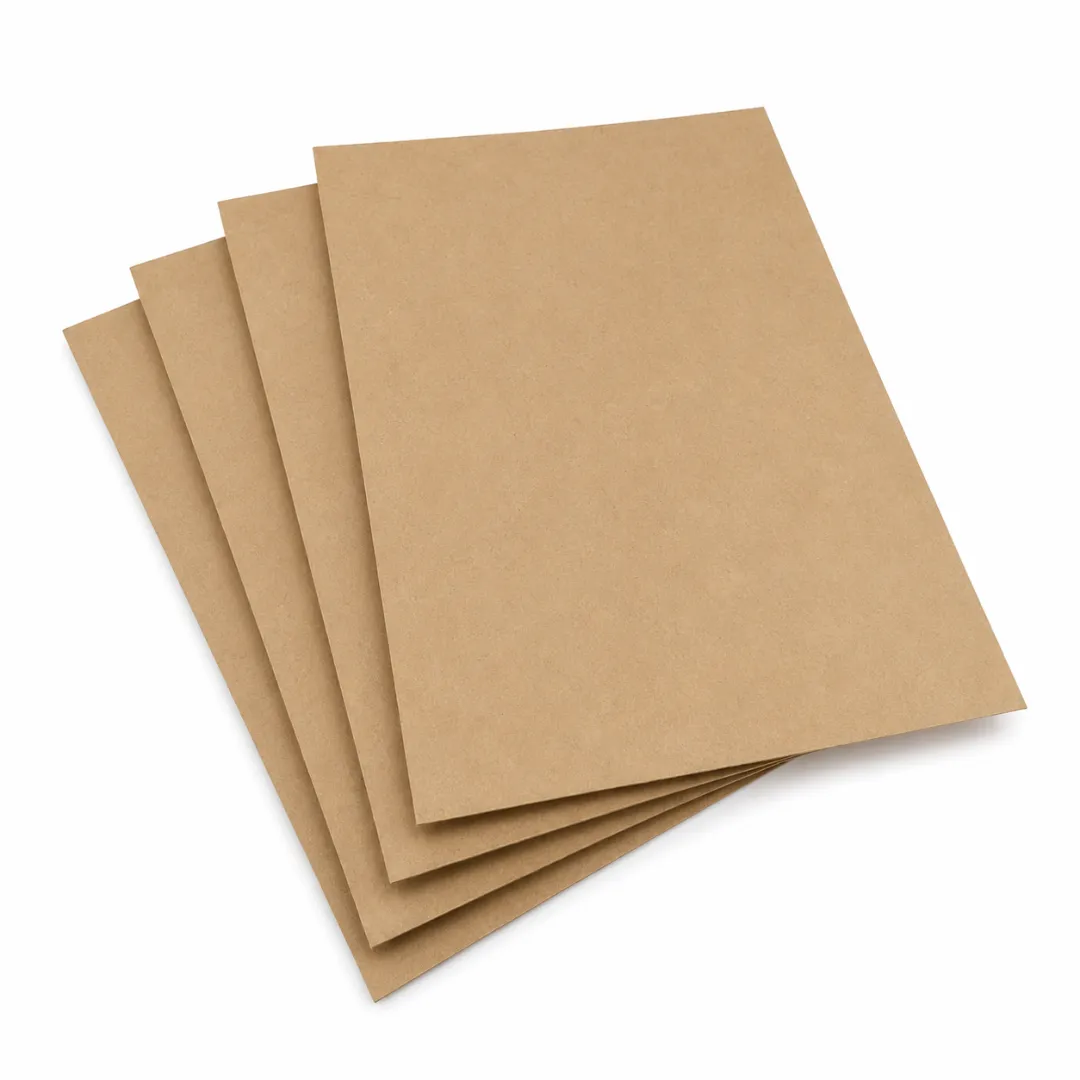
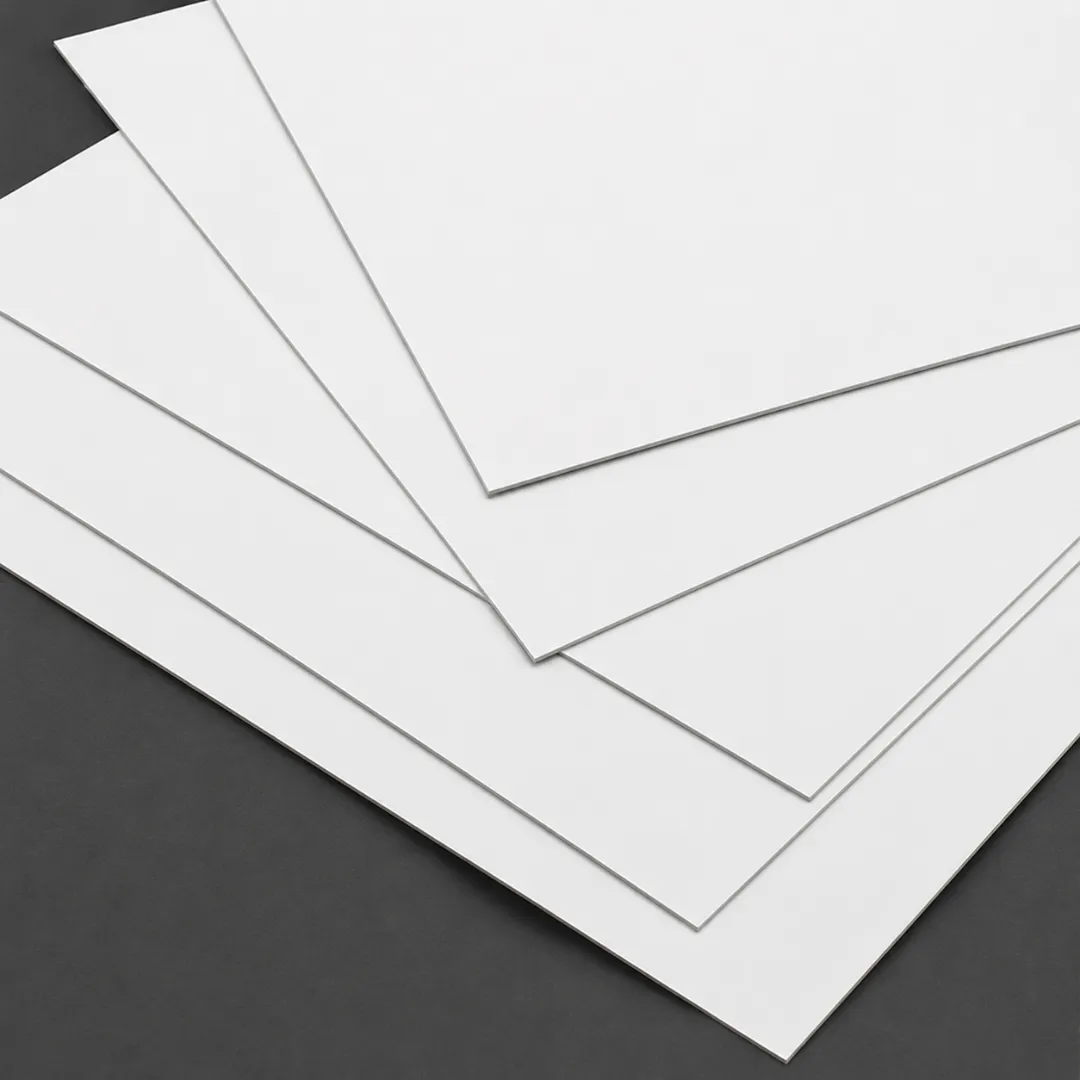
Kraft paper is a strong, durable and reliable material that is widely used across many different industries.
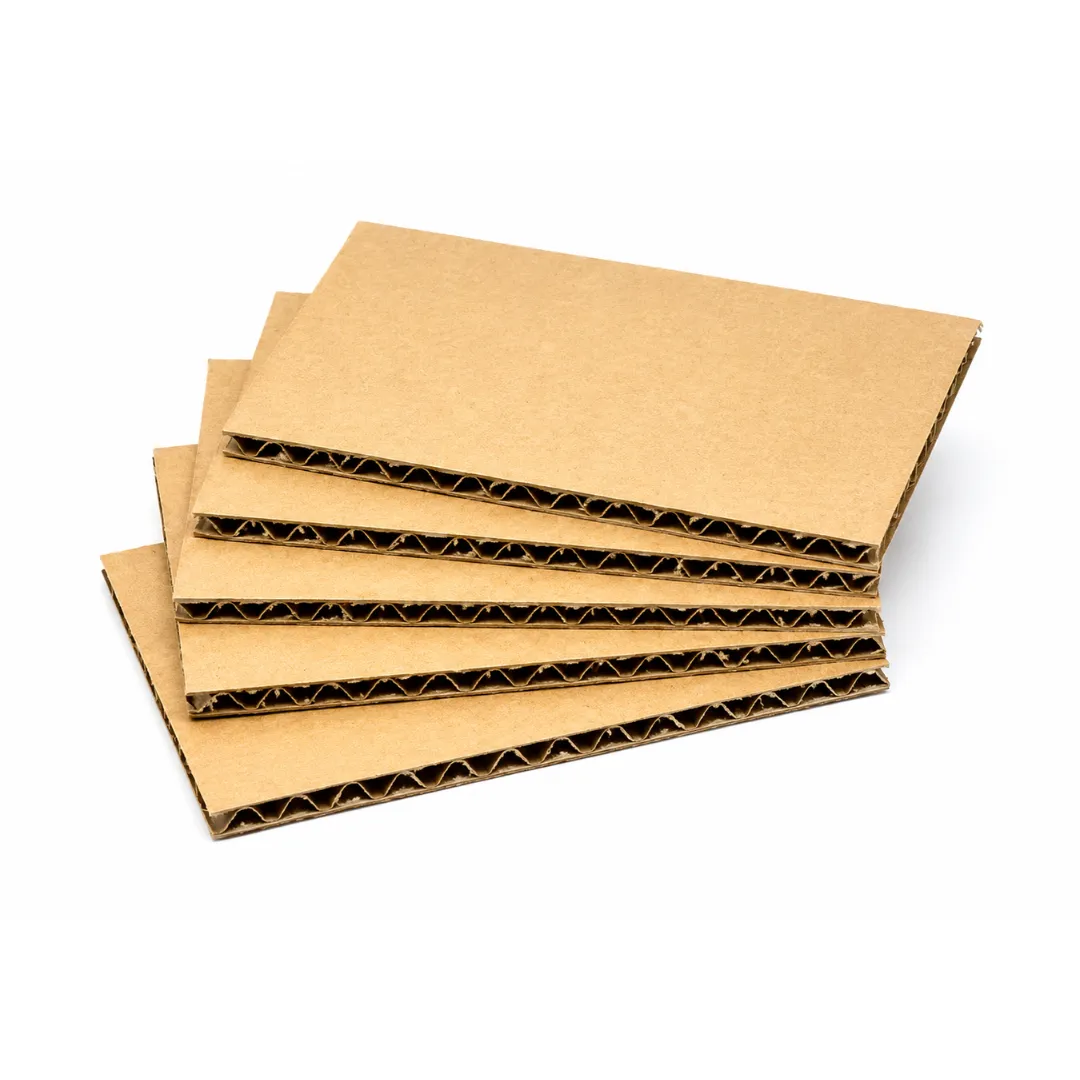
We use cardboard material with the least environmental impact and minimizes waste generation.
Corrugated material is easy to customize, cost effective and sustainable. It is also great for branding purposes.
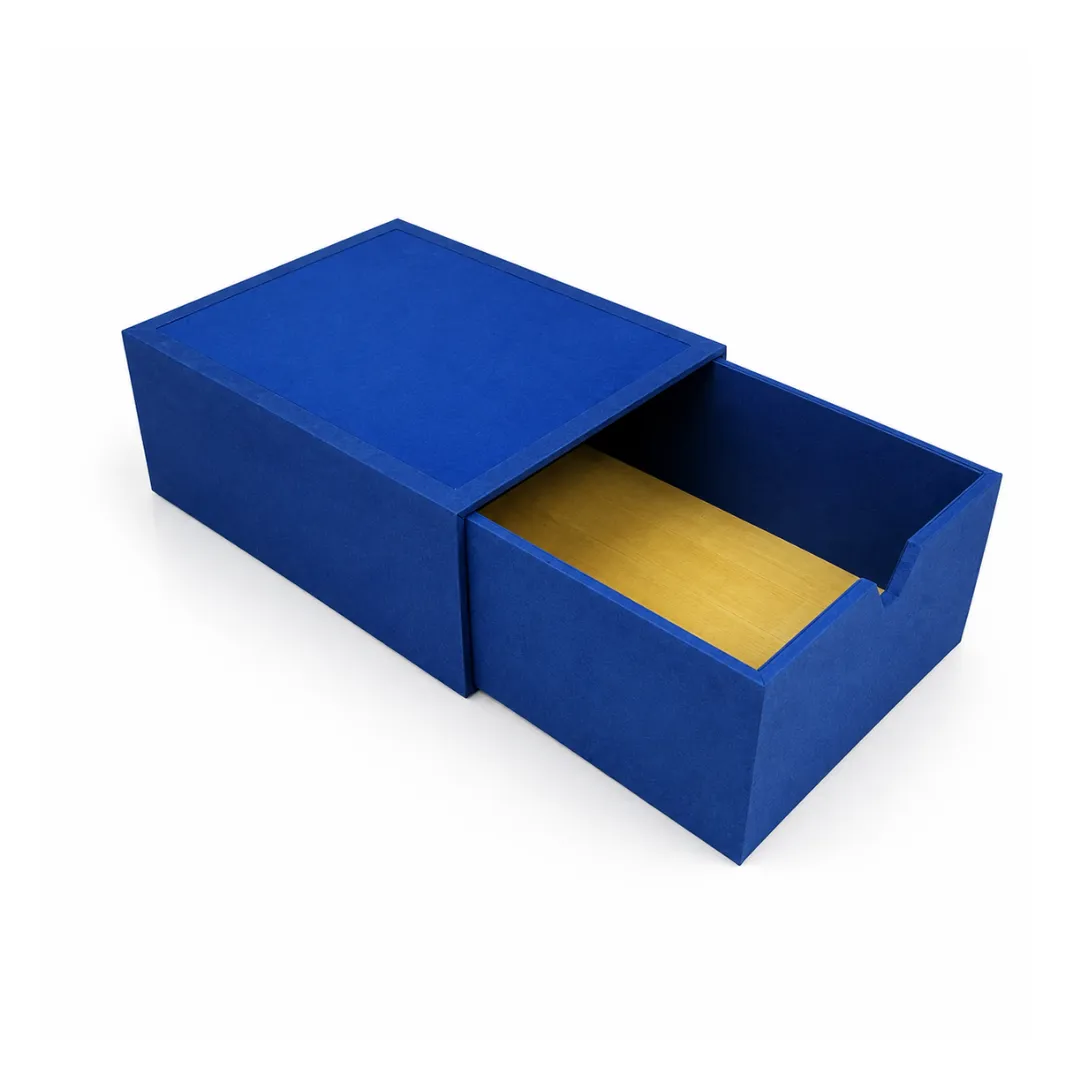
Rigid is highly protective, affordable and recyclable material. These boxes provide maximum protection.
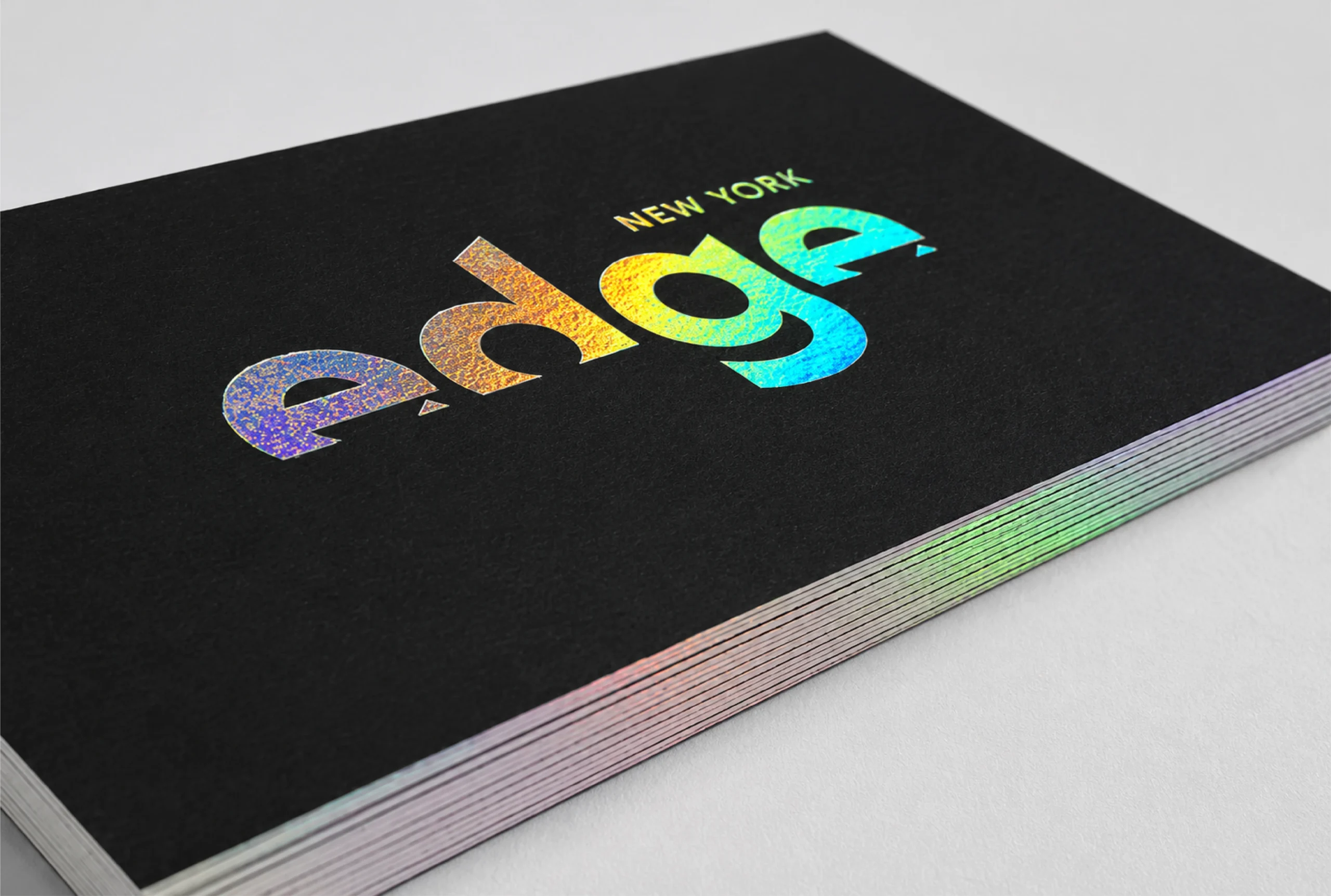
Holographic foil diffracts light and reveals the colors of the rainbow at various angles.
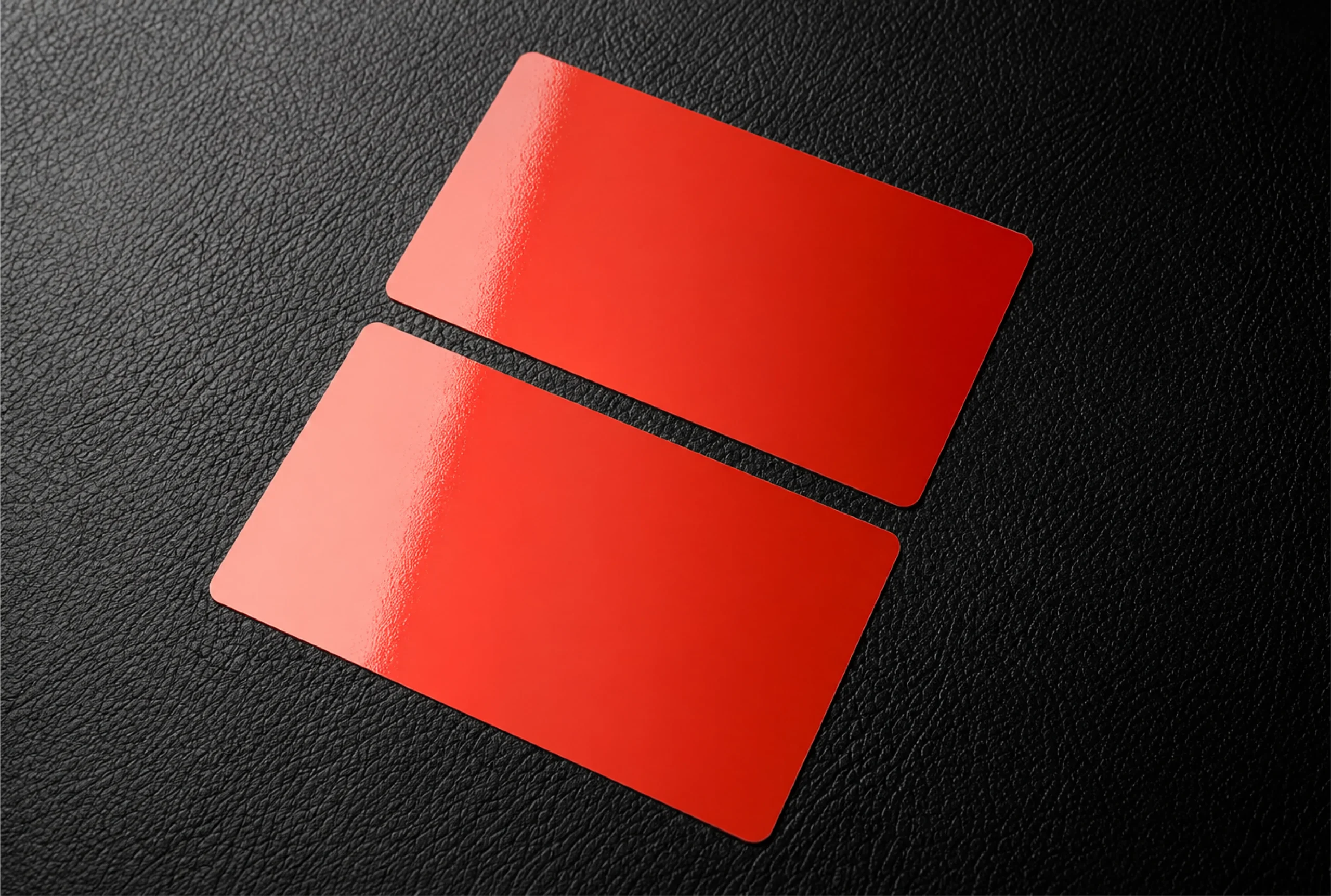
Our glossy finishing gives your packaging an extra layer of shine.
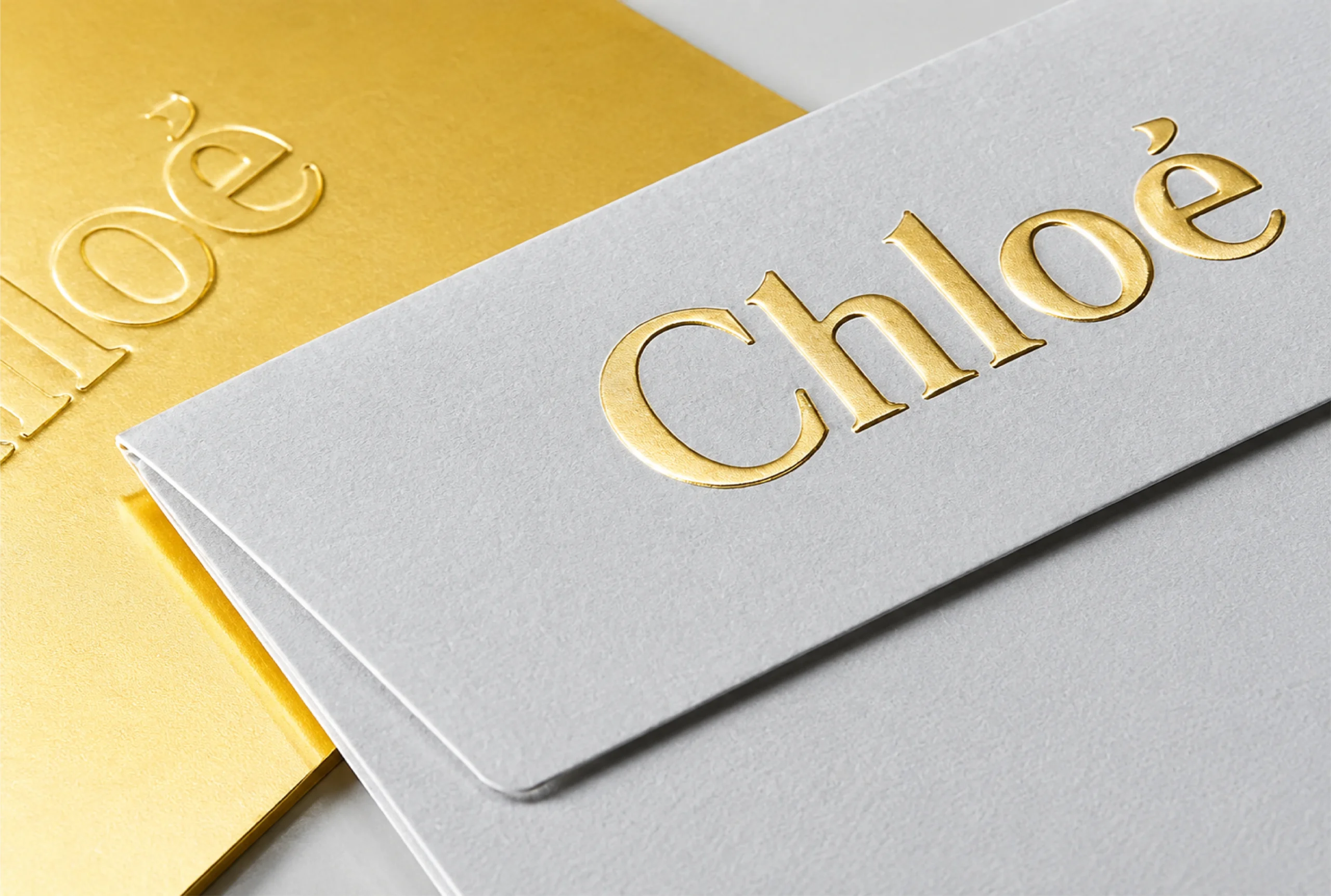
Decorate a wide range of your product packaging with our foil stamping.

With our embossing technique, we transfer the finest details of your product on packaging.
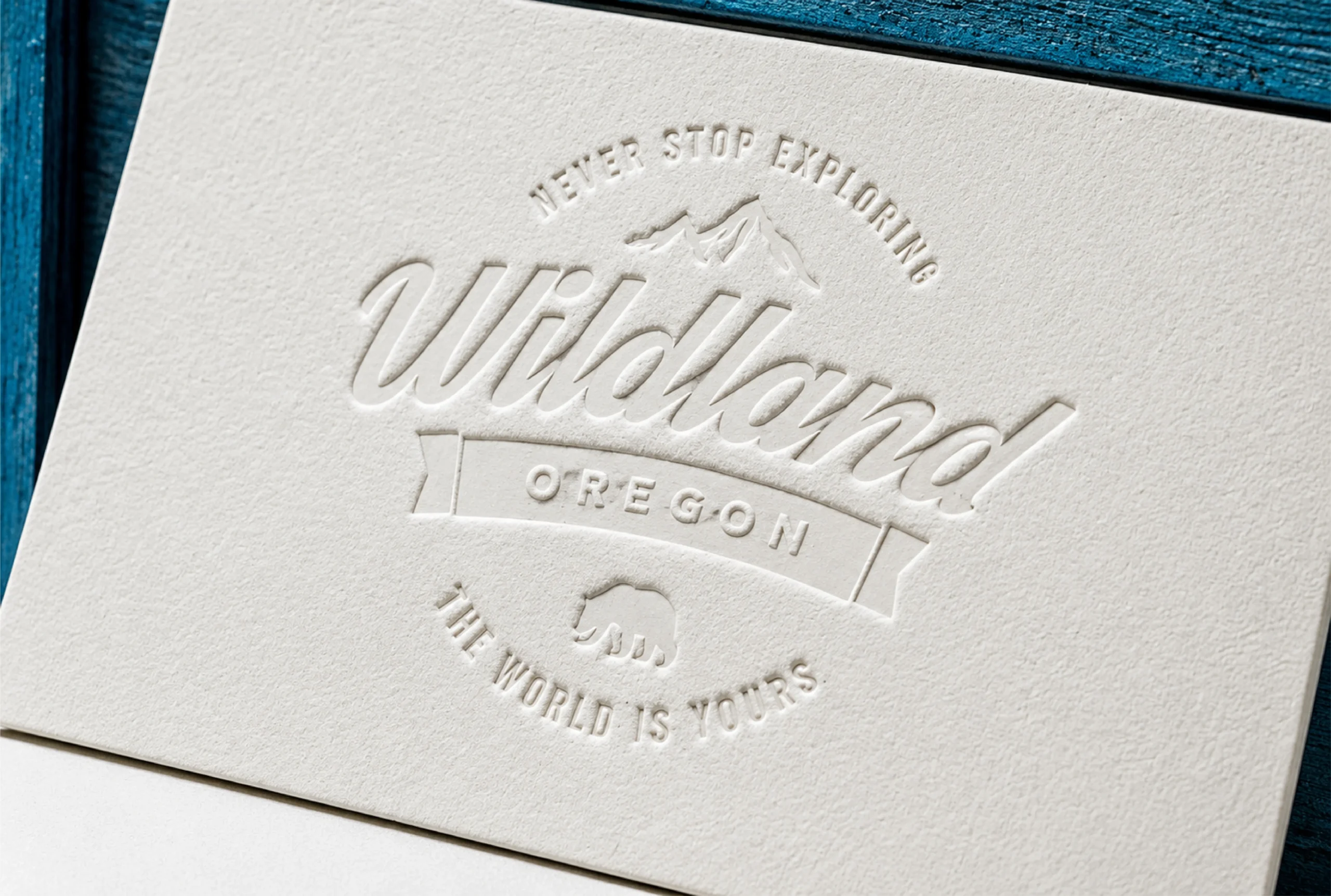
We use debossing technique to add unique graphics into your packaging.
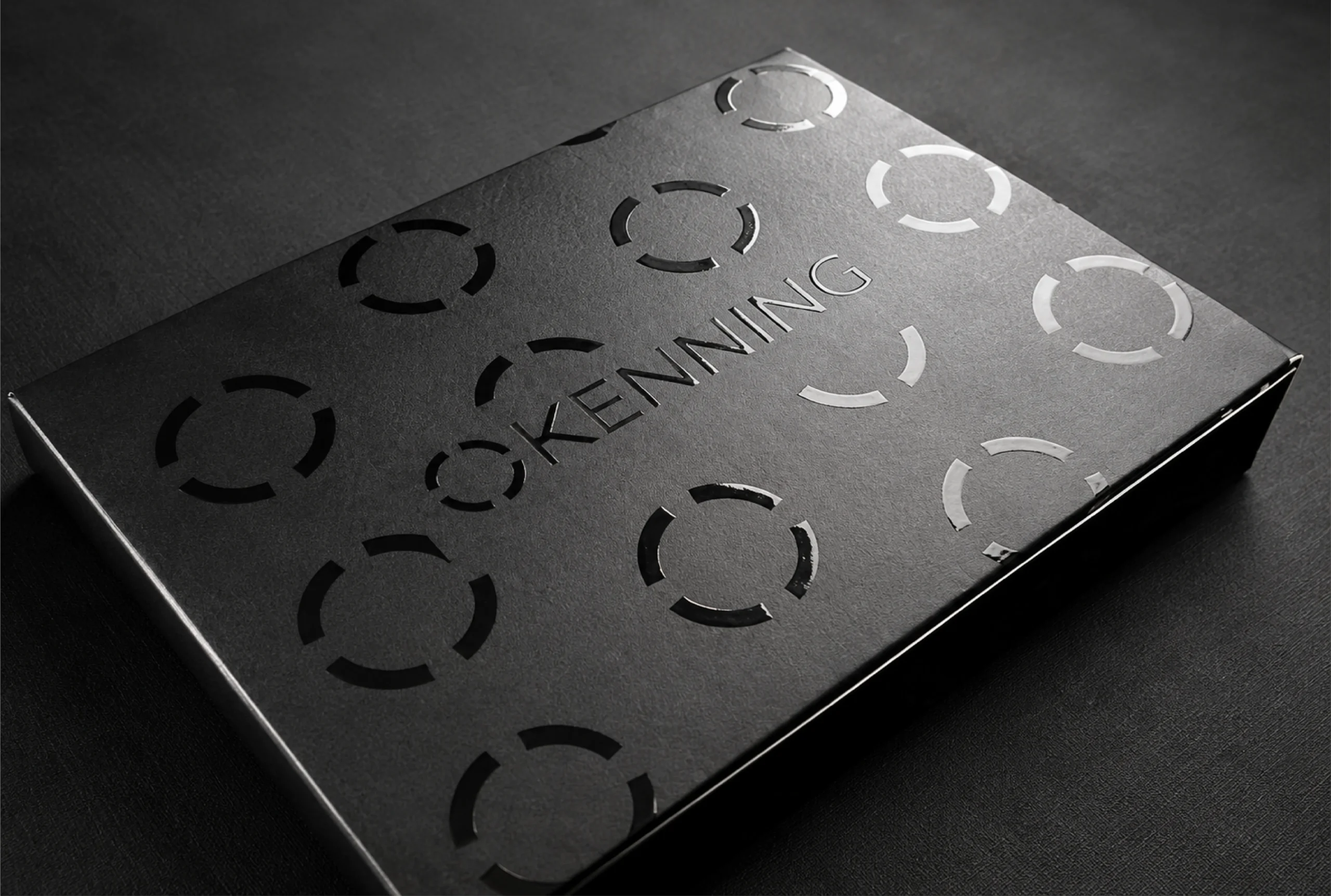
Our high-gloss UV coating gives light and shine to cure the printed material's varnish.
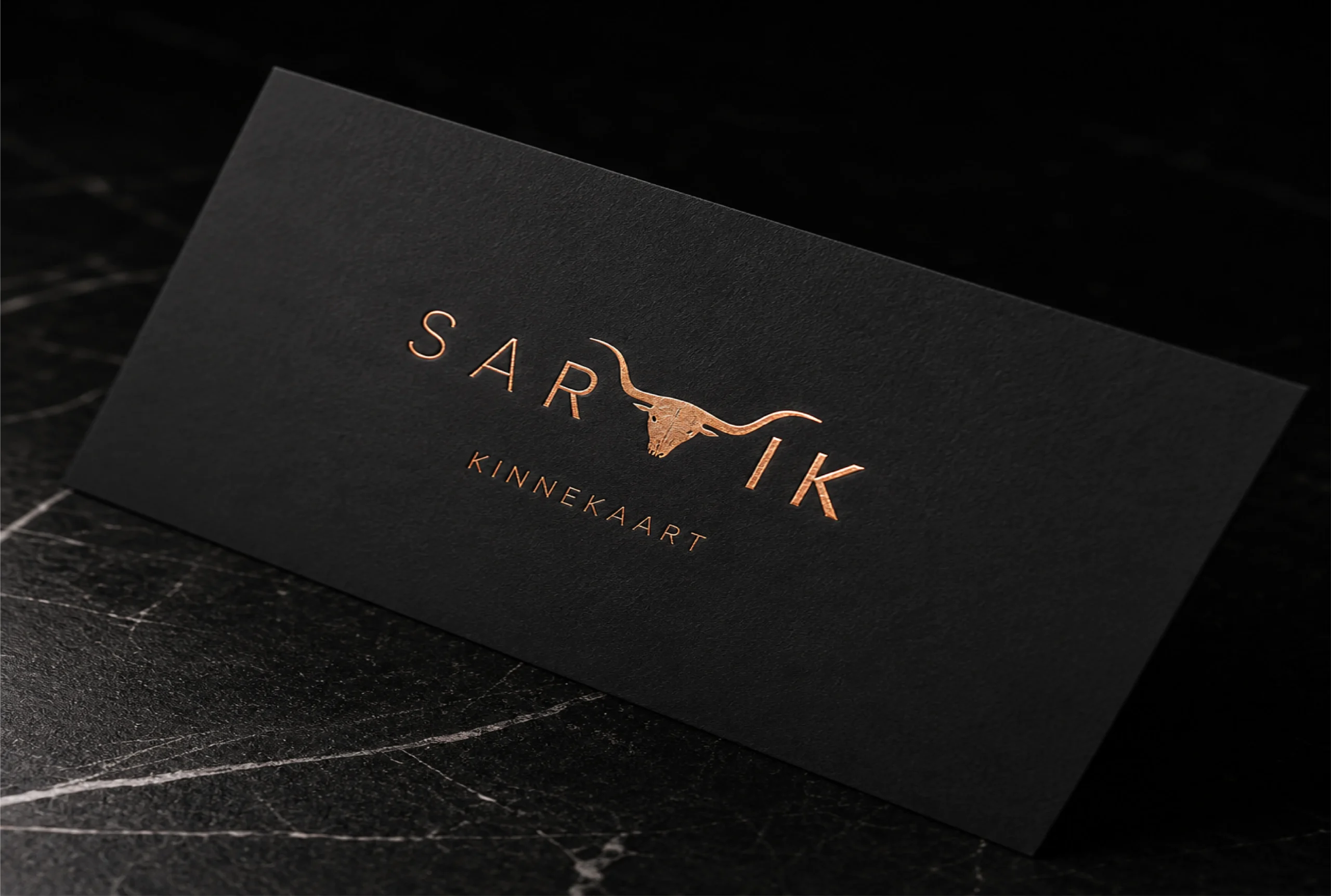
We add additional layer of protection with soft touch lamination from toner chipping.
With our matte finish, fingerprints and smudges will now be less visible on the packaging.
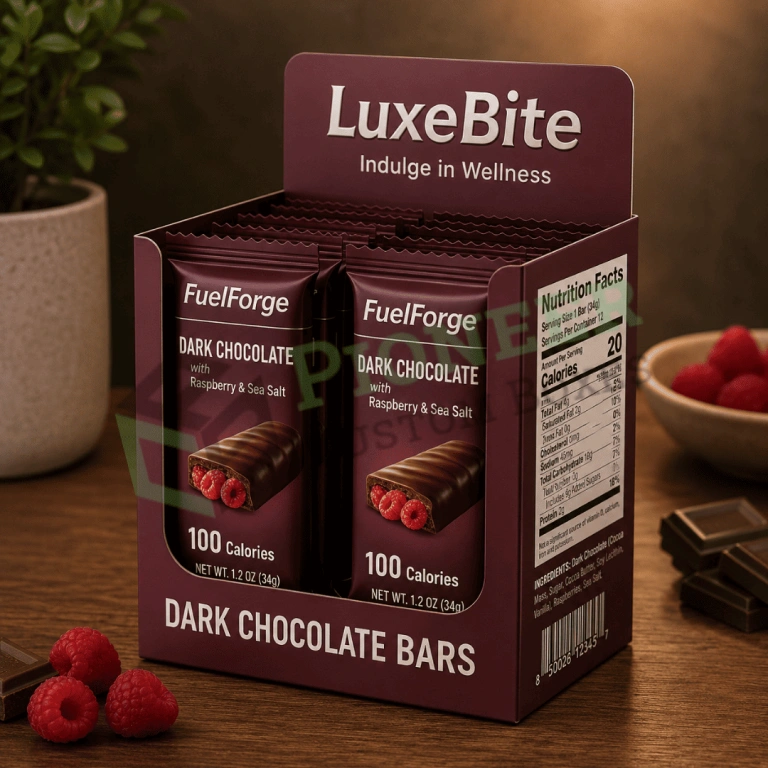
Flat tuck display boxes help retail, cosmetic, food, wellness, stationery, toy, and small product brands present products with a foldable structure, front display panel, strong branding space, and easy shelf placement. Choose custom flat tuck display packaging with cardboard stock, kraft stock, SBS paperboard, CMYK or PMS printing, die-cut windows, perforation options, matte coating, gloss coating, Spot UV, foil accents, inserts, custom sizes, and wholesale display packaging across the USA.
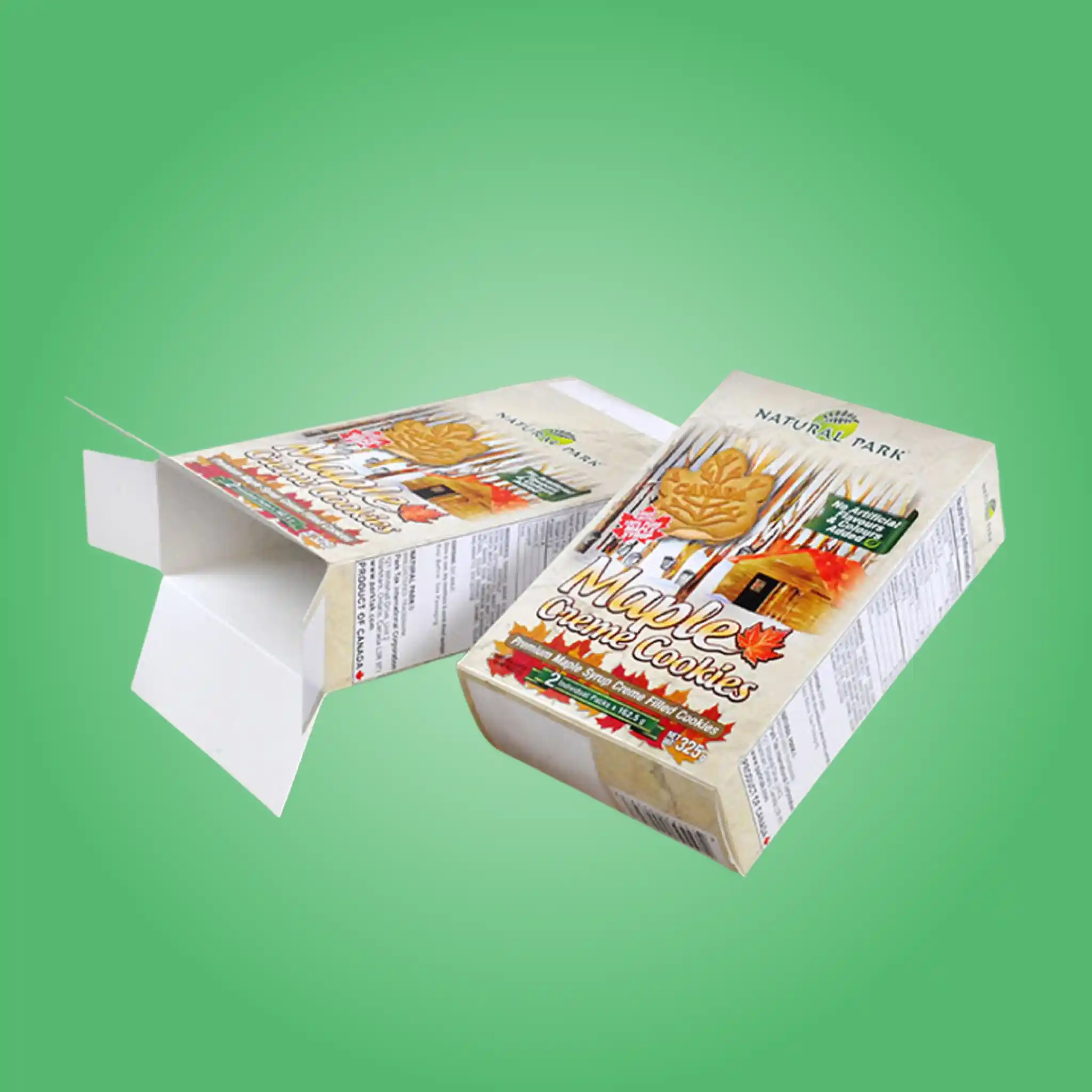
Custom seal end tuck boxes from Pioneer Custom Boxes help food, cereal, pharmacy, hardware, detergent and pet brands package products with glued ends, tamper evidence and high line speed. Choose SBS, CRB or kraft board, barrier liners, sift-proof seals, tear perforations, windows, logo printing, free design support, no MOQ and free USA shipping.
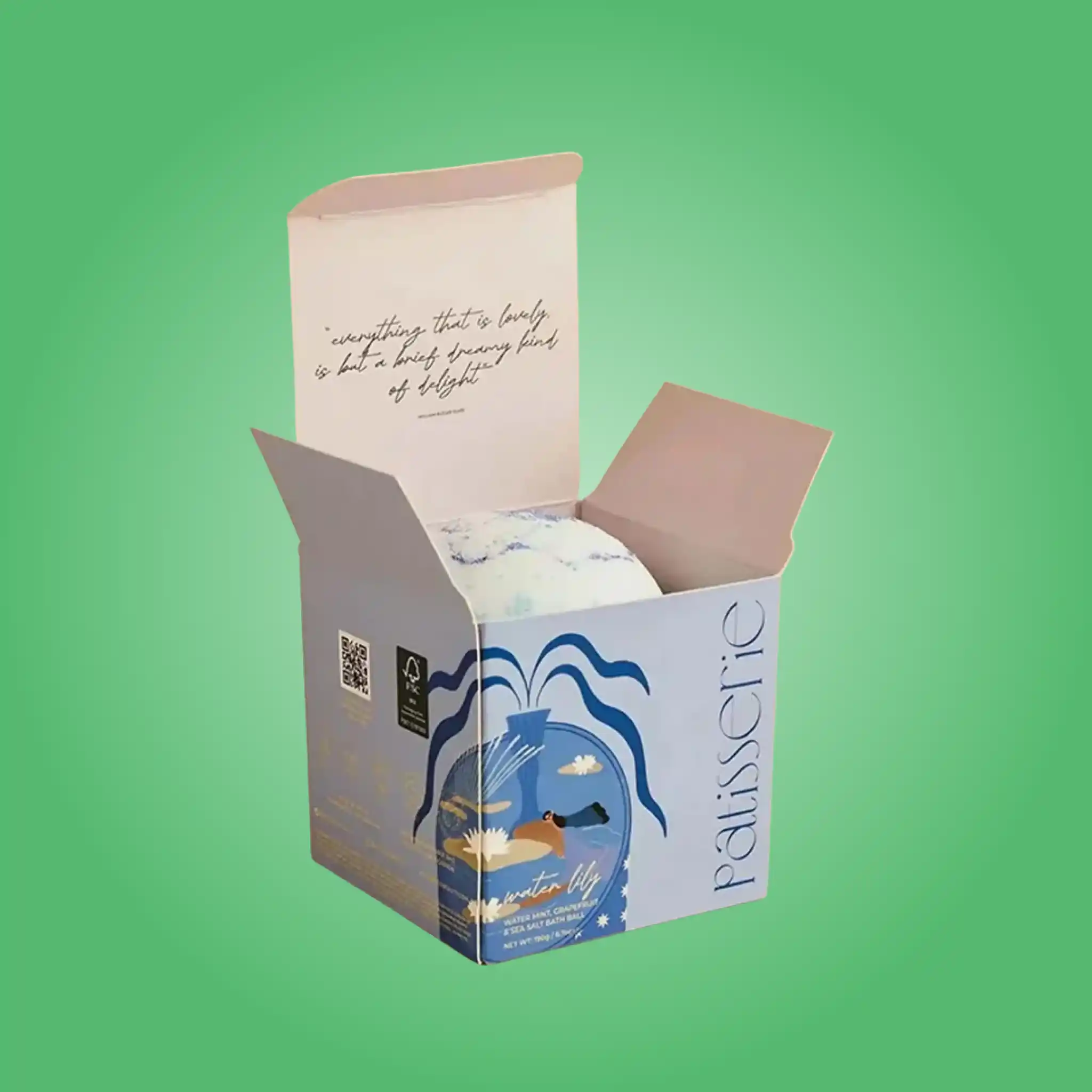
Custom tuck top boxes from Pioneer Custom Boxes help candle, home fragrance, food, bakery, hardware, gift and ecommerce brands package heavier products safely. Choose auto-lock or snap lock bases in SBS, kraft, CRB or E-flute board, with collar inserts, windows, foil, lamination, logo printing, free design support, no MOQ and free USA shipping.
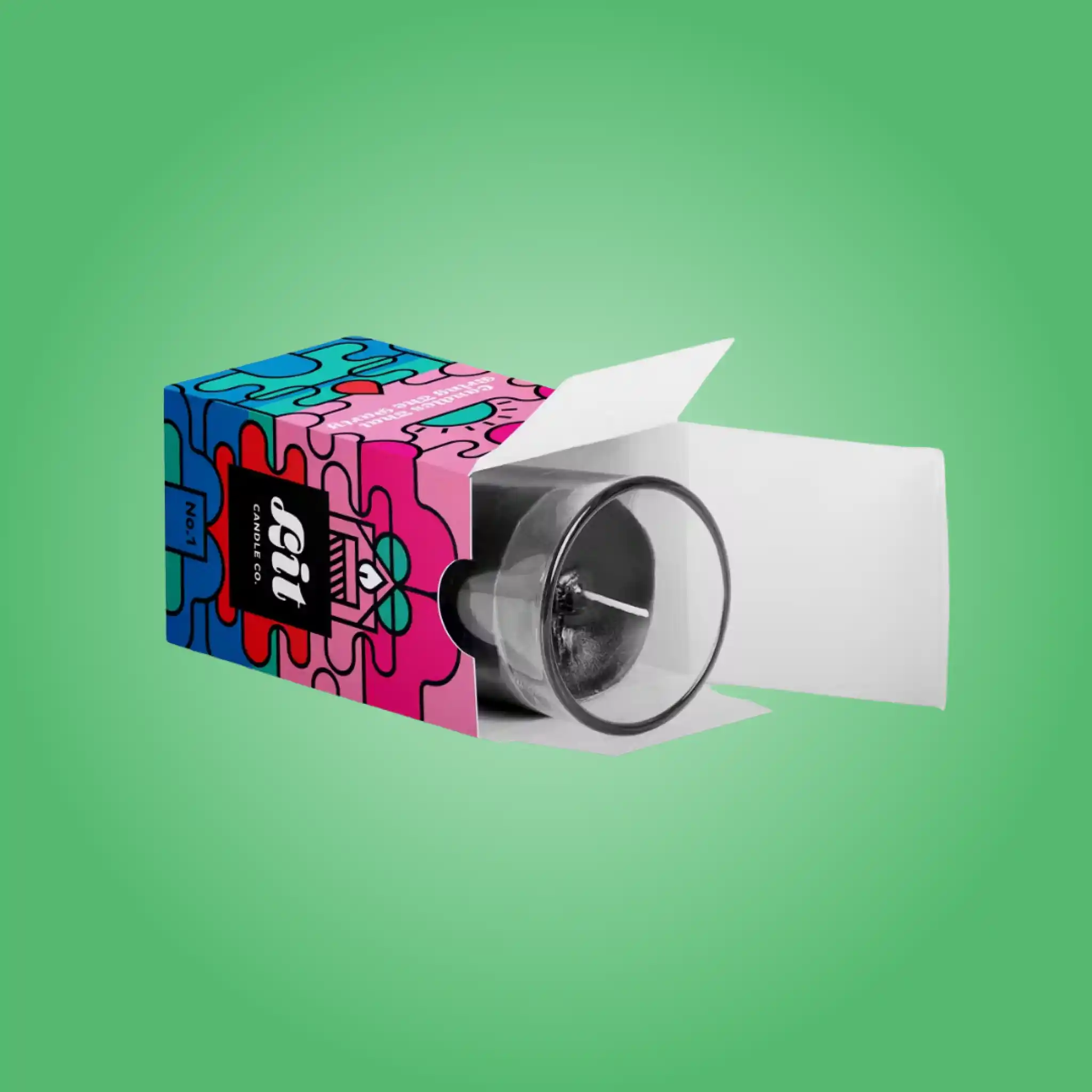
Reverse tuck candle boxes from Pioneer Custom Boxes help candle makers, home fragrance brands, gift companies and ecommerce sellers package filled glass vessels safely. Choose SBS, kraft, CRB or E-flute board from 18pt to 24pt, collar inserts, windows, foil stamping, soft touch lamination, logo printing, free design support, no MOQ and free USA shipping.