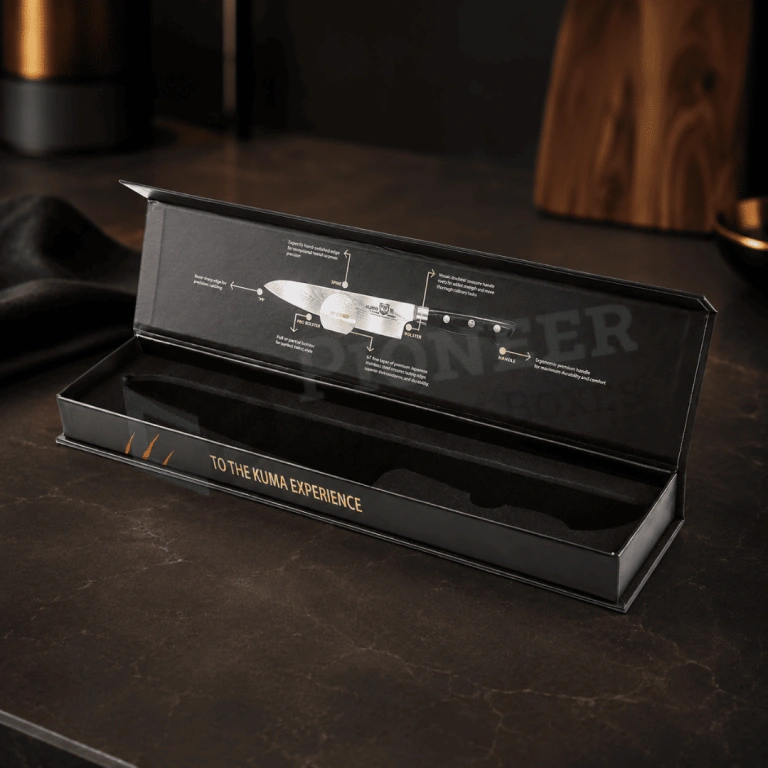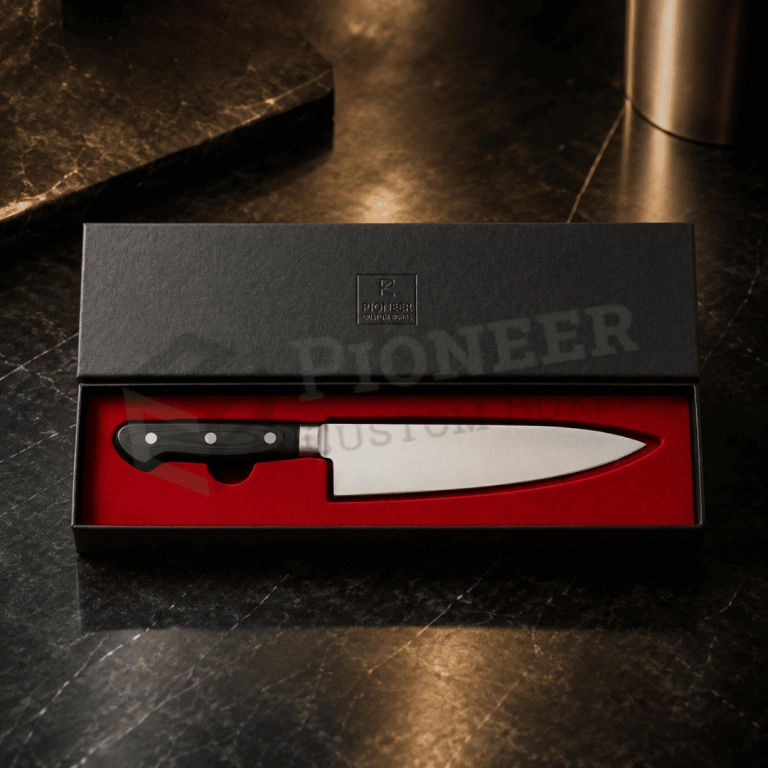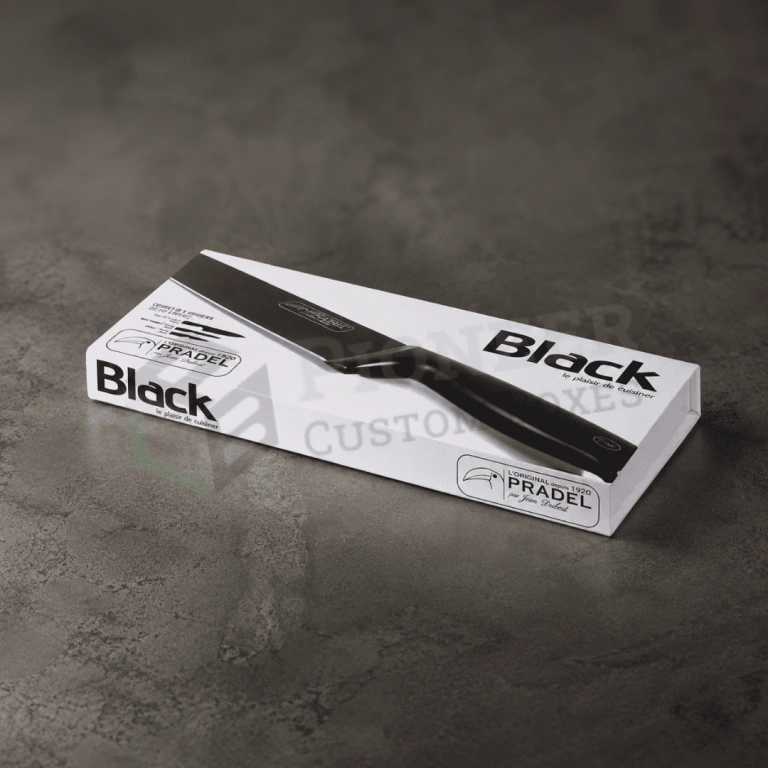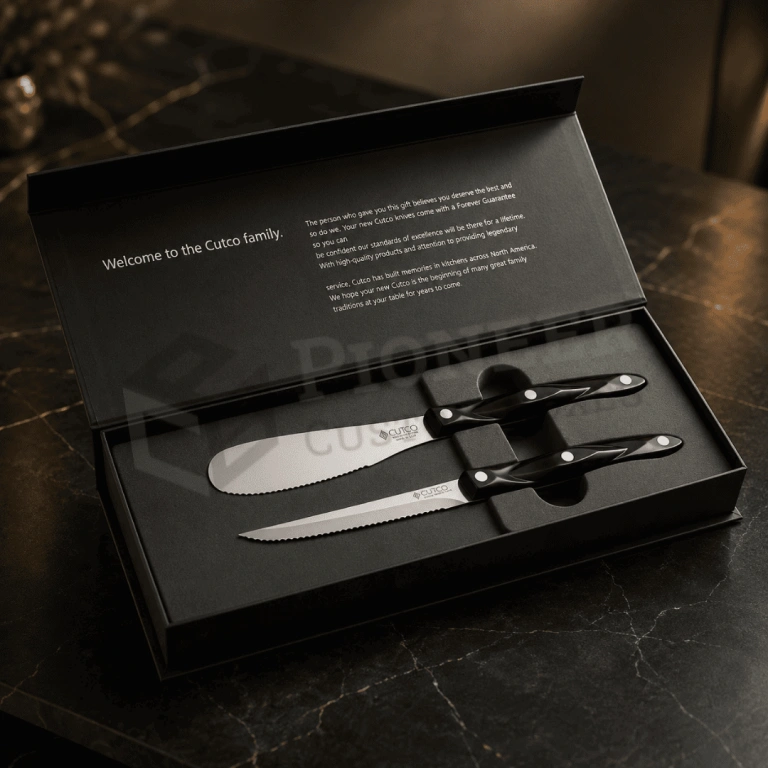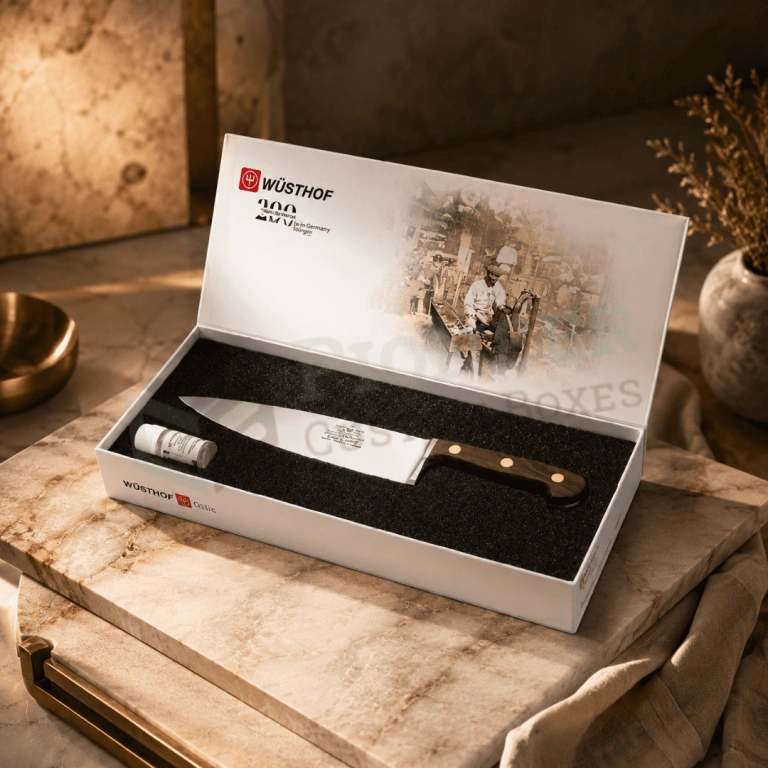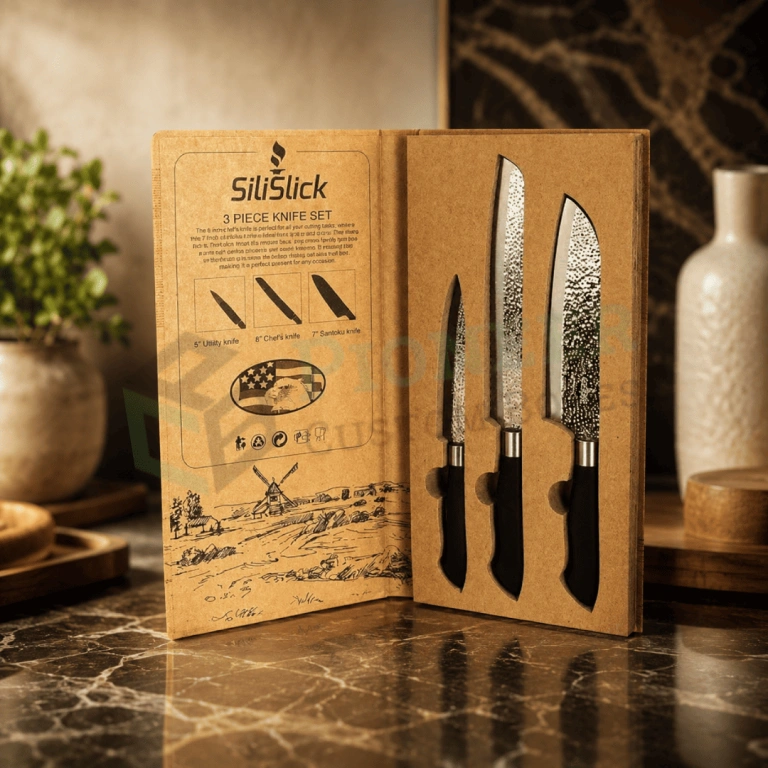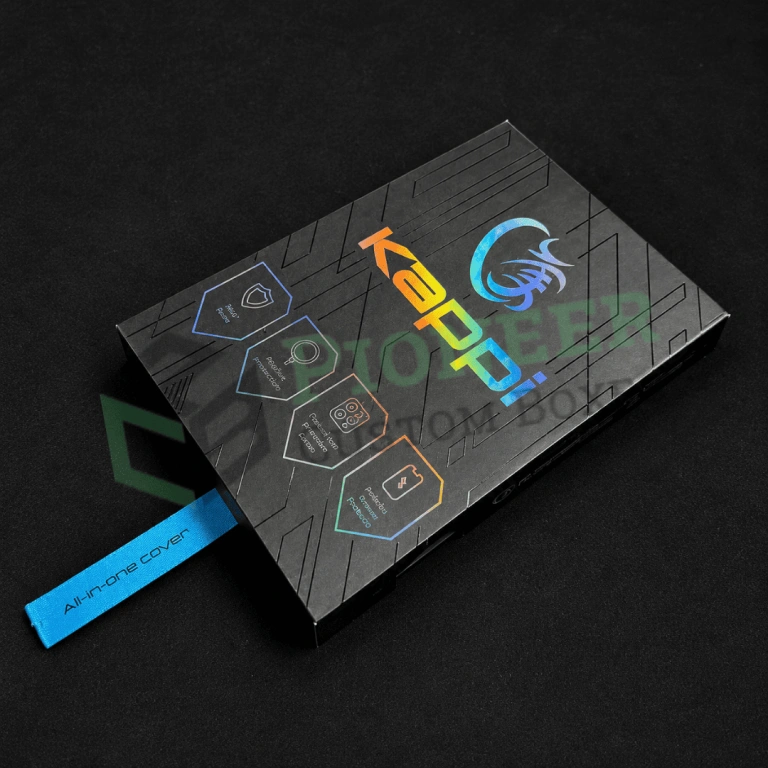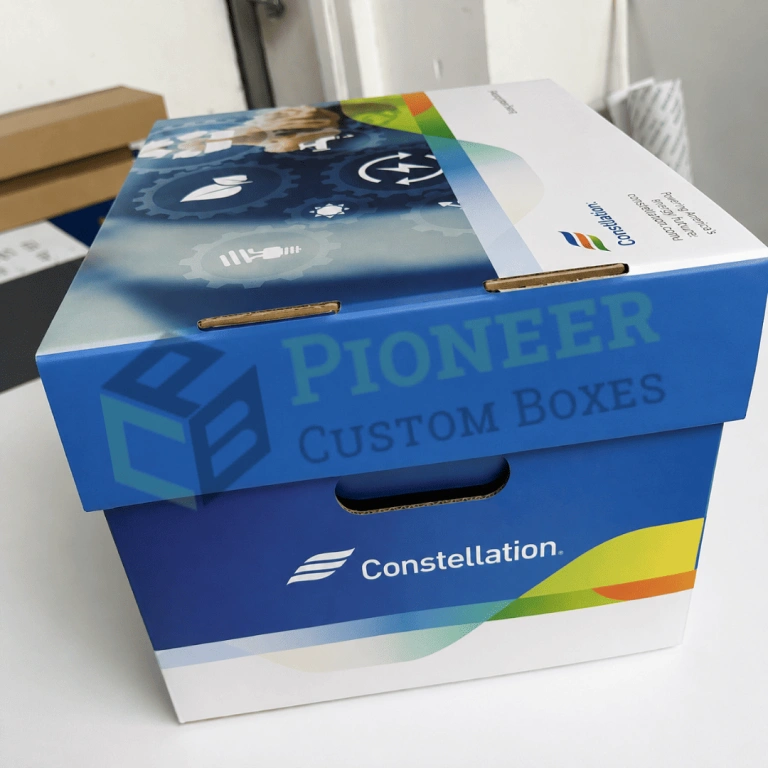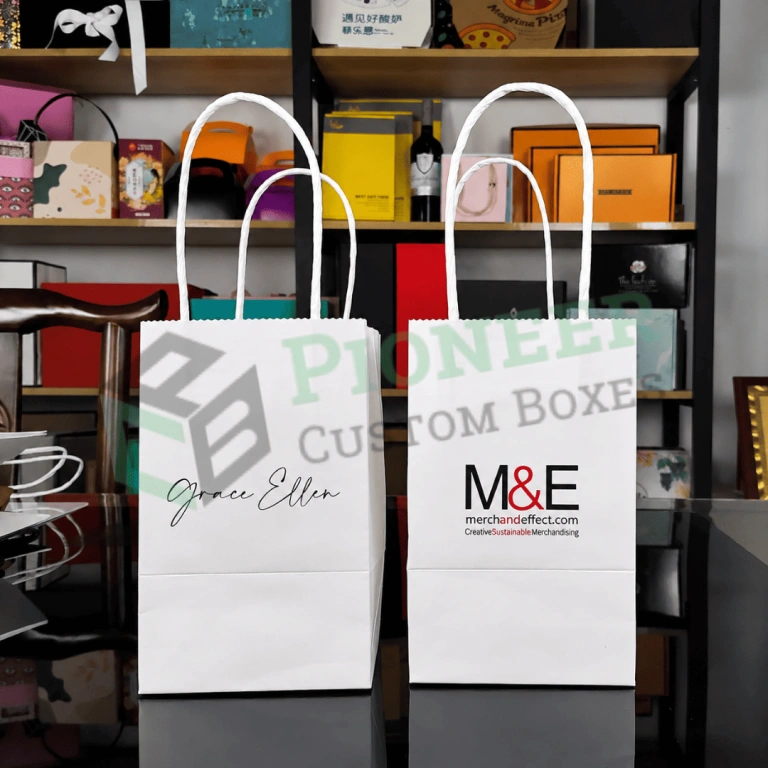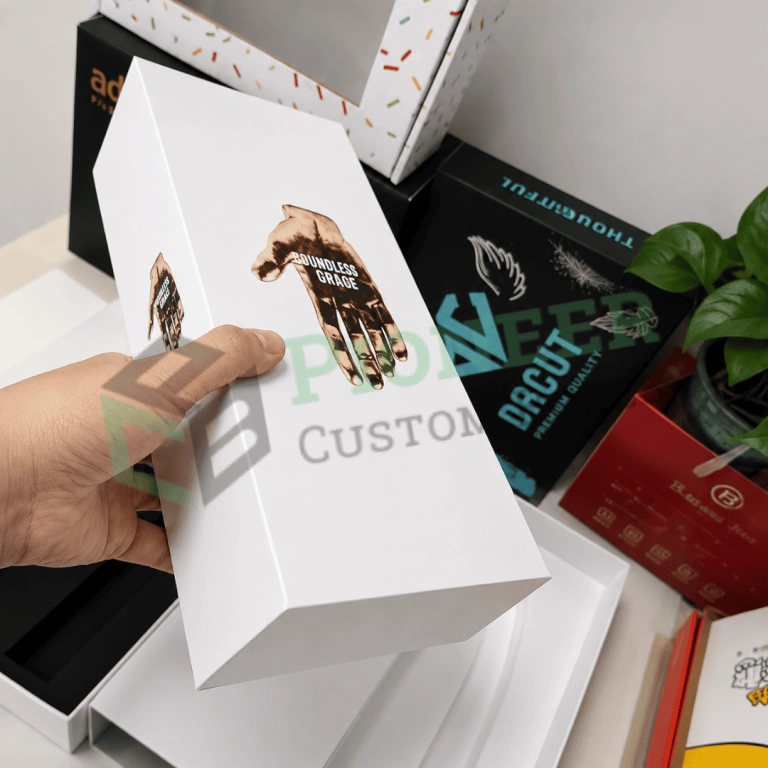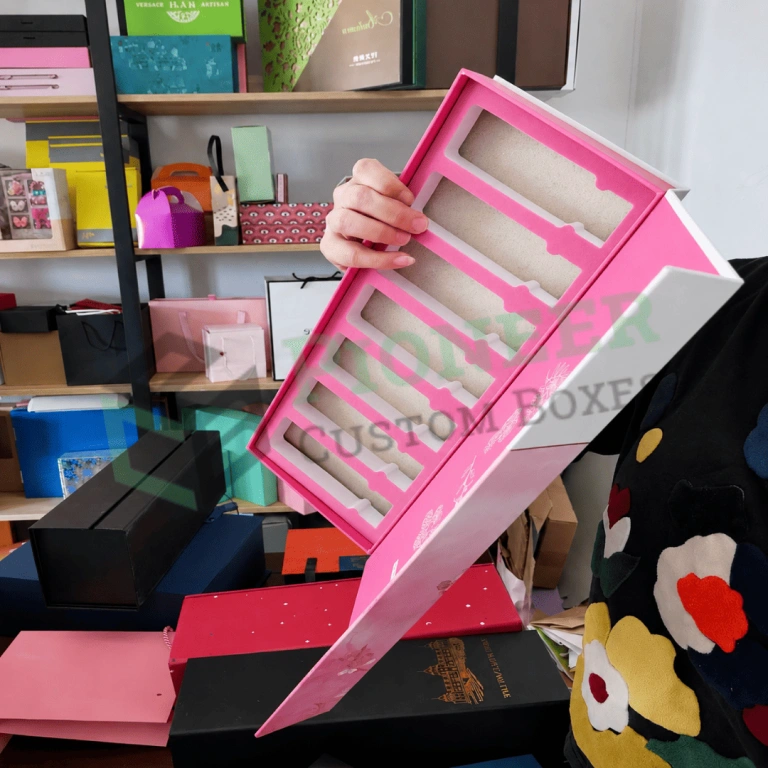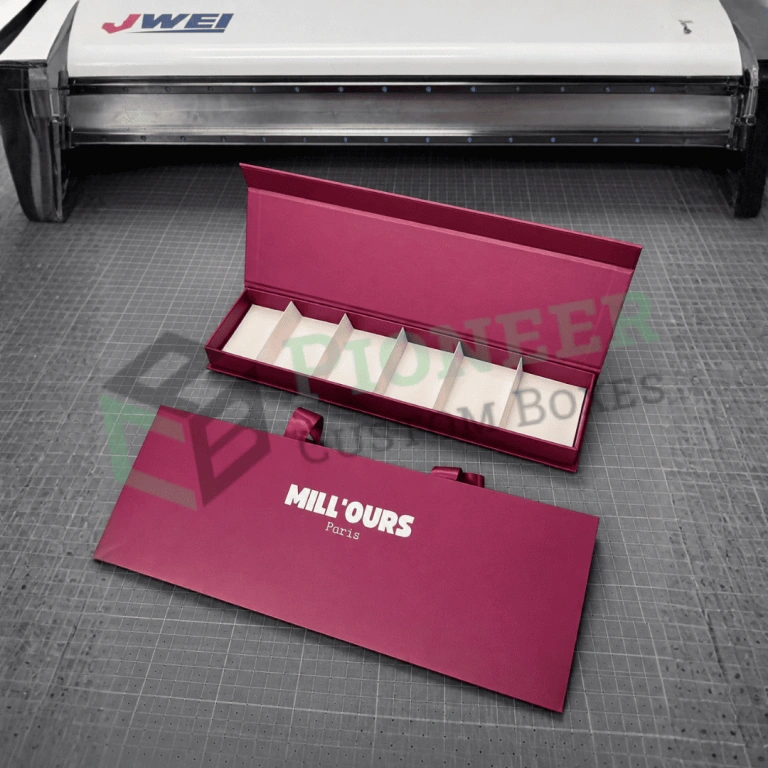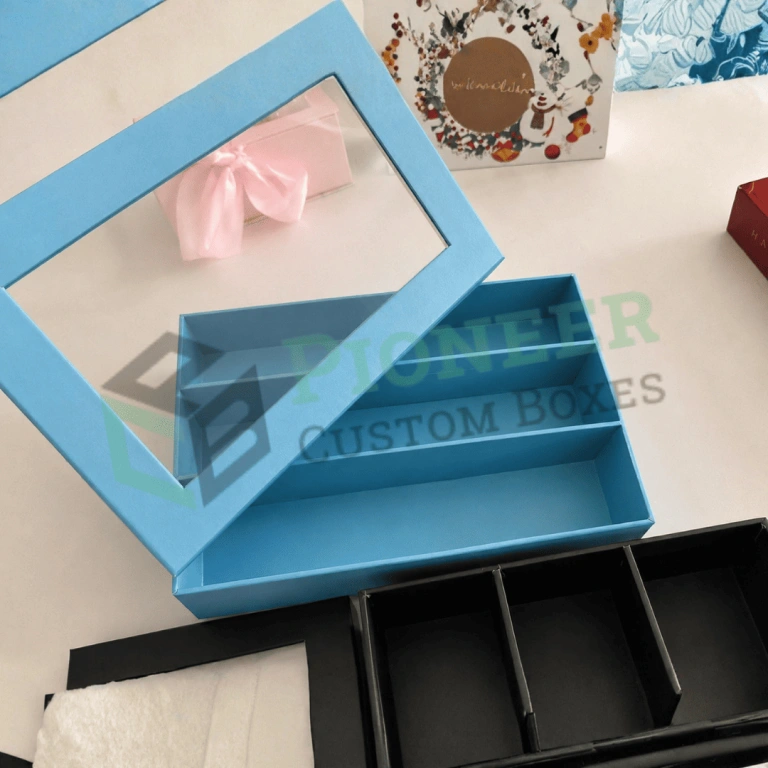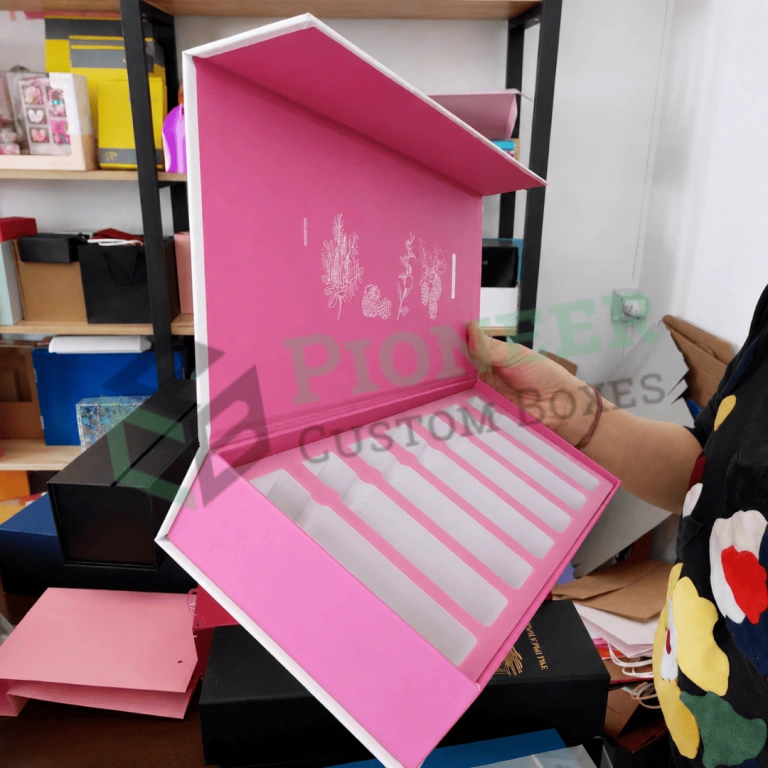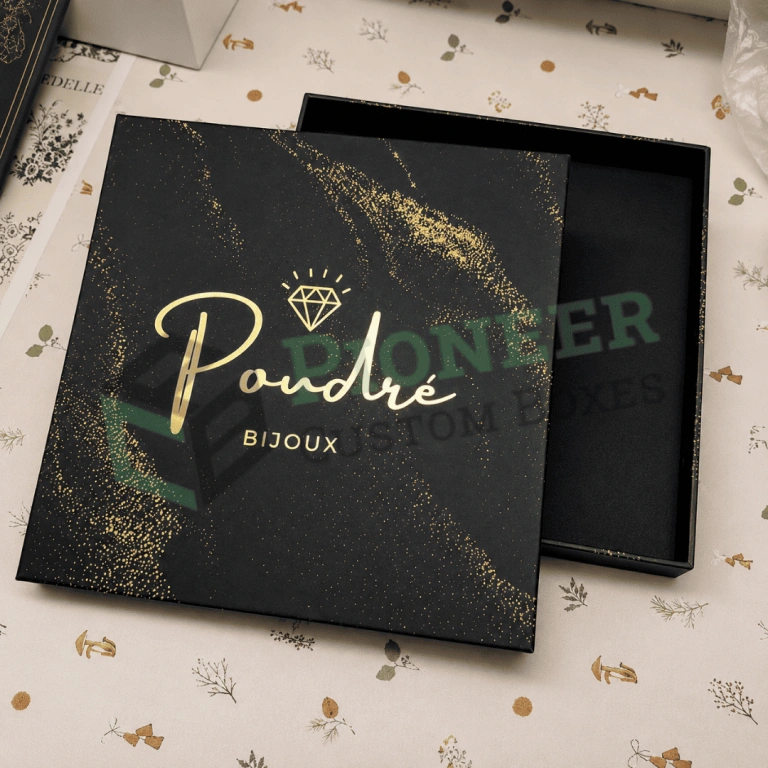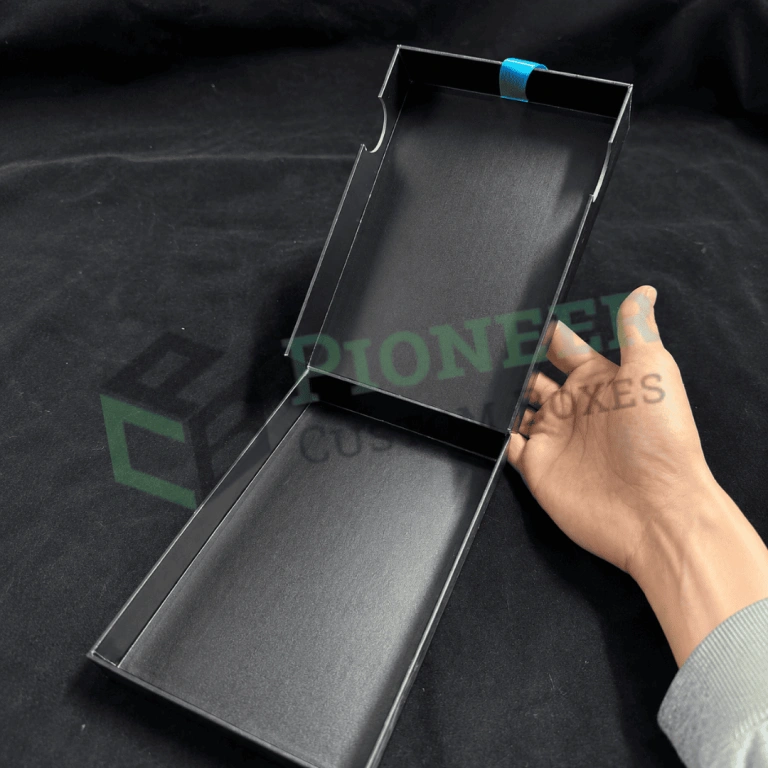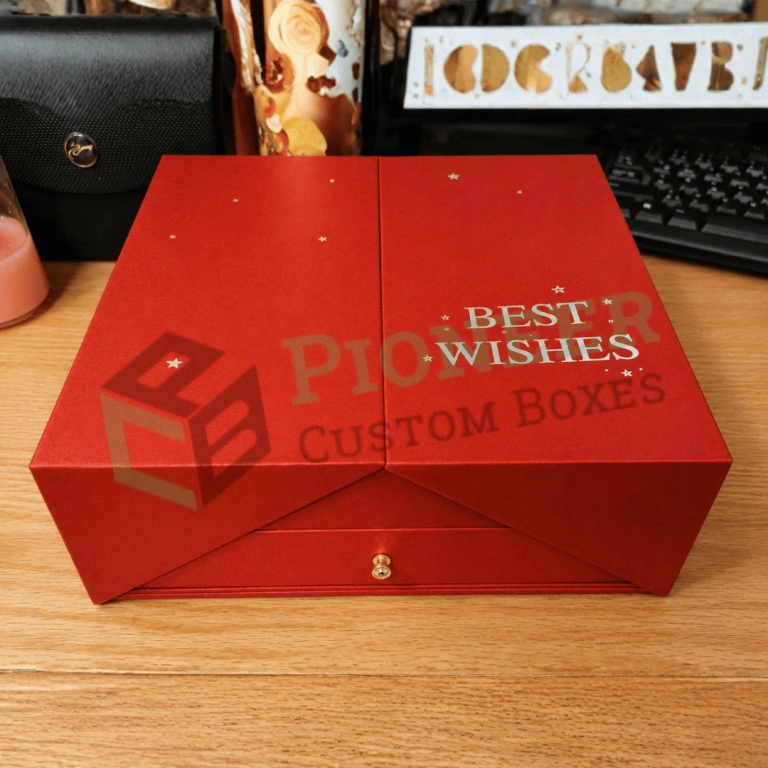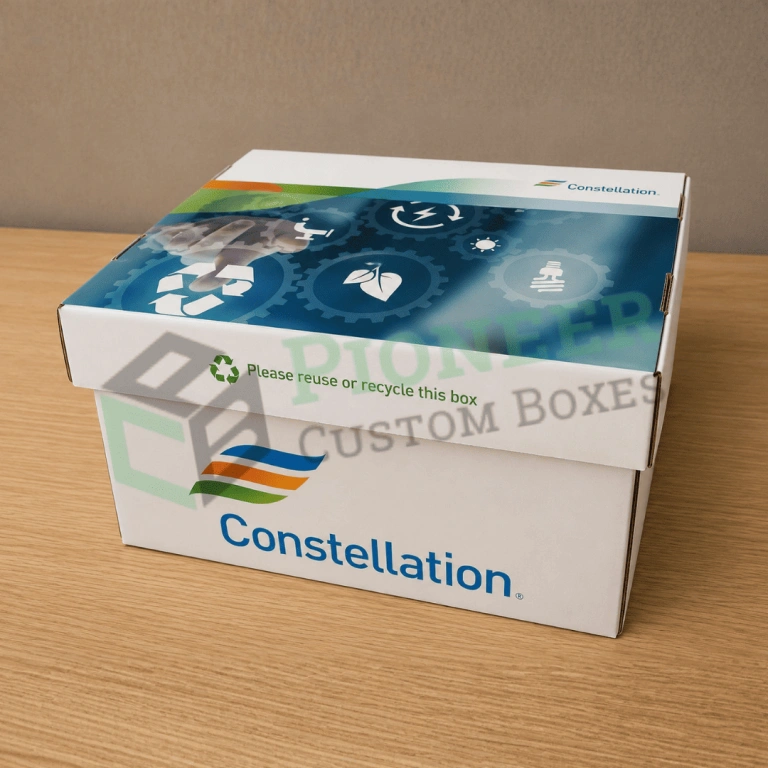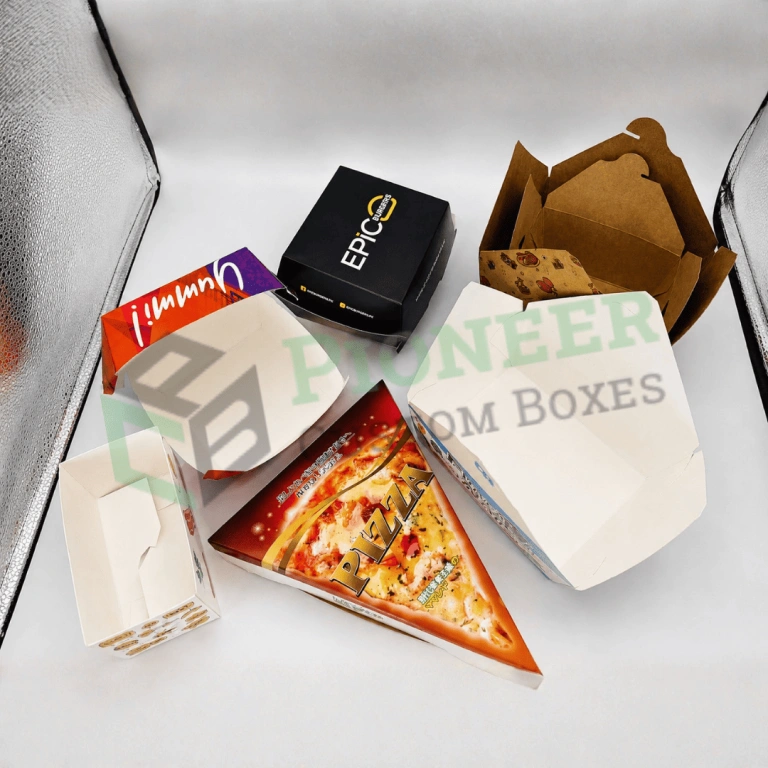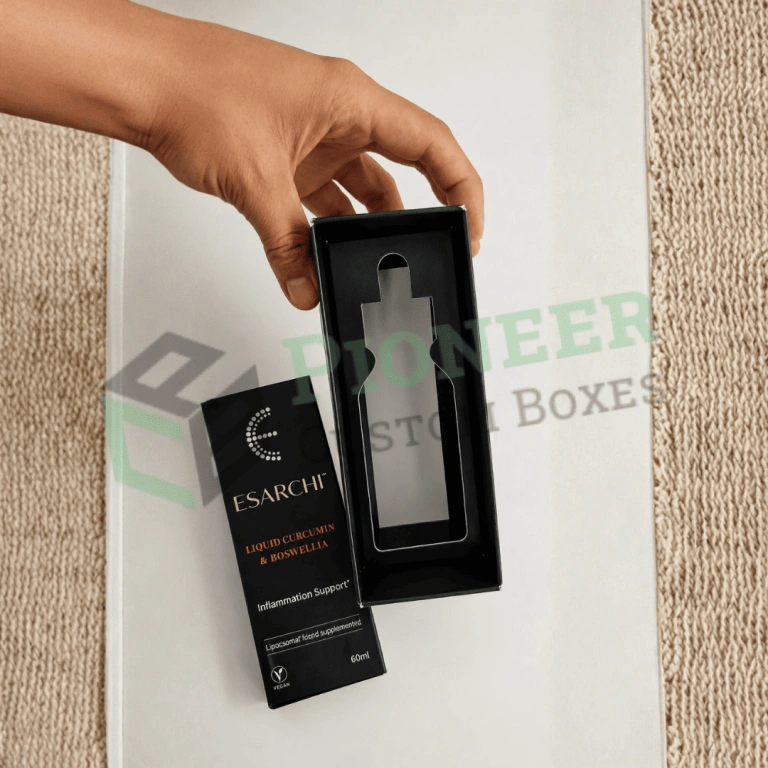
Custom knife boxes from Pioneer Custom Boxes contain the point, hold the edge away from the board and carry the weight of real steel. Choose rigid boxes, sleeve and tray, tuck cartons, window packs, set boxes or corrugated mailers in wrapped greyboard, heavy SBS, kraft or B-flute, with recessed tip pockets, molded pulp beds, foil maker marks, free design support, zero MOQ and free USA shipping.
Custom knife boxes are printed cartons engineered to contain a cutting edge, resist a point and carry steel that is heavy for its size. Pioneer Custom Boxes manufactures them across the United States with zero minimum order quantity and free shipping.
Knives are among the hardest small products to package properly. The blade cuts, the tip punctures, the steel is dense and the customer is usually paying for craftsmanship they want to feel before they see it.
Tip puncture is the constraint most brands underestimate. An edge lying flat is relatively harmless inside a carton, while a point under transit pressure will go through thin board and sometimes through an outer carton too.
Edge containment is the second. A blade that shifts inside its box will score the inner panel, and a carton arriving with a slit reads as tampering rather than as a packaging fault.
Weight forms the third constraint. A chef knife or a full kitchen set is dense, and a carton sized by dimension rather than by mass will bow along the base before it reaches a shelf.
Presentation carries the fourth. Knives sell on craft, and the moment a customer lifts a lid to find a blade seated properly in a fitted bed does most of the work a product photograph cannot.
We manufacture custom printed knife boxes for cutlery brands, custom knifemakers, kitchenware companies, outdoor and hunting brands, chef supply distributors, gift retailers and private label packers. Moreover we cut our own dies and run our own presses, so we build the carton around your actual blade length and profile.
Order wholesale knife packaging in any quantity you need. There is no minimum order, design support costs nothing, and shipping across the United States stays free on every order. Searching for knife boxes near me usually returns brokers, and we are the factory those brokers buy from.
Structure follows the blade length, the price point and whether the knife ships alone. All three vary widely across this category.
A base and lid in wrapped greyboard with a fitted bed. This is the standard for premium chef knives and custom makers, because the weight of the steel demands it and the lid lift carries the presentation.
An inner tray sliding out of a printed sleeve. The reveal is slow and deliberate, and it suits collector and limited-edition knives particularly well.
An economical printed folding carton for kitchen knives at mainstream price points. Board caliper and a proper edge guard matter far more here than in most folding carton work.
A folding carton with a die-cut window showing the blade. Retail cutlery relies on this, since customers buy on blade profile and finish rather than on copy.
A larger fitted box holding several knives in a die-cut or pulp tray. Sets carry most of the gifting revenue in this category, and the tray must hold every blade separately.
A compact carton for a closed folding knife. The blade is contained by the handle, so presentation and retail security matter more than edge protection.
A sturdier carton or rigid box holding a fixed blade with its sheath. The sheath does the edge work and the box has to accommodate its extra bulk.
A fluted outer with die-cut fitments for direct shipping. A retail knife box is not a shipper, and the tip is exactly what finds the weak point of an unsuitable one.
| Format | Knife Type | Typical Price Point | Why Choose It |
|---|---|---|---|
| Two-piece rigid | Chef and custom knives | 80 dollars and above | Weight and lid lift signal craft |
| Sleeve and tray | Collector and limited edition | 100 dollars and above | Slow reveal suits a considered purchase |
| Straight tuck carton | Mainstream kitchen knives | 15 to 50 dollars | Lowest cost, fast to reorder |
| Window carton | Retail cutlery | 20 to 60 dollars | Blade profile drives the purchase |
| Knife set box | Multiple knives | 150 dollars and above | Gifting and unboxing carry the sale |
| Pocket knife carton | Folding knives | 20 to 80 dollars | Compact, retail security friendly |
| Outdoor knife box | Fixed blade with sheath | 50 dollars and above | Accommodates sheath bulk |
| Corrugated mailer | Any knife shipping alone | Any | Stops tip puncture in transit |
Send us the finished knife, sheath included where there is one. Blade length, spine thickness, handle profile and total weight all decide the die, and none of them are reliable from a drawing.
Every die is cut to your blade and handle. These formats cover the knife packaging we produce most often.
| Knife or Set | Typical Box Size (inches) | Board | Insert |
|---|---|---|---|
| Paring knife, 3.5 inch blade | 9 x 2.5 x 1 | 18pt SBS | Edge guard and tray |
| Utility knife, 5 inch blade | 11 x 2.5 x 1 | 18pt to 20pt | Edge guard and tray |
| Santoku, 7 inch blade | 13 x 3.25 x 1.25 | 20pt or rigid | Die-cut tray |
| Chef knife, 8 inch blade | 14.5 x 3.5 x 1.25 | Rigid 2mm | Fitted bed |
| Chef knife, 10 inch blade | 16.5 x 3.5 x 1.5 | Rigid 2mm | Fitted bed |
| Bread knife, 9 inch blade | 15 x 3 x 1.25 | 20pt or rigid | Die-cut tray |
| Folding pocket knife | 5.5 x 2.5 x 1 | 18pt SBS | Card retainer |
| Fixed blade with sheath | 12 x 4 x 2 | Rigid or E-flute | Pulp or foam bed |
| Three-piece starter set | 15 x 8 x 1.75 | Rigid with tray | Three-cavity tray |
| Six-piece knife set | 17 x 11 x 2.5 | Rigid with tray | Six-cavity tray |
| Single knife shipping mailer | 16 x 5 x 2.5 | 32 ECT E-flute | Die-cut fitment |
Measure the finished knife rather than the blade specification. Handle thickness is usually the deepest point and the bolster is usually the widest, and neither appears on a blade drawing.
This is the technical heart of the category, and it is where knife packaging differs from every other sharp product we make.
Start with the tip, because it causes the failures brands find hardest to predict. A point concentrates force onto a tiny area, and under stacking pressure it will pass through board that would resist an edge easily.
Tip containment is therefore structural rather than a matter of thickness. We seat the point into a recessed pocket or behind a doubled panel, so the force never lands on a single unsupported face.
The edge is a different problem with a different answer. A blade lying against an inner wall will score it over a long transit, and the resulting slit looks exactly like someone opened the package.
A die-cut tray or an edge guard solves that by removing movement. The blade sits in a channel, the spine takes the contact and the cutting edge never touches board at all.
Corrosion is the third factor and it damages the product rather than the pack. High-carbon steel rusts readily, and packaging that holds ambient humidity against a blade will spot it within weeks in a warm warehouse.
Uncoated board is the usual culprit, since it absorbs and holds moisture. A coated inner face, a wrap or an oiled blade sleeve all address it, and the right answer depends on the steel rather than the box.
Weight distribution closes the picture. A chef knife is heavy at the bolster and light at the tip, so a bed that supports only the middle lets both ends flex the carton during handling.
Retail security is a real design input too. Knives sit in locked or tagged fixtures in many stores, and a carton destined for that channel usually needs a tag pocket designed in rather than added later.
Board selection balances a craft aesthetic against the weight of steel and the point at the end of it.
Greyboard at 2mm or heavier, wrapped in litho-printed paper. This is the default for chef knives and custom makers, because it carries the weight without deforming and it resists a tip far better than folding board.
Solid bleached sulphate at heavier calipers for mainstream kitchen cutlery. The bright coated face prints cleanly, and at 24pt with a proper tray it handles a paring or utility knife comfortably.
Fluted board for shipping mailers and larger sets. The flute absorbs impact and, more importantly, a point pressing on a fluted panel is resisted by the structure rather than by a single liner.
Heavier flutes for knife sets, block sets and anything shipping alone. A six-piece set is a genuinely heavy parcel, and single wall board flexes under it.
Natural brown board for heritage, bushcraft and small-batch maker positioning. It reads as honest and unprocessed, though it needs a coated inner face wherever carbon steel is involved.
A sealed inner face that stops ambient moisture reaching the steel. It matters most on high-carbon and damascus blades, which spot far faster than stainless.
Recycled fiber pressed into a formed bed. It cradles a heavy knife securely, it replaces foam entirely and it recycles with the carton.
Available across every grade above. Cutlery buyers increasingly ask about sourcing, so we document what your board contains under recognized Forest Stewardship Council chain of custody rather than leaving you to assume it.
| Material | Caliper or Weight | Weight Capacity | Tip Resistance | Best For |
|---|---|---|---|---|
| Rigid chipboard with wrap | 2mm and above | Excellent | Excellent | Chef knives and custom makers |
| SBS paperboard | 20pt to 24pt | Good | Moderate, needs a tray | Mainstream kitchen cutlery |
| E-flute corrugated | 32 ECT typical | Excellent | Good | Mailers and larger sets |
| B-flute and double wall | 44 ECT and above | Highest | Excellent | Knife sets and parcel shipping |
| Kraft board and liner | 20pt to 24pt | Good | Moderate | Heritage and bushcraft positioning |
| Coated inner liner | Any of the above | As per base | As per base | Carbon steel and damascus blades |
| Molded pulp | Formed bed | Excellent | Excellent | Plastic-free premium bedding |
| FSC-certified stock | Any of the above | As per base | As per base | Documented sustainable sourcing |
One note on rigid construction specifically. The tip is where every rigid knife box fails, so we specify a base deep enough that the point sits well below the lid line rather than pressing toward it.
Cutlery sells on craft, so print has to convey precision rather than shout. Four methods cover the category.
Offset holds the finest detail and the steadiest color across a run. Knife packaging carries fine type, steel specifications and often a close photograph of a blade, and offset keeps all three sharp. The economics favor it past roughly a thousand cartons per design.
Digital prints without plates, which suits custom makers and small runs exceptionally well. A maker producing forty knives a month can print proper branded boxes rather than buying plain stock.
An offset sheet laminated onto corrugated board. Knife sets and premium mailers use it when they need fluted strength with full retail print quality outside.
Flexo prints corrugated outers and shipping cases economically. It handles solids and line work well and reproduces photographic detail less faithfully than offset.
Digital presses can change content between boxes. Serial numbers on limited editions, steel type, blade length and maker marks all print inline rather than being applied as labels.
A practical note for custom makers. Digital printing with no minimum means a one-person workshop can package to the same standard as a national cutlery brand, which is usually the gap customers notice first.
Finish decides how a knife box feels at the moment a customer lifts it, and this category is judged almost entirely on craft signals.
A velvet hand feel with immediate premium signal. It suits chef knives and custom makers, because the customer holds the box while forming an opinion about the steel inside.
A flat, low-glare surface that reads as precise and modern. It hides handling marks on a retail pack that gets picked up repeatedly, and it costs a fraction of soft touch.
No film at all, sometimes on a laid or felt-finish wrap. It reads as workshop rather than factory, and heritage and bushcraft makers use it deliberately.
A water-based protective layer applied inline. It seals the print surface, resists scuffing through distribution and stays compatible with paper recycling.
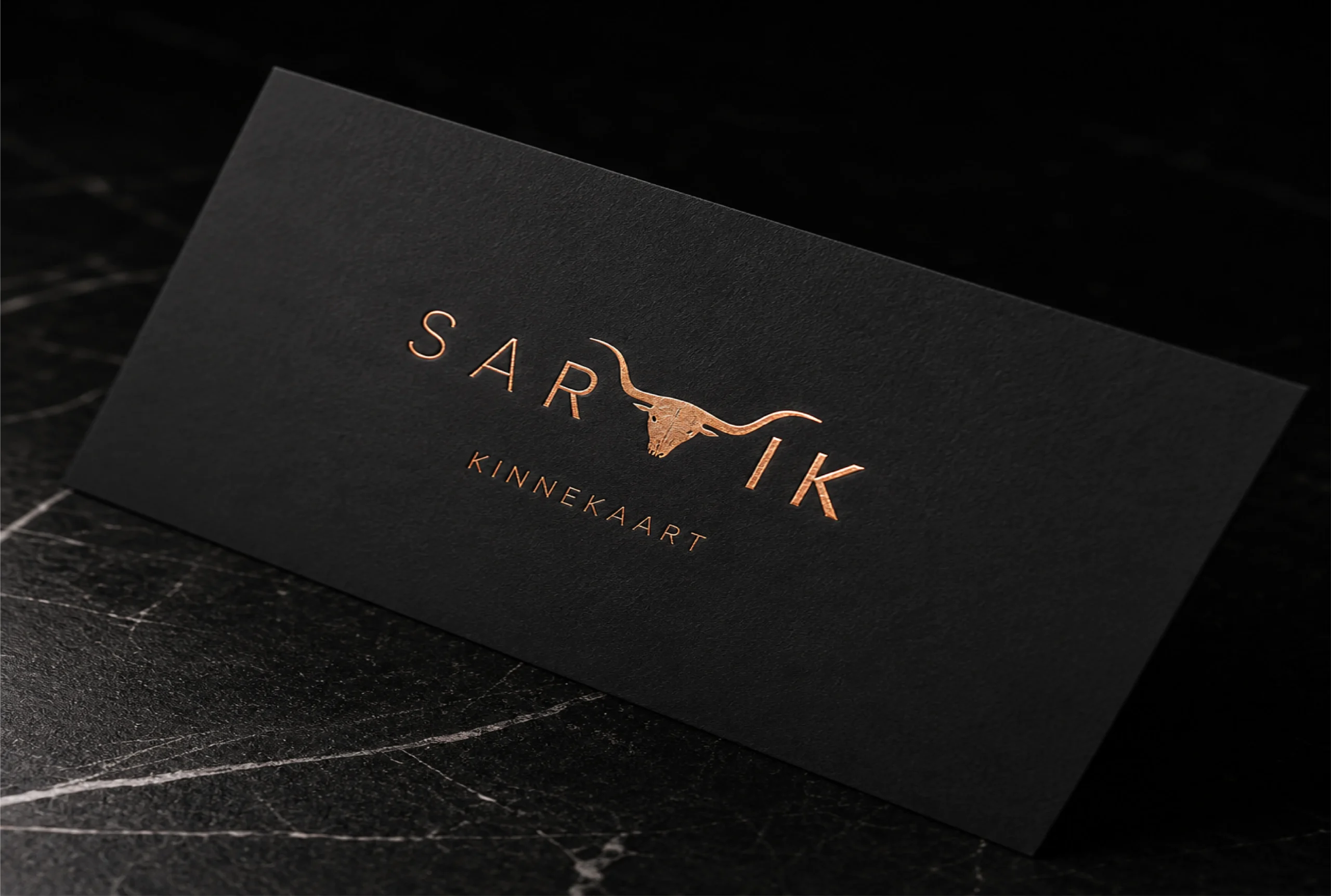
Hot foil in gold, silver, copper or black. A silver foil maker mark on a dark matte lid is the signature look of premium cutlery, and it costs far less than most makers assume.
Raised or recessed detail, usually registered to a logo. A blind debossed maker mark reads as confident in a way printed ink never quite does.
Selective gloss against a matte field. Used behind a logo or along a blade graphic it adds depth without adding another color to the run.
Restraint matters here more than almost anywhere. A blind deboss on uncoated stock reads as more expensive than four finishes stacked together, and it costs a fraction as much.
Cutlery branding leans on blacks, grays and metallics, and those are the hardest colors to hold consistently.
CMYK builds every shade from cyan, magenta, yellow and black. It reproduces blade photography and illustrated artwork accurately, and it costs the least. Deep blacks and neutral grays sit right at the edge of what CMYK holds run to run.
Pantone inks arrive pre-mixed and print identically every time. Cutlery brands often use a single signature color across a whole range, and spot ink is the only way to hold it across years of reordering.
RGB is a screen color space and no press prints it directly. Your website, marketplace listings and maker photography all live in RGB, and conversion shifts color noticeably. We convert with proper profiles and show the printed result on your actual board first.
One point specific to this category. Metallic effects print far more convincingly as foil than as metallic ink, and foil also resists the handling a display box receives.
Each option below either holds the blade still, protects the point or earns its place in the unboxing.
| Feature | What It Does | Best Suited To |
|---|---|---|
| Die-cut paperboard tray | Seats the blade in a channel, spine down | Kitchen and retail cutlery |
| Molded pulp bed | Cradles a heavy knife along its full length | Chef knives and custom makers |
| Recessed tip pocket | Stops the point loading a single panel | Every fixed blade carton |
| Edge guard or blade sleeve | Covers the cutting edge entirely | Mainstream kitchen knives |
| Oiled or VCI blade wrap | Slows corrosion on reactive steel | High-carbon and damascus blades |
| Coated inner face | Stops ambient moisture reaching the steel | Humid storage and long shelf cycles |
| Multi-cavity tray | Holds each knife in a set separately | Three to eight piece sets |
| Magnetic closure | Lid snaps shut and reopens cleanly | Premium rigid and gift boxes |
| Ribbon pull tab | Lifts a seated knife out of a deep bed | Rigid boxes with a tight fit |
| Certificate or card slot | Seats a maker card or care guide | Custom and limited edition work |
| Security tag pocket | Seats an electronic article tag discreetly | Locked and tagged retail fixtures |
| Corrugated shipping outer | Absorbs impact and resists the tip | Anything shipping alone |
Choose deliberately rather than comprehensively. Most knife boxes need a fitted bed, a recessed tip pocket, the right inner face for the steel and one premium cue, and little beyond that returns its cost.
Knives are lawful products with genuine handling risk, and both the carrier and the retailer have expectations of the packaging.
Carrier requirements come first because they are the ones that stop a shipment. USPS packaging and marking standards for knives and sharp instruments require the blade to be secured so it cannot cut through or protrude from the package, which is a packaging specification rather than a formality.
That standard is a useful design brief in its own right. A knife bedded so it cannot move, with the point recessed, satisfies the carrier and prevents the damage a customer would otherwise see.
State and local law varies considerably on which knives may be sold and to whom. Automatic and certain fixed blade knives are restricted in some jurisdictions, and that is a matter for your legal counsel rather than your packaging supplier.
Age restriction wording appears on many retail knife packs for that reason. Where a retailer requires it, the panel has to be legible rather than tucked into a corner.
Safe handling and care guidance belongs on the pack as well. Hand washing, drying and storage guidance protects the product, and sharpening guidance reduces the injuries a dull blade causes.
Retail security is a practical requirement in this category. Knives sit in locked or tagged fixtures in most general retail, and the buyer will ask how the pack accommodates that.
Environmental claims carry their own exposure. A recyclable claim on the carton should not imply the blade or a plastic sheath recycles with it, because neither usually does.
We build to carrier packaging standards as a matter of course and lay out warning panels as part of free design support. We manufacture packaging rather than provide legal advice, so confirm your own obligations formally.
Knife boxes are larger than most small-product cartons, so board area does count here. Structure still dominates.
Folding carton versus rigid leads by a wide margin. A printed carton and a wrapped rigid box for the same chef knife sit at completely different price points, and rigid earns its cost above roughly eighty dollars retail.
Bedding comes second and it is the one worth paying for. A die-cut paperboard tray costs little, molded pulp costs more, and both prevent the movement that causes every failure in this category.
Box length is a quiet cost driver unique to knives. A ten inch blade needs a sixteen inch box, and board consumption grows faster than the blade length suggests once you add the tray.
Finishing ranks next. Soft touch lamination is the most expensive common option, and a matte laminate with a foil maker mark usually delivers a stronger craft impression for considerably less.
Number of separate dies matters for ranges. A cutlery line usually spans three or four blade lengths, and consolidating to those rather than cutting one die per product is the largest structural saving available.
Shipping protection is the cost most often forgotten. A brand that ships a retail knife box without a corrugated outer pays for it in tip punctures and replacements.
Consolidating across your wider range helps too. Brands ordering knife boxes alongside the rest of their rigid boxes usually secure better pricing on both, because the runs share stock and setup.
The overspend we correct most often is foam bedding in a rigid box. A die-cut paperboard or pulp bed holds a knife more securely, costs less and recycles with the carton.
A point, an edge and real weight mean we test these boxes physically with a live blade rather than visually.
Knife boxes get one test that matters more than all the others, and it is the one a dieline review can never predict. We seat a live blade and drop the box on its end from waist height.
That single drop finds tip failures nothing else reveals. A point concentrates force onto a tiny area, and under an end impact it will pass through board that resists an edge without difficulty. If the tip reaches the panel, the recessed pocket goes deeper before anything else changes.
Retention comes next. We invert the box and shake it, then inspect the inner panels for scoring, because a blade that moves scores its own packaging over a long transit and the resulting slit reads as tampering rather than as a packaging fault.
Fit gets measured on the finished knife rather than the blade. The bolster is usually the widest point and the handle the deepest, and neither appears on a blade drawing. On rigid boxes we load the base with the full weight of the knife, since that mass concentrates at the bolster.
Corrosion is the slow failure and it damages the product rather than the pack. We hold a coated inner face in humid conditions against high-carbon steel, because stainless tolerates ambient moisture and carbon does not. Finally we open the box as a customer would, since a hand should always meet the handle rather than the edge.
We drop every new knife box on its end with a live blade seated. That single test finds tip problems no dieline review will ever reveal, and the tip is the one failure with a real safety consequence.
Knives reach customers through several very different routes, and each one rewrites the specification.
Kitchenware and department store retail rewards visible product. Customers buy on blade profile and finish, so a window carton frequently converts better than the best photograph would.
Direct-to-consumer changes the priority entirely. The knife travels alone, the tip meets every impact in a parcel network, and the unboxing is the first physical contact the brand gets.
Custom makers and small workshops compete on craft above all. A blind debossed maker mark on uncoated stock signals workshop rather than factory, and it separates a handmade knife from a production one instantly.
Chef and professional supply cares about durability and count. Boxes move through back rooms by the case, and presentation matters far less than protection and clear identification.
Outdoor and hunting retail needs the sheath accommodated properly. The sheath does the edge work, and a box sized for the bare blade will not close over it.
Gifting concentrates sharply into the fourth quarter and justifies rigid sets. The price point supports it and the recipient expects weight and ceremony.
General retail brings security requirements that shape the pack. Locked fixtures and electronic tags are standard in this category, and the buyer asks about them early.
Most cutlery brands sell through at least three of these at once. The workable answer is one box structure per blade length with print and bedding varied by channel.
Knives are long-lived products, which gives this category a stronger sustainability story than most.
Paperboard recovers well through existing programs, and EPA figures for paper and paperboard recovery show paper and paperboard as the most recovered packaging stream in the country.
The weak point is almost always the bedding. Vacuum-formed plastic and foam both undermine an otherwise clean box, and a die-cut paperboard tray or molded pulp holds a knife more securely than either.
Rigid boxes deserve honesty. A wrapped rigid box mixes greyboard with a paper wrap and often a laminate, and laminated stock is harder to recover. An unlaminated wrap with a matte coating keeps the weight and the recyclability.
The product itself is the real story. A well-made knife lasts decades, and packaging that presents it as an object worth keeping supports that positioning far better than an environmental claim on the panel does.
Many customers keep a good knife box, which is worth designing for deliberately. A rigid box with a fitted bed becomes storage rather than waste, and that is a genuine reduction rather than a claim.
Right-sizing still matters. A box cut to the finished knife uses less board, holds the blade more securely and reduces the void that lets a tip build momentum in the first place.
These errors repeat across cutlery brands and makers of every size, and each one is avoidable before a die is cut.
Ignoring the tip leads the list, and it is the only mistake here with a real safety consequence. A point under transit pressure goes through board that would resist an edge without difficulty.
Bedding a knife loosely is second. A blade that moves scores the inner panel over a long transit, and the resulting slit reads as tampering rather than as a packaging fault.
Sizing to the blade rather than the finished knife is third. The bolster is usually the widest point and the handle is usually the deepest, and neither appears on a blade drawing.
Shipping a retail knife box without a corrugated outer costs far more than the outer would. Tip punctures generate replacements, and a blade protruding from a parcel is a serious incident.
Using uncoated board with high-carbon steel produces rust spots within weeks in a warm warehouse. Customers read that as poor steel rather than poor packaging.
Building deep blacks in CMYK produces visible drift across a run. Cutlery artwork leans on black and gray constantly, and a spot black solves it for very little.
Finally, discovering retail security requirements after approval. A locked fixture or a tag pocket means new tooling and a missed listing window, and buyers raise it early if you ask.
A chef knife brand approached us after parcels began arriving with the blade tip visibly through the end of the shipping box.
It was the most serious packaging problem we saw that year. Couriers were refusing parcels, and a protruding blade is a genuine injury risk rather than a cosmetic complaint.
Their retail box was a well-made rigid box with a shallow foam bed. The knife sat correctly at rest and moved perhaps a centimeter under an end drop, which was all the tip needed.
We made three changes and kept their artwork untouched. A molded pulp bed cradled the knife along its full length, a recessed pocket seated the point behind a doubled panel, and the rigid base went deeper so the tip sat well below the lid line.
We also specified a B-flute shipping outer with a die-cut fitment, so the retail box could no longer shift inside it during an end drop.
Tip punctures stopped completely across the following two seasons. Packaging cost rose by about thirty cents per order, and the courier issues that had been threatening their direct channel disappeared.
We manufacture domestically and ship free to every state, so production schedules hold and nothing waits at a port.
Our knife customers include cutlery brands, custom knifemakers, kitchenware companies, outdoor and hunting brands, chef supply distributors, gift retailers and private label packers.
We produce for brands in New York, Chicago, Portland, Seattle, Denver, Austin, Nashville and Los Angeles, and we supply individual makers across Oregon, Montana, Idaho, Texas, Tennessee, Pennsylvania and the Carolinas.
Humidity genuinely changes the recommendation. Southeastern and Gulf Coast storage makes a coated inner face worth specifying on carbon steel, while dry mountain west conditions are far more forgiving.
Scale changes it too. A custom maker producing forty knives a month needs digital printing with no minimum, while a national cutlery brand needs offset and consolidated tooling. We do both on the same floor.
Wherever you trade, the terms stay identical. Zero minimum order quantity, free design support, free shipping and a written specification with every order.
Ordering runs through four steps, and our team handles the technical work at each one.
First, send the finished knife with its sheath where there is one, plus your blade lengths and your channels. Tell us the steel type, because carbon and damascus change the inner specification.
Second, we return a free dieline and a written quote within one business day. Folding carton and rigid options are costed separately, so you can see the difference rather than being defaulted to the expensive one.
Third, you approve a digital proof and we recommend a physical sample. Seat a live blade, drop it on its end from waist height and open it as a customer would before you commit to a run.
Fourth, we produce and ship. Standard production runs eight to twelve business days, rush production runs four to six, and shipping anywhere in the United States costs nothing.
Three commitments make custom knife packaging workable for a one-person workshop as well as a national brand, and none carry a hidden charge.
Zero minimum order quantity means you order what you need. Digital printing carries no plate cost, so a maker producing forty knives a month can package to the same standard as a cutlery giant.
Free design support covers the dieline, bed engineering, tip pocket design, warning panel layout and artwork preparation. If you have no artwork at all, our team can build a clean maker mark from your existing branding.
Free shipping applies across the United States on every order, rush production included. We manufacture domestically, so a seasonal release never waits in a customs queue.
We are a direct manufacturer rather than a broker. We cut our own dies, run our own presses and finish every order in house, which is why we quote quickly and stand behind what leaves our floor.
On knife packaging the deciding property is containment. The tip causes every serious failure in this category, and it has to be tested with a live blade and a real end drop rather than assumed from a dieline.
You also get the paperwork. Every order ships with a specification naming the board, the caliper, the coating, the bedding and the finishing, so your own quality records stay accurate.
Send us a finished knife, your blade lengths and your steel type, and we will return a free dieline and a written quote for custom knife boxes within one business day. Order now, or get a free quote and we will build the bed that keeps the point exactly where it belongs.
| Box Style | Custom Knife Boxes |
| Dimension (L + W + H) | All Custom Sizes & Shapes |
| Quantities | No Minimum Order Required |
| Paper Stock | 10pt to 28pt (60lb to 400lb) Eco-Friendly Kraft, E-flute Corrugated, Bux Board, Cardstock |
| Printing | No Printing, CMYK, CMYK + 1 PMS color, CMYK + 2 PMS colors |
| Finishing | Gloss Lamination, Matte Lamination, Gloss AQ, Gloss UV, Matte UV, Spot UV, Embossing, Foiling |
| Included Options | Die Cutting, Gluing, Scored, Perforation |
| Additional Options | Eco-Friendly, Recycled Boxes, Biodegradable |
| Proof | Flat View, 3D Mock-up, Physical Sampling (On request) |
| Turnaround | 4 – 8 Business Days, RUSH |
| Shipping | FLAT |
Every great product deserves packaging that turns heads. Here's how we make it happen — step by seamless step.
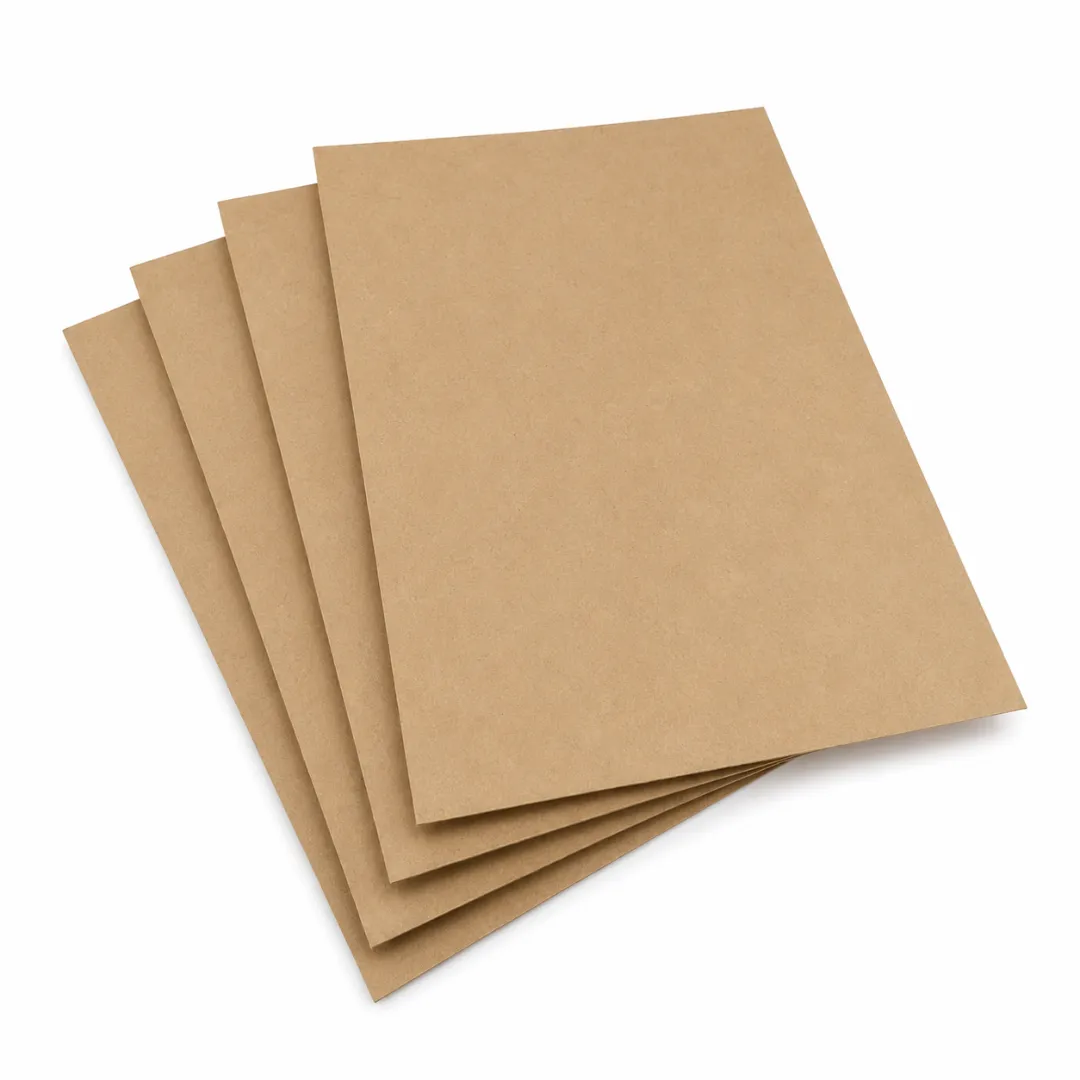
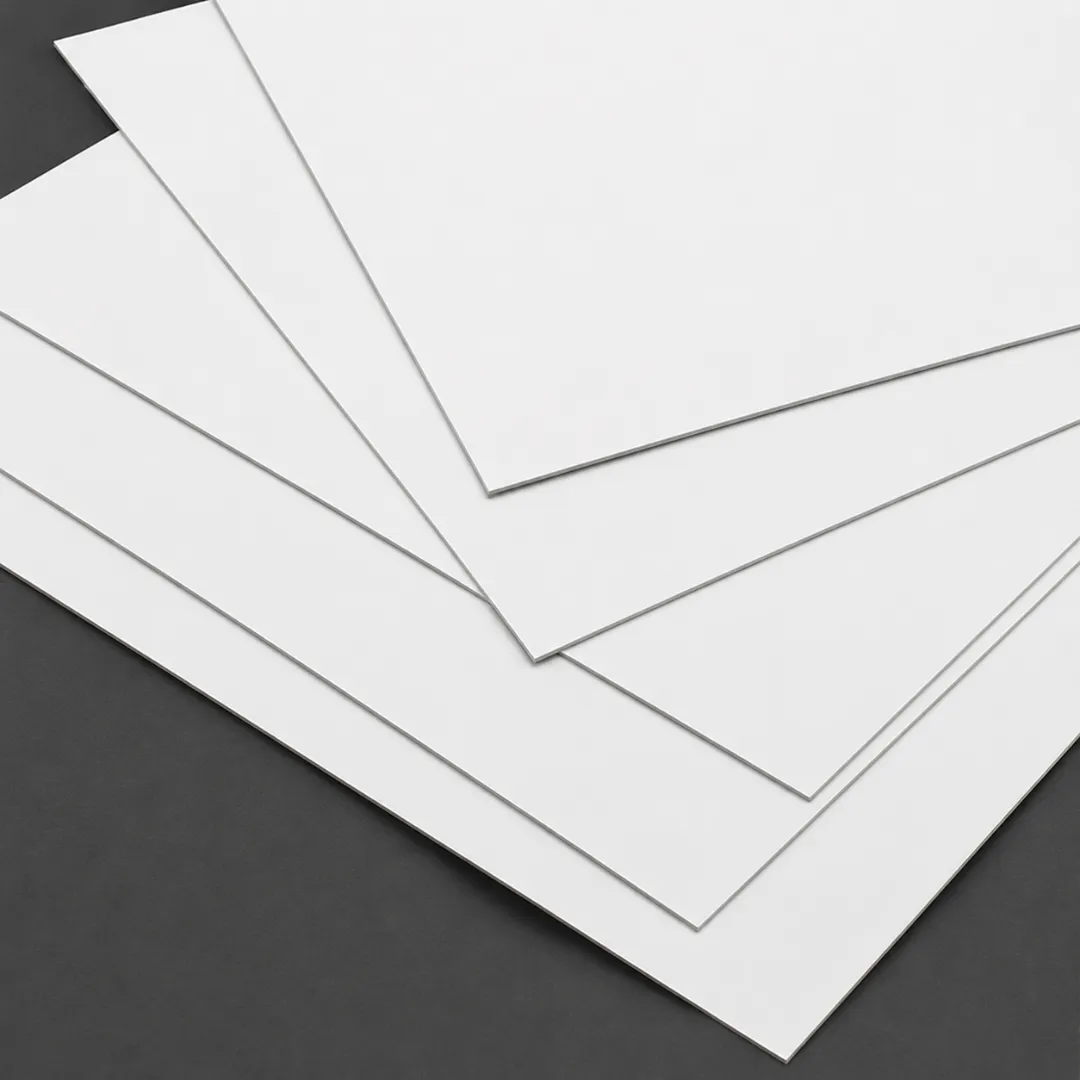
Kraft paper is a strong, durable and reliable material that is widely used across many different industries.
We use cardboard material with the least environmental impact and minimizes waste generation.
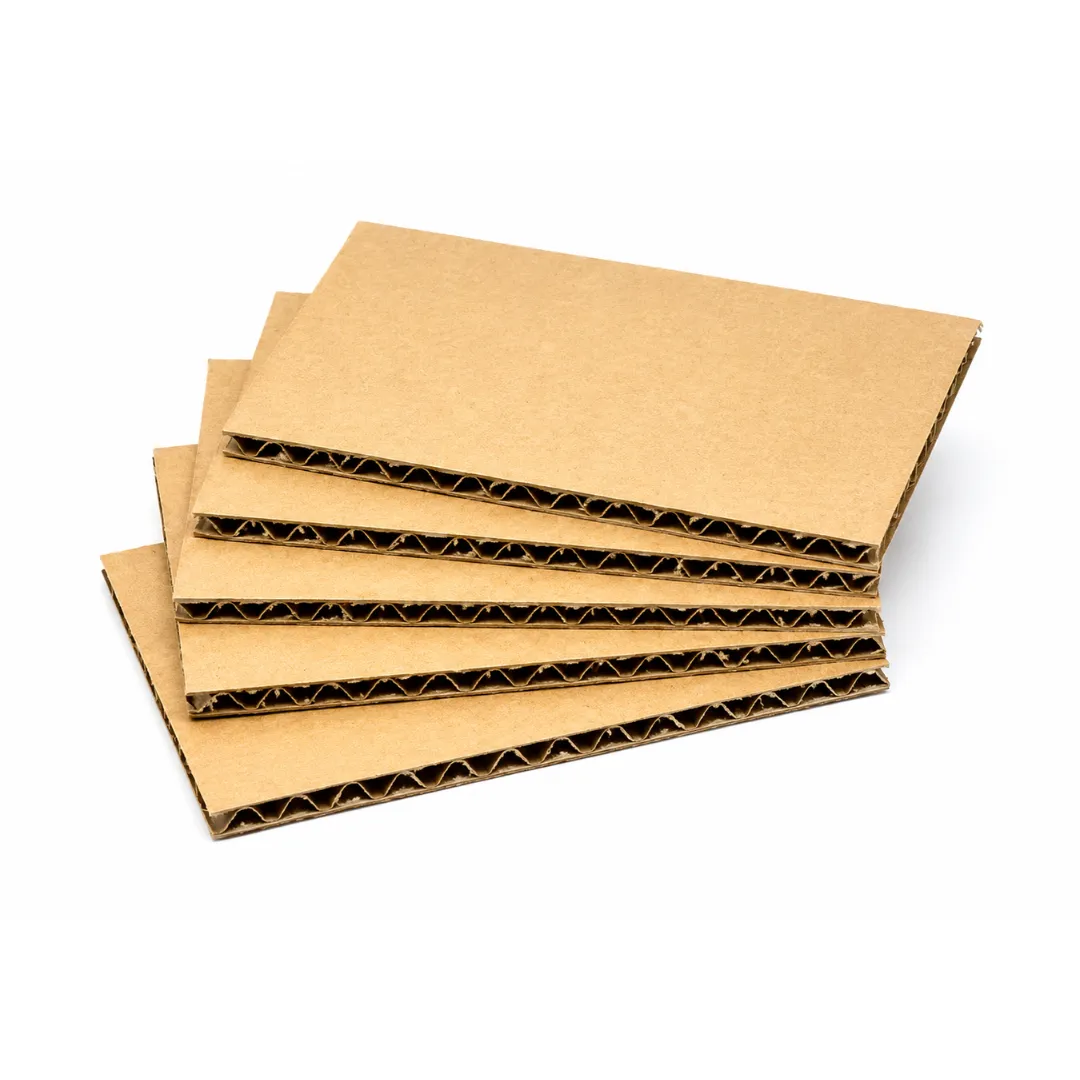
Corrugated material is easy to customize, cost effective and sustainable. It is also great for branding purposes.
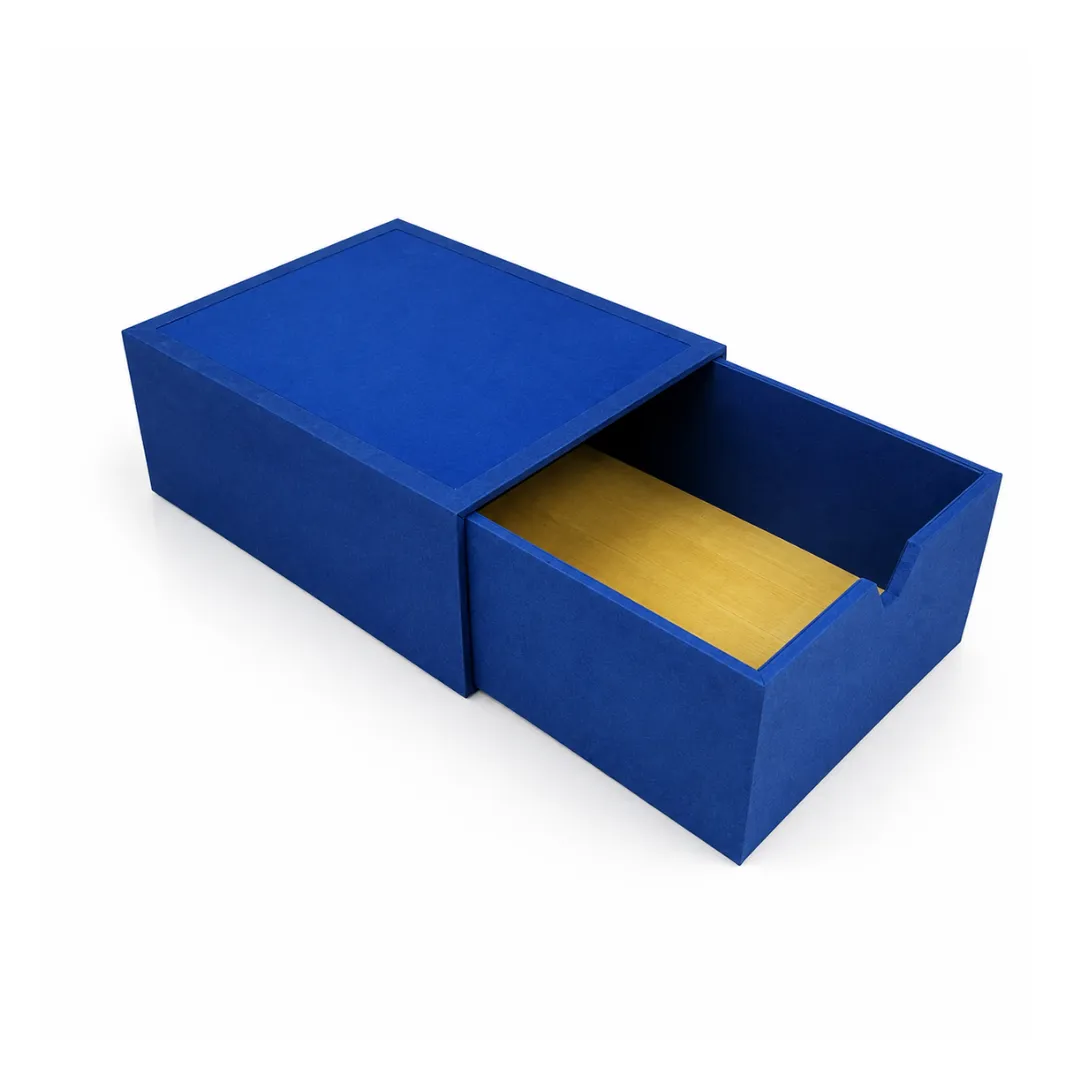
Rigid is highly protective, affordable and recyclable material. These boxes provide maximum protection.
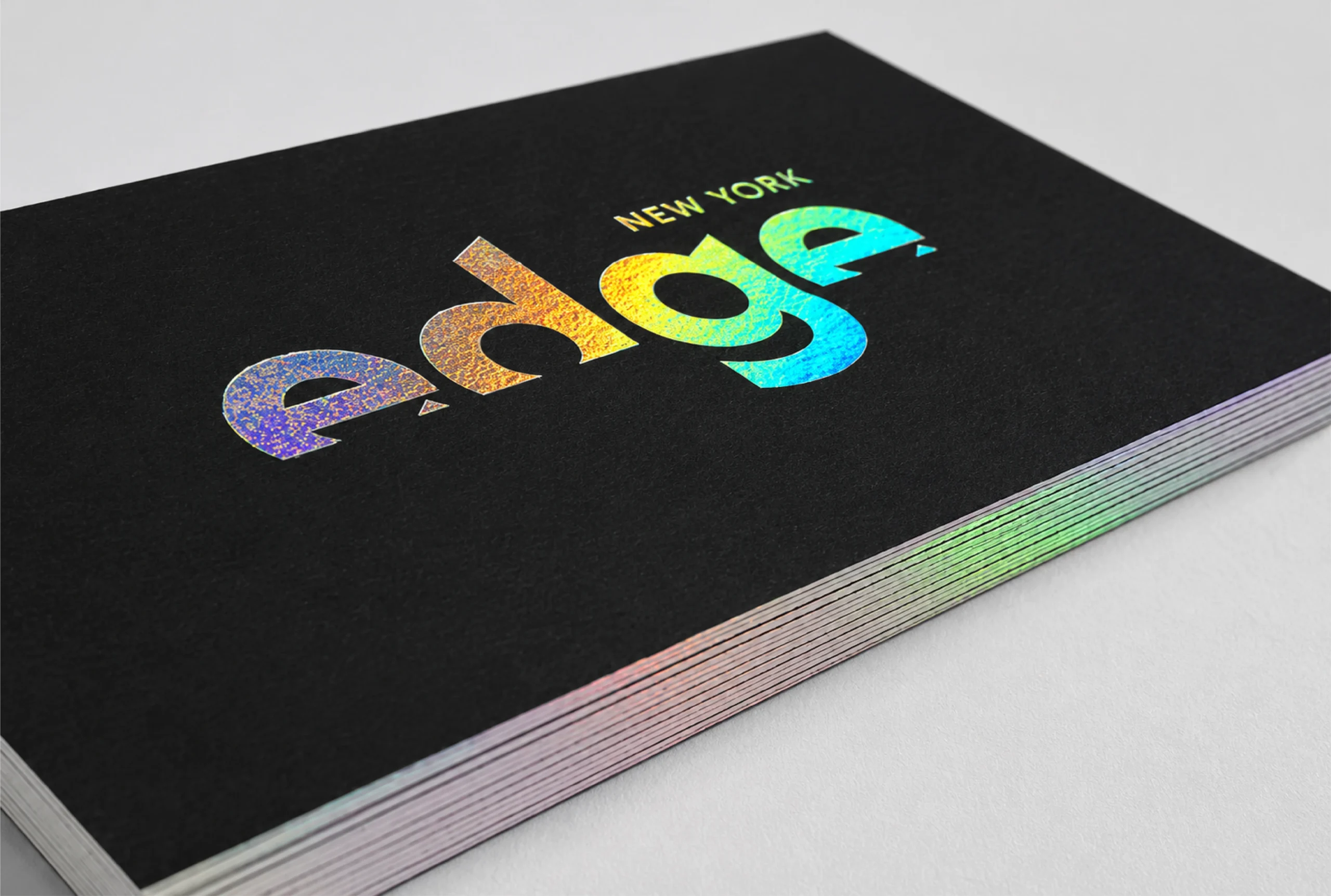
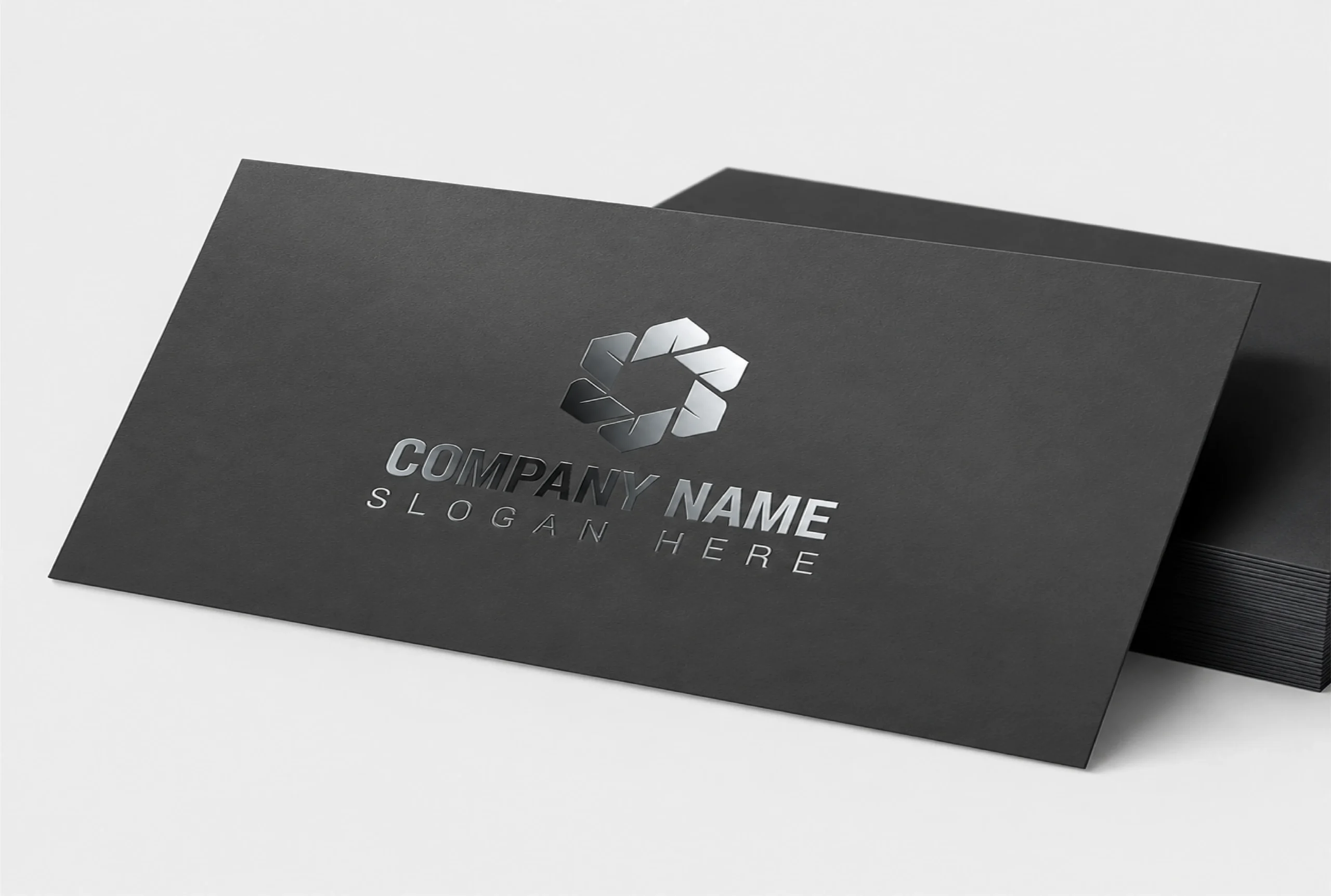
Holographic foil diffracts light and reveals the colors of the rainbow at various angles.
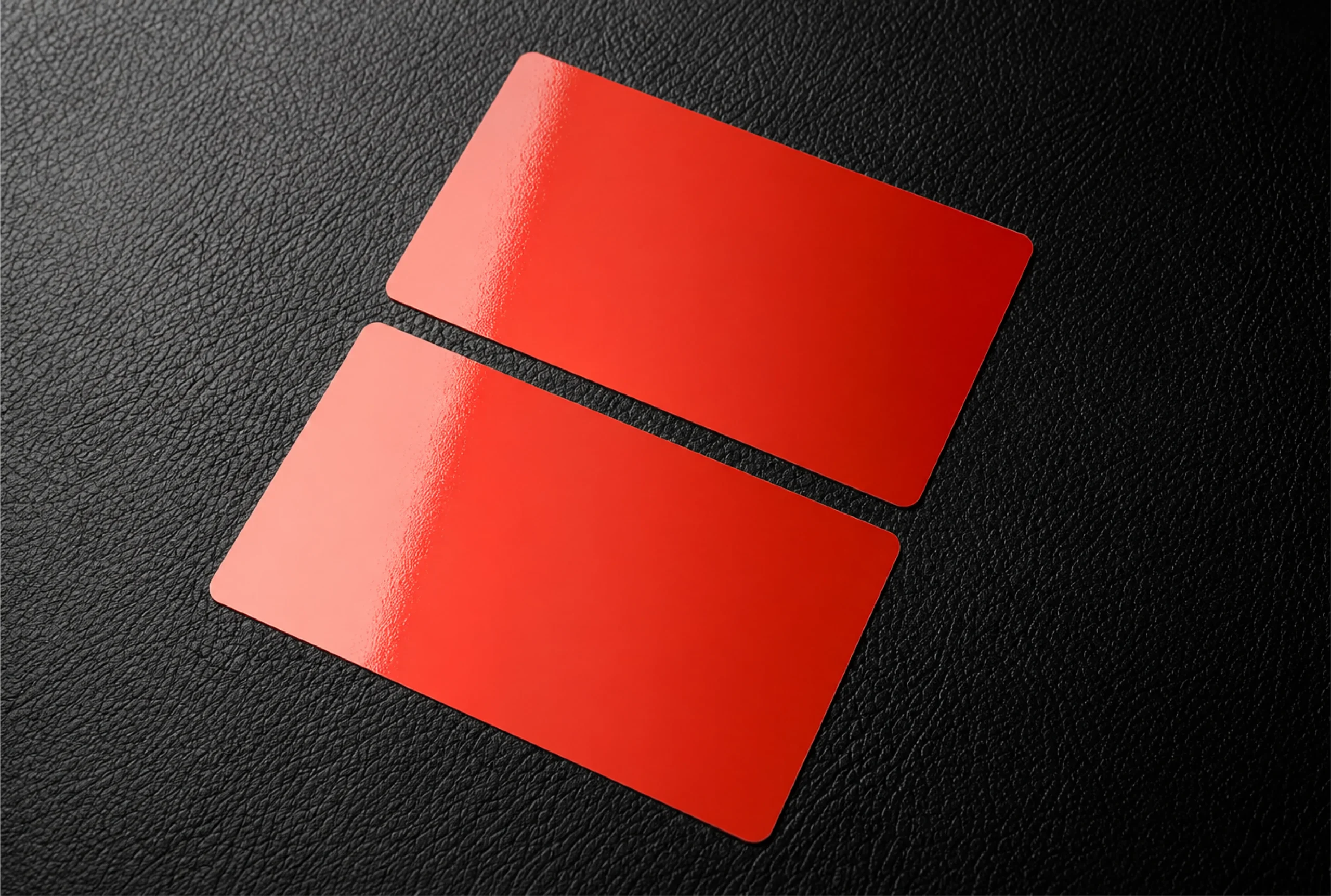
Our glossy finishing gives your packaging an extra layer of shine.
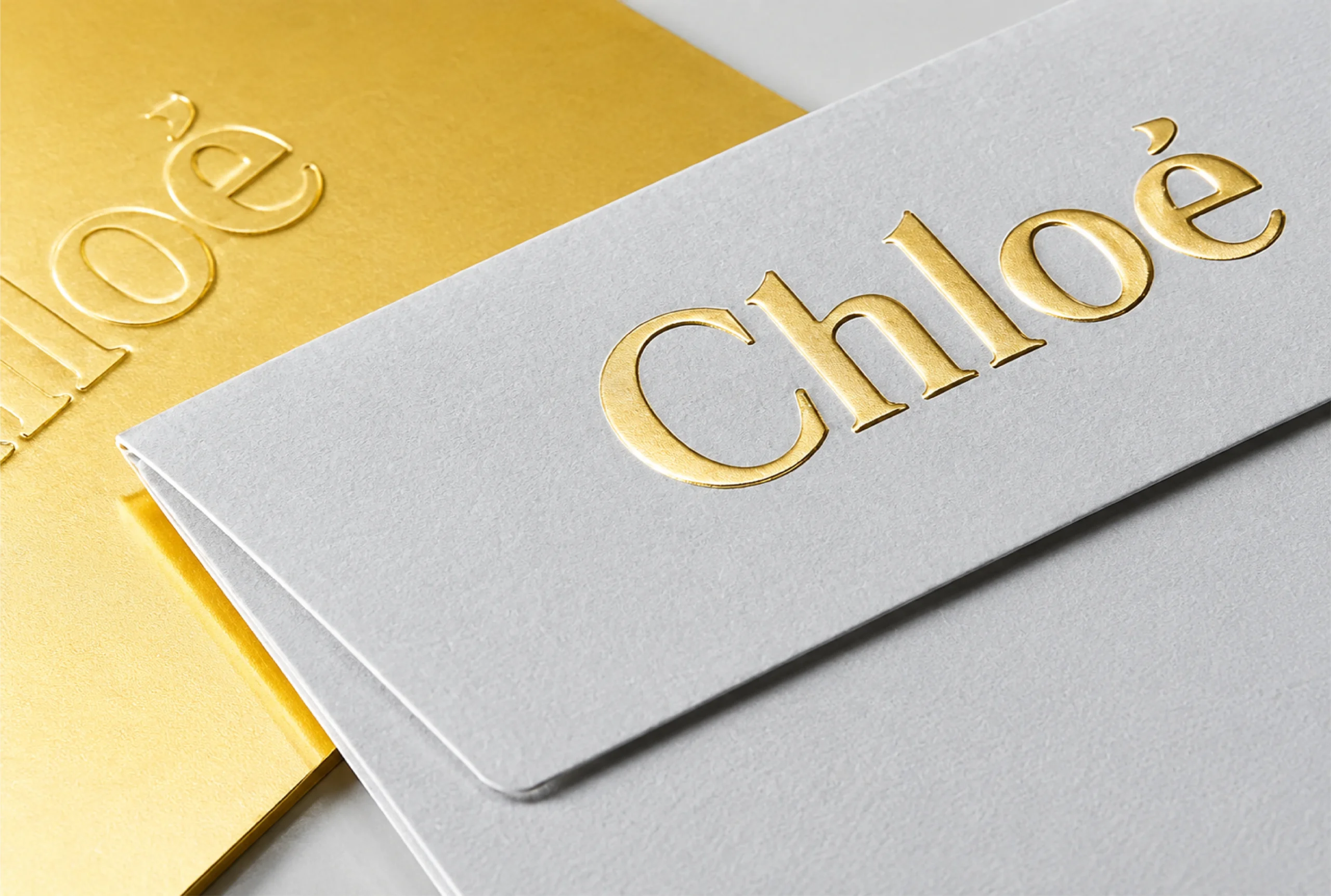
Decorate a wide range of your product packaging with our foil stamping.

With our embossing technique, we transfer the finest details of your product on packaging.
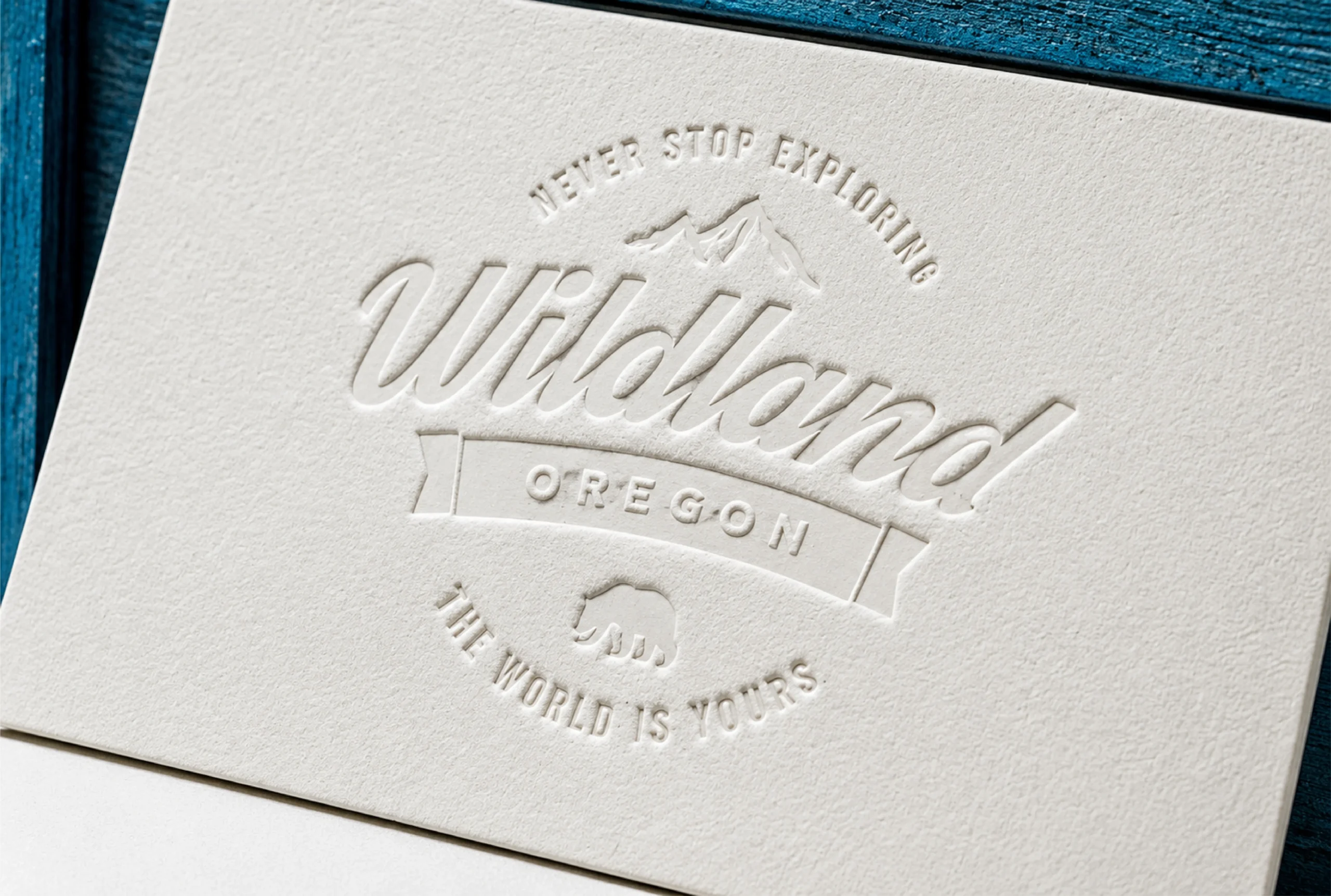
We use debossing technique to add unique graphics into your packaging.
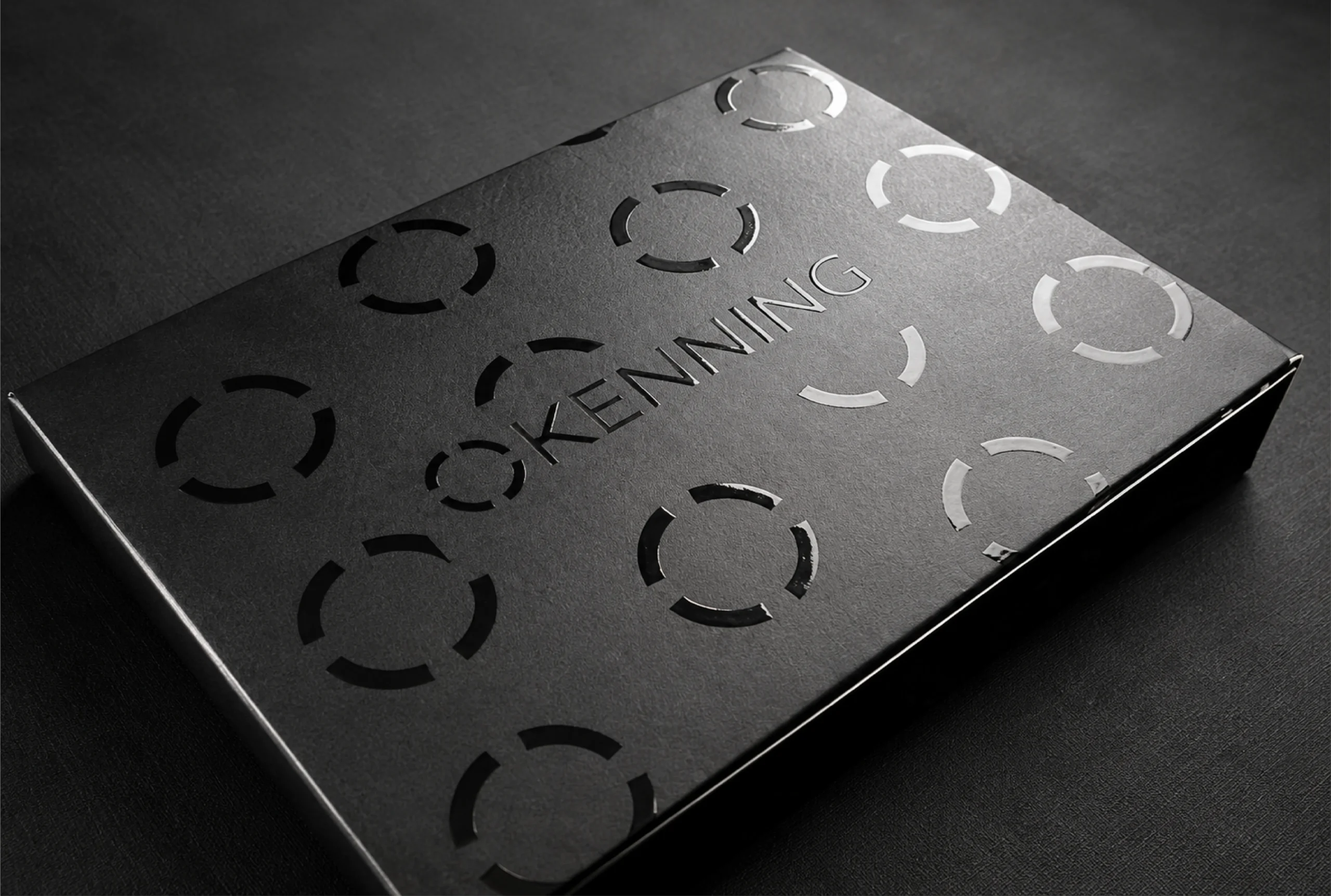
Our high-gloss UV coating gives light and shine to cure the printed material's varnish.
We add additional layer of protection with soft touch lamination from toner chipping.
With our matte finish, fingerprints and smudges will now be less visible on the packaging.
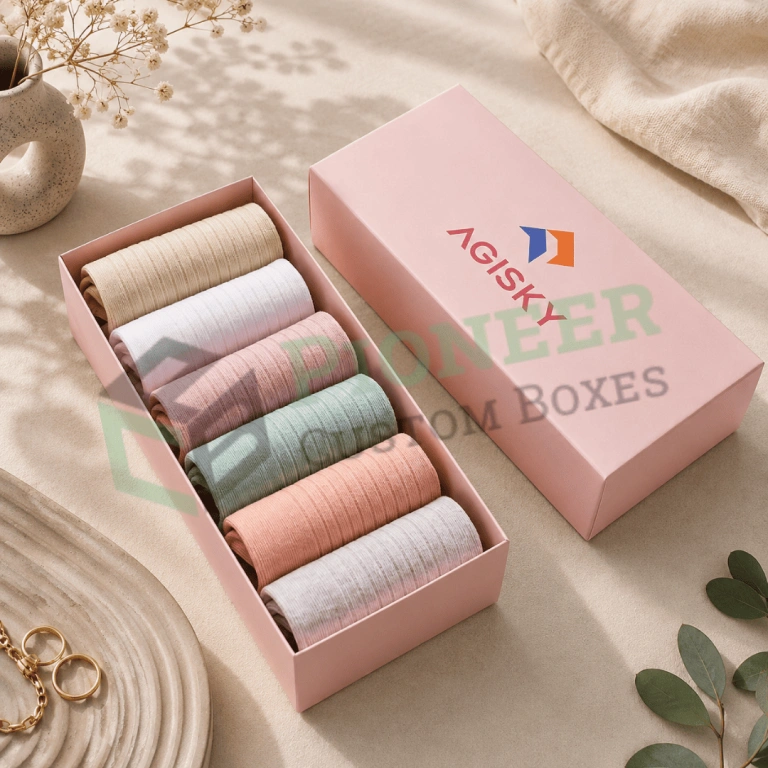
Custom towel boxes help towel brands, spas, hotels, salons, and ecommerce sellers package bath towels, hair towels, bow towels, hand towels, microfiber towels, and towel gift sets with clean folds, better protection, and stronger presentation. They support custom sizes, printing, inserts, windows, mailer structures, kraft finishes, and retail-ready towel packaging.
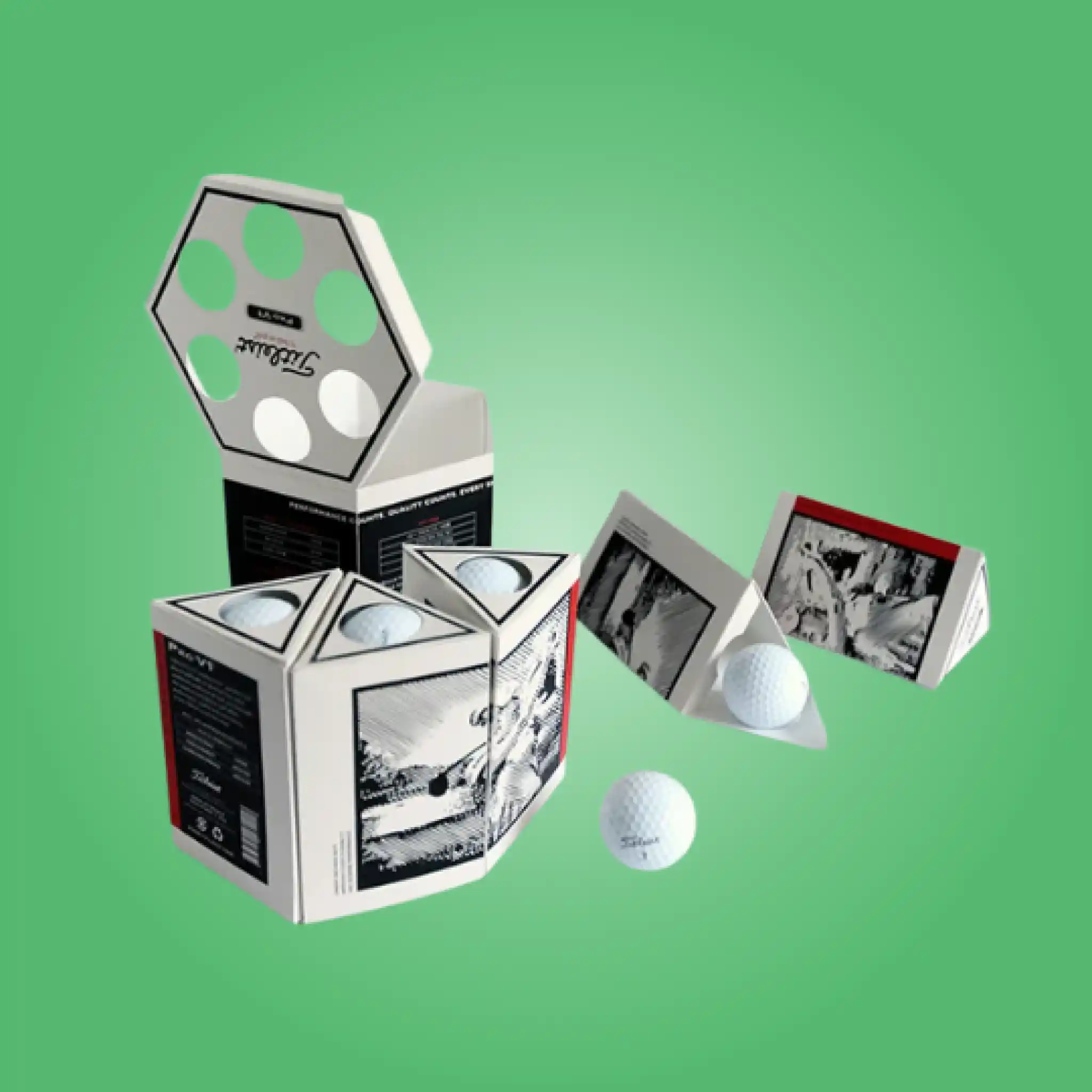
Custom sports boxes from Pioneer Custom Boxes help sportswear, footwear, protective equipment, supplement, accessory and memorabilia brands package products that are heavy, bulky or awkwardly shaped. Choose 32 to 51 ECT corrugated, SBS or kraft board with pulp cradles, partitions, protective liners, hang tabs, exact Pantone team color matching, free design support, no MOQ and free USA shipping.
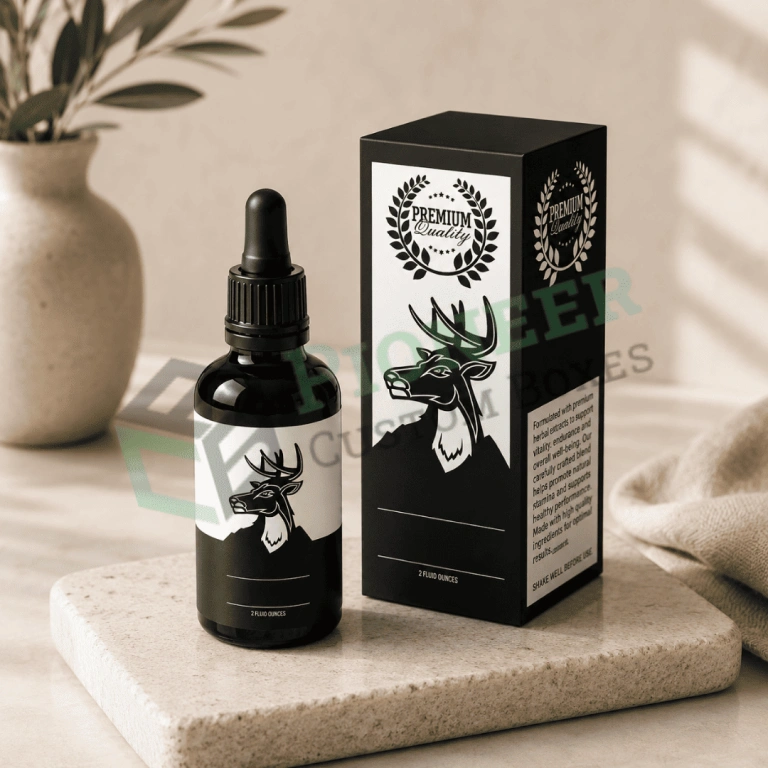
Custom beard oil boxes from Pioneer Custom Boxes help grooming brands package dropper bottles, glass oils, CBD beard oils, gift sets, and retail grooming products with accurate sizing, protective inserts, custom printing, durable stock, luxury finishes, and free shipping across the USA.

Protect your cannabis, CBD, hemp, and herbal pre-rolls with premium custom packaging designed for US dispensary standards. Each box reinforces freshness, aroma control, and legal clarity while showcasing your brand. With custom sizing and fast USA delivery, your pre-rolls stay safe and retail-ready.