Custom sandwich boxes from Pioneer Custom Boxes help delis, cafes, convenience retailers, caterers and food-to-go brands display a sandwich properly while controlling moisture. Choose wedge, clamshell, sub or platter formats in grease-resistant SBS, kraft or E-flute board, with anti-fog windows, venting, auto-lock bases, free design support, zero MOQ and free USA shipping.
Custom sandwich boxes are printed paperboard cartons built to hold a cut sandwich upright, show the filling and control moisture. Pioneer Custom Boxes manufactures them across the United States with zero minimum order quantity and free shipping.
A sandwich sells on its cross-section. Customers scan a chilled cabinet in seconds, and they buy the filling they can actually see. Therefore the carton has to open the product visually while still protecting it.
That creates the central tension in this category. More window means better visibility and weaker structure. Less window means a stronger box that hides the product. Every good sandwich carton resolves that trade-off deliberately rather than by accident.
Moisture drives almost every technical decision here. Bread releases moisture, fillings release more, and a chilled cabinet condenses it onto the film. Consequently board grade, venting and film choice matter more than print quality does.
We manufacture custom printed sandwich boxes for cafes, delis, sandwich chains, convenience retail, catering kitchens and food service wholesalers. Moreover we cut our own dies and run our own presses. That is why we quote quickly and build the carton around your actual sandwich.
Order wholesale sandwich boxes in any quantity you need. There is no minimum, design support costs nothing, and shipping across the United States stays free on every order.
Sandwich packaging splits into a handful of structures, and each one suits a different product and a different counter.
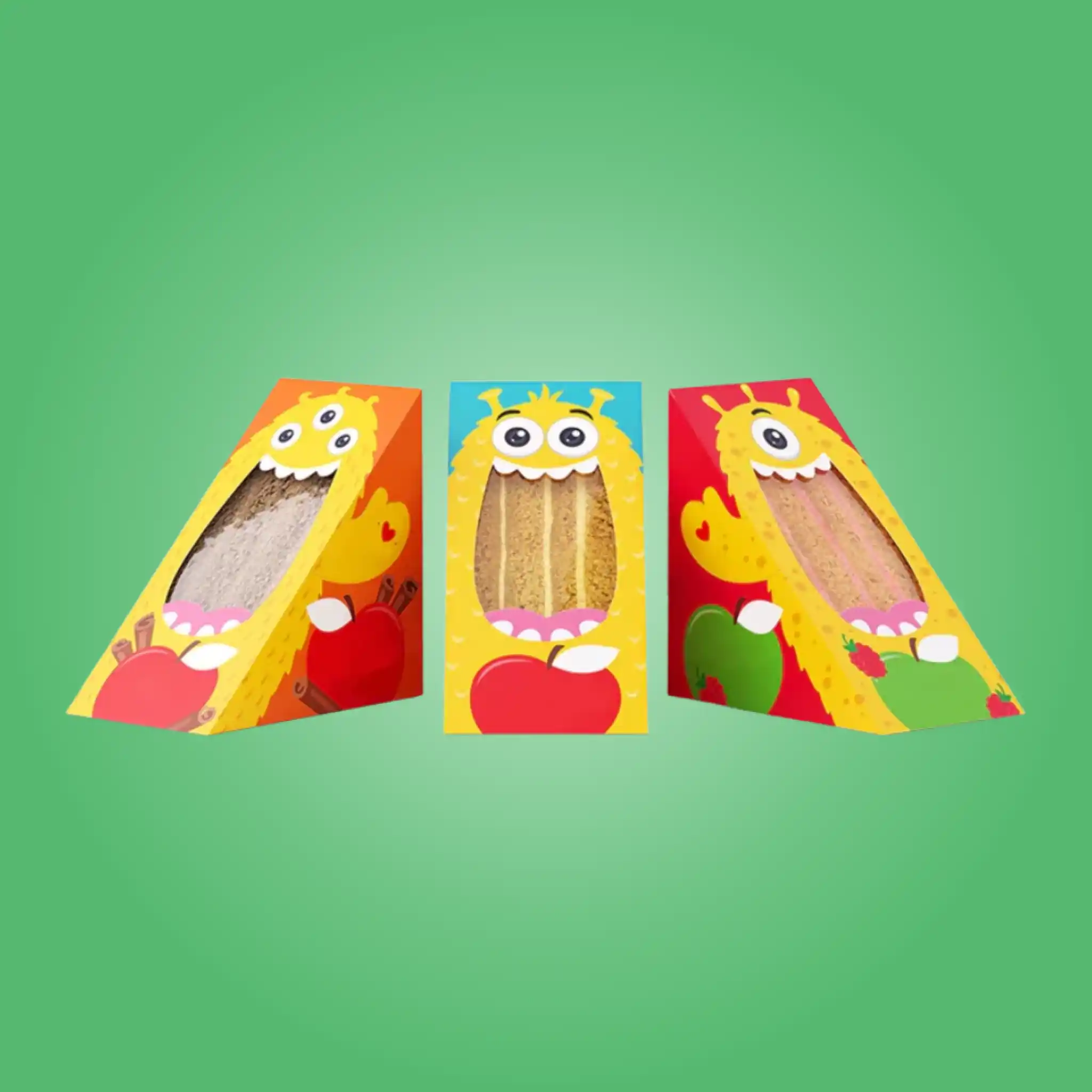
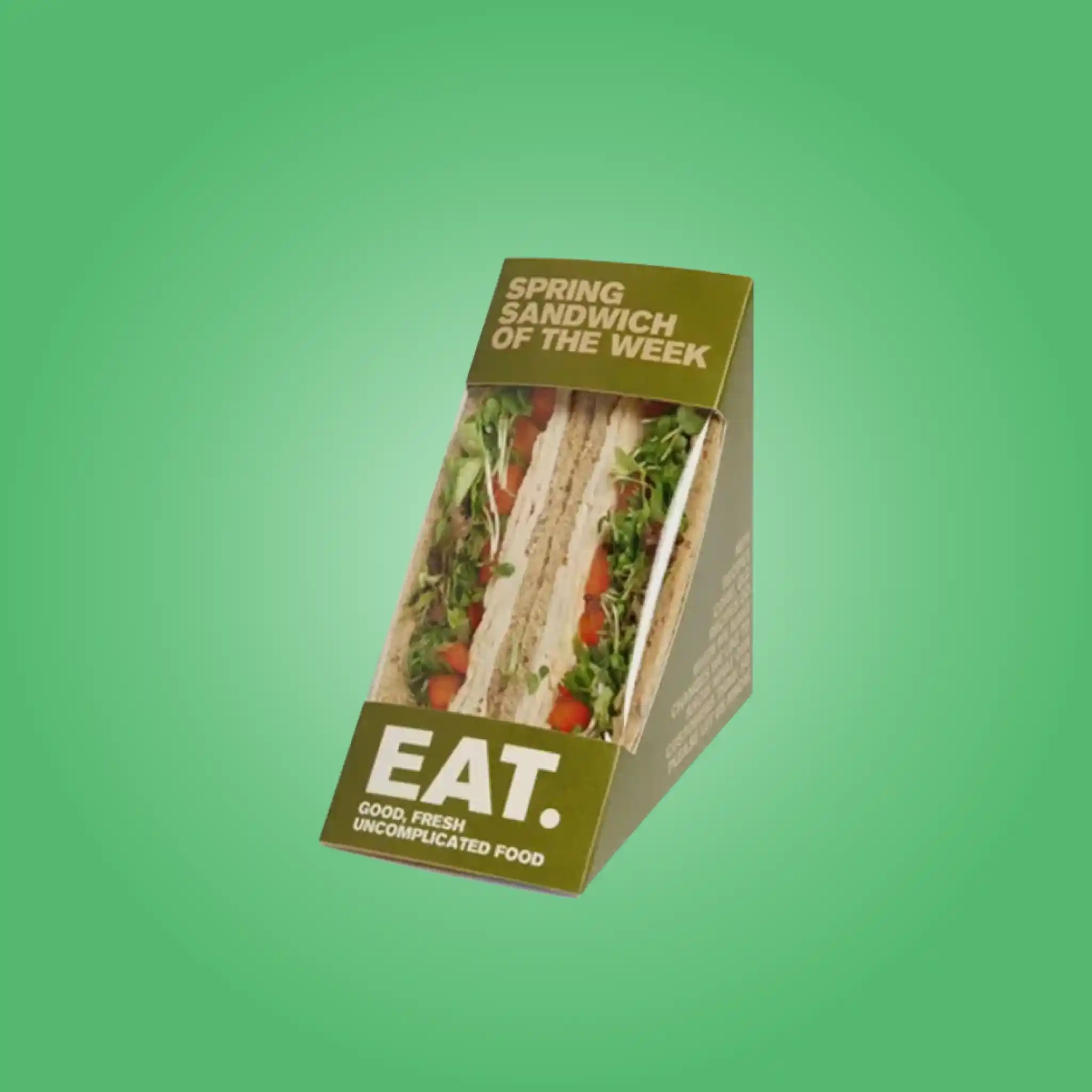
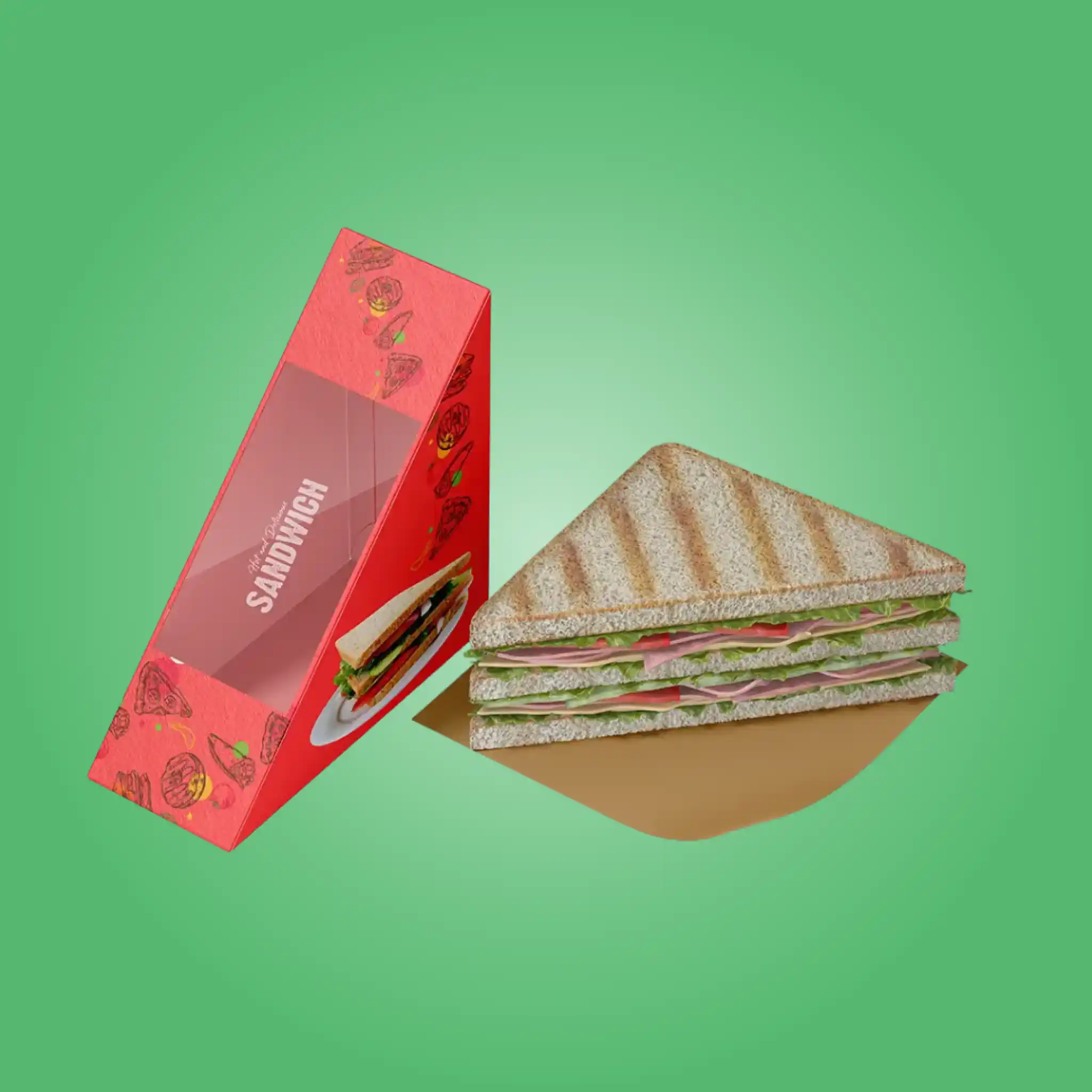
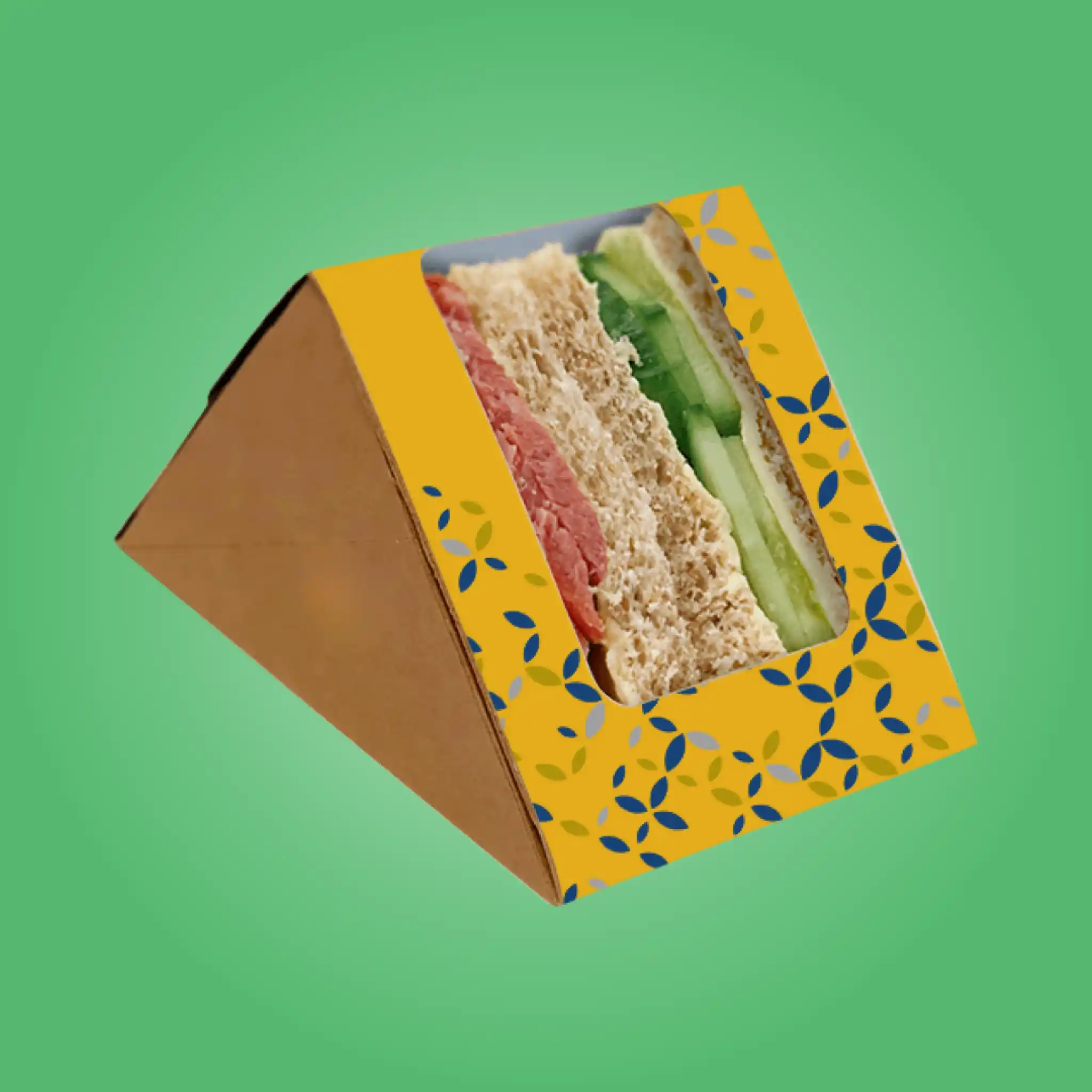
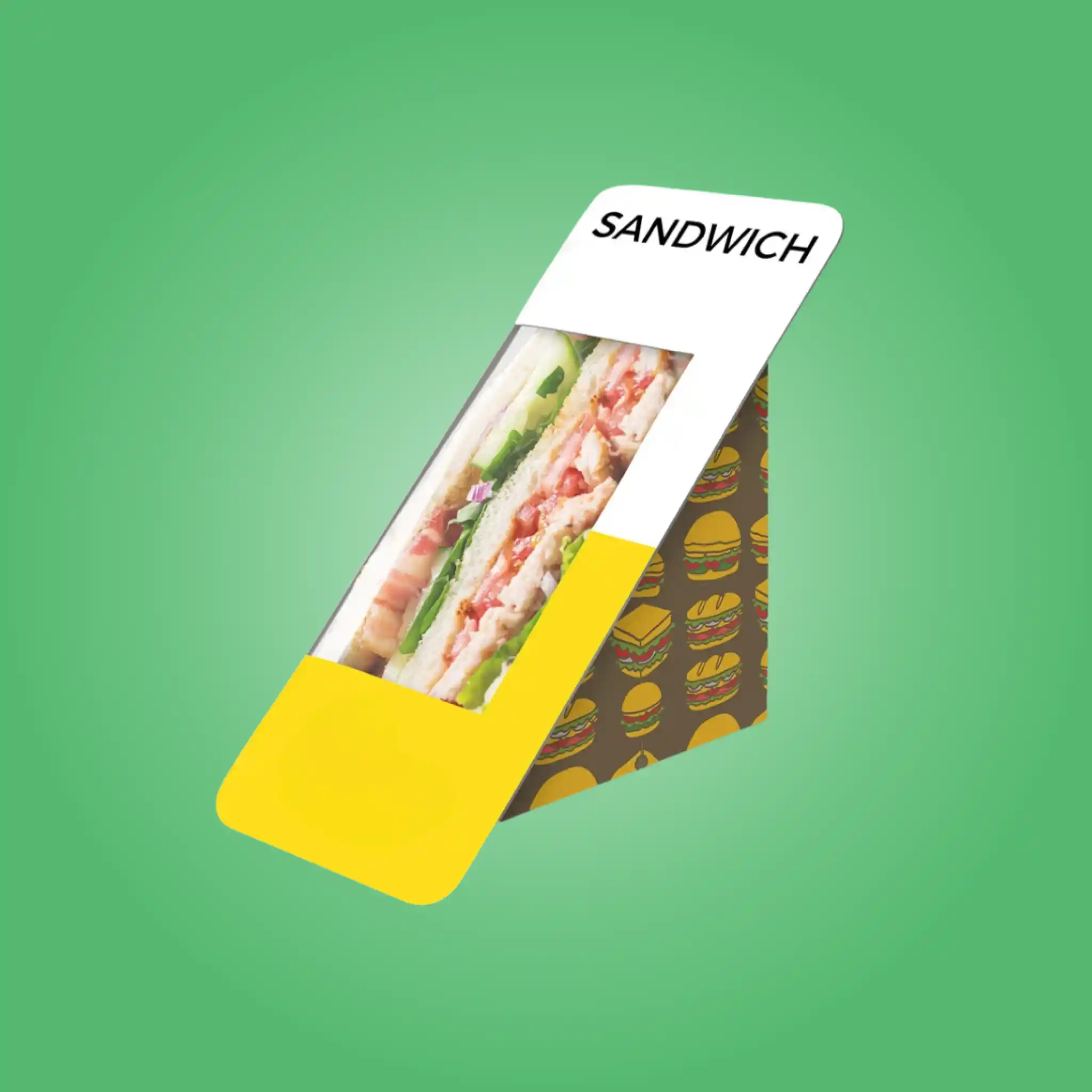
The classic triangular carton for a sandwich cut corner to corner. It stands the cut face toward the shopper, which is exactly what sells the product. Wedges stack tightly in a chilled cabinet, so they suit high-turnover grab-and-go retail better than any other format.
A hinged carton that opens flat and closes in one motion. It handles thicker fillings, uncut sandwiches and anything a wedge would compress. Staff assemble it faster than a two-piece box, which matters across a lunch rush.
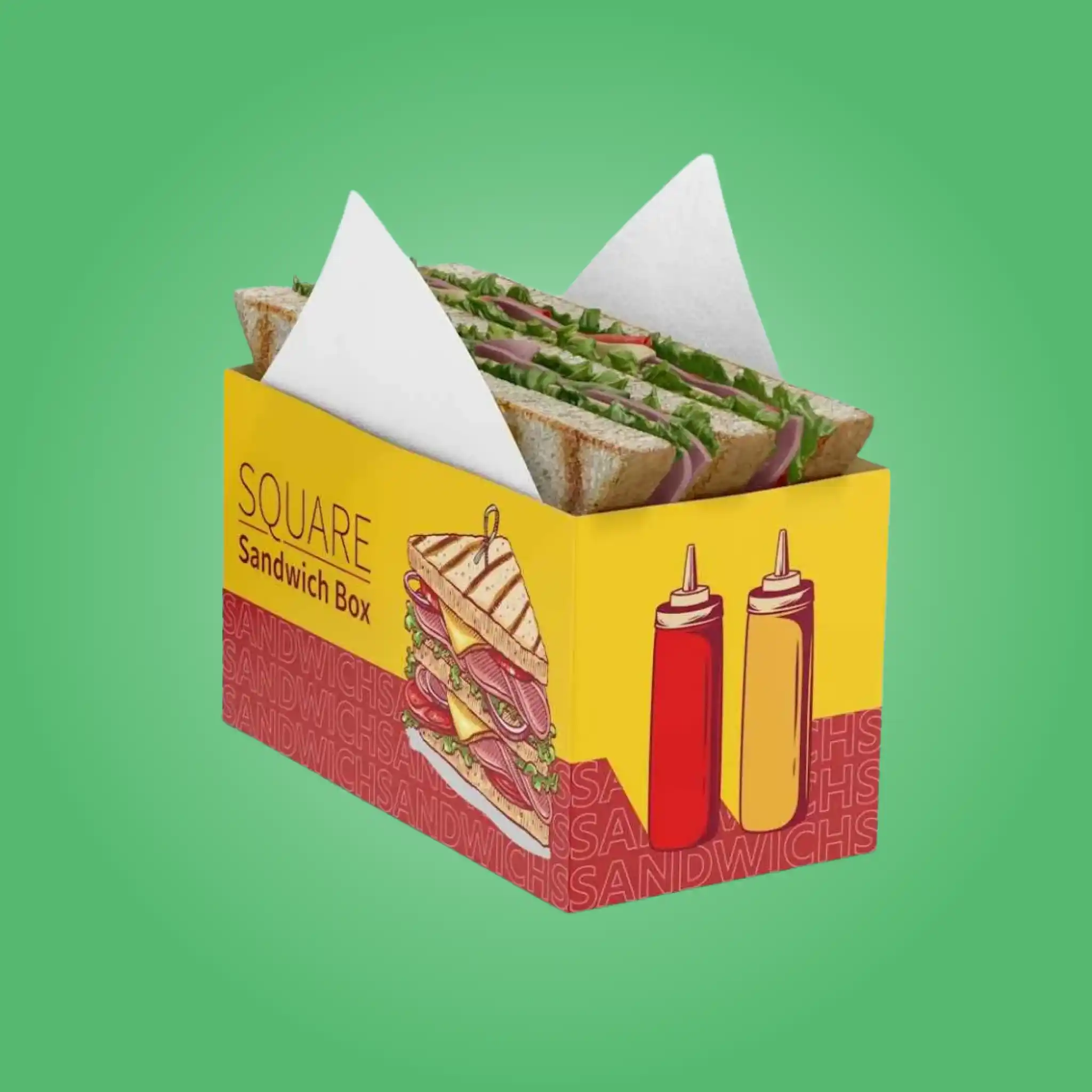
A long, narrow carton for baguettes, subs, hoagies and rolls. Length creates a structural problem, because a long flat base sags under a loaded sandwich. We specify a heavier caliper or a scored reinforcing rib to hold the span.
An open-ended sleeve that grips a wrapped tortilla and leaves both ends visible. It uses very little board, so it costs less per unit than any enclosed carton. Sleeves also print beautifully, since the whole panel stays flat.
A vented carton for a hot pressed sandwich. Venting is not optional here, because trapped steam turns a crisp panini soft within minutes. We place vents on the upper panel where condensation collects first.
A compartment carton holding a sandwich alongside a snack and a drink. Meal deals carry higher basket value, and the packaging has to keep the components separate and presentable.
A large shallow tray with a lid for platters of cut sandwiches. Platters need genuine base strength, since a loaded tray gets carried by hand across an office floor.
Send us your sandwich and we will build the die around it. Measuring a real filled product removes every assumption about height, weight and clearance.
Every die is cut to your actual sandwich. These formats cover what we produce most often across cafes, delis and retail.
| Format | Typical Size (inches) | Board | Feature |
|---|---|---|---|
| Standard wedge | 5 x 3 x 3 | 18pt grease resistant | Front window, upright halves |
| Deep fill wedge | 5.5 x 3.5 x 3.5 | 18pt grease resistant | Extra depth for thick fillings |
| Rectangular clamshell | 7 x 5 x 2.5 | 18pt grease resistant | Hinged lid, window |
| Baguette box | 12 x 3.5 x 3 | 18pt to 20pt | Length rigidity, side window |
| Sub and roll box | 9 x 4 x 3 | 18pt grease resistant | Window, secure closure |
| Wrap sleeve | 8 x 2.5 x 2.5 | 16pt grease resistant | Open end, minimal board |
| Toastie and panini box | 7 x 4 x 2 | 18pt grease resistant | Vent holes for steam |
| Bento meal deal box | 9 x 6 x 2.5 | 18pt with divider | Compartments for sides |
| Half platter | 14 x 10 x 2.5 | E-flute | Rigid base, clearing lid |
| Full catering platter | 18 x 12 x 3 | E-flute | Reinforced base, handles |
Send us your bread type, cut and typical filling depth. Filling depth matters more than most operators expect, since a generous sandwich in a box sized for a thin one gets compressed and loses its cross-section.
The window is the commercial heart of a sandwich box, and it is where most of them go wrong.
Position matters first. In a wedge box the window belongs on the face showing the cut cross-section, because that is what sells the sandwich. A window on the top or the side shows bread, which sells nothing. That sounds obvious and it is specified incorrectly surprisingly often.
Fogging is the most common failure. Sandwiches contain moisture, chilled cabinets are cold, and condensation forms on the inside of a standard film within minutes. A fogged window hides the product entirely, which means the box is doing the opposite of its job during the exact period the customer is choosing.
Anti-fog film solves it. The film carries a treatment that spreads condensation into a transparent layer rather than letting it form droplets, and it keeps the view clear through a full chilled display cycle. For any refrigerated sandwich it is not an upgrade, it is a requirement.
Window size is a balance. A larger window shows more and weakens the panel, and on a wedge box the front face is also the structural face holding the halves upright. We size the aperture to show the full cross-section while leaving enough board around it to hold shape.
Film-free windows are possible where the box is sold at ambient temperature and eaten quickly, and they remove a plastic component. In a chilled cabinet they let the sandwich dry out, so they suit counter service rather than retail display.
Compostable and recyclable window films are available. They cost slightly more than standard PET and close an obvious gap for brands whose positioning is built on sustainability.
Sandwich cartons fail during packing far more often than in transit, and that outcome is decided before anything is printed.
Every dimension we quote is internal, measured to the inside faces of the assembled carton. Board carries real thickness, so an 18pt carton finishes roughly a millimeter larger on each external axis. Sending external dimensions produces a box your sandwich will not fit, and it is the sizing error we correct most.
Measure a real sandwich rather than your intended build. Kitchens fill generously, and a carton cut to a recipe drawing crushes the product it was supposed to present.
Clearance around a sandwich should stay tight, at one to two millimeters per side. Tight clearance holds the cut face against the window where the customer can see it. Loose clearance lets the product slump, and a slumped sandwich looks old.
Height clearance behaves differently for hot and cold products. A chilled sandwich needs almost none, whereas a toastie needs a few millimeters plus venting so steam can escape.
Caliper follows loaded weight rather than carton size. A wedge holding a light salad sandwich sits comfortably on 16pt. A loaded sub on the same caliper sags within minutes, and it needs 18pt or a scored reinforcing rib.
Send us the filled sandwich. Measuring and weighing a real one here removes every assumption, and it costs you nothing but postage.
Each feature below either helps the product sell or stops it arriving damaged.
| Feature | What It Does | Best Suited To |
|---|---|---|
| Die-cut window | Shows the cut face and the filling | Chilled grab-and-go retail |
| Anti-fog film | Stops condensation clouding the view | Any chilled cabinet display |
| Film-free aperture | Open window, fully recyclable carton | Ambient counters and eco ranges |
| Vent holes | Releases steam from a hot product | Toasties, paninis and melts |
| Auto-lock base | Assembles square in one motion | High-volume cafes and delis |
| Tamper-evident seal | Shows the carton was not opened | Third-party delivery orders |
| Stacking lip | Prevents crushing in a cabinet or bag | Deep cabinet stacking and delivery |
| Date and barcode panel | Clear area for coding and scanning | Supermarket food-to-go listings |
| Compartment insert | Separates a sandwich from a snack | Meal deal and bento formats |
| Reinforcing rib or heavier base | Holds the span on a long carton | Subs, baguettes and platters |
Choose deliberately rather than comprehensively. Most sandwich cartons need a window, the right film and an auto-lock base, and nothing beyond that earns its cost.
Cartons are not the only option, and the honest comparison helps you spend correctly.
Flow wrap and film cost the least per unit and seal tightly. However film shows every imperfection in the product, offers almost no print area, and gives a cheap impression on a premium sandwich.
Paper bags cost little and suit hot takeaway well. They crush easily though, they hide the product completely, and grease shows through quickly.
Rigid plastic clamshells display the product clearly and protect it well. They also carry a growing regulatory and reputational cost, and several states now restrict them.
Printed paperboard cartons sit between those positions. They present the product, carry a full brand, protect the sandwich properly and stay in the paper recycling stream.
| Option | Unit Cost | Product Visibility | Brand Area | Protection |
|---|---|---|---|---|
| Flow wrap film | Lowest | High but unflattering | Very limited | Low |
| Paper bag | Low | None | Moderate | Low |
| Plastic clamshell | Moderate | Excellent | Limited | High |
| Printed paperboard carton | Moderate | Controlled and flattering | Full | High |
For anything sold above a commodity price point, the printed carton usually returns its extra cost within the first week of display.
Board choice decides whether a sandwich box survives a chilled cabinet, and it matters more here than in dry-goods packaging.
The default specification for printed sandwich cartons. Bleached board prints brilliantly on the outside while a grease-resistant treatment blocks oil migration on the inside. We run 16pt for wedges and sleeves, then 18pt for clamshells, subs and anything holding a heavy filling.
Natural brown board for artisan, deli and small-batch positioning. It costs less than bleached stock and hides minor marking well. Colors print warmer on kraft, and white will not read as white, so kraft designs work best with one or two bold inks.
CRB carries recycled fiber under a coated printing surface, and it sits below SBS on cost. High-volume sandwich programs use it constantly, and it supports a genuine recycled content claim.
Chilled cabinets are humid, and standard board softens over a full day of display. Moisture-resistant grades hold rigidity through that, so the carton still looks crisp at four in the afternoon.
For catering platters, large meal boxes and anything traveling through a delivery network. A loaded platter in plain paperboard flexes badly, whereas E-flute holds the span and adds crush resistance.
Grease resistance historically relied on fluorinated chemistry. That has changed, and the FDA market phase-out of PFAS grease-proofing substances removed those grease-proofing agents from the US market. We supply PFAS-free treated board as standard and document exactly what your stock contains.
Food contact compliance sits underneath all of it. Paper and paperboard touching food falls under 21 CFR 176.170, and we specify board and inks that meet it. Certified fiber is available across every grade through Forest Stewardship Council certification chain of custody.
One caliper note specific to sandwiches. A filled sub weighs far more than its size suggests, and bases fail long before panels do. We match caliper to loaded weight rather than to carton dimensions.
| Material | Typical Caliper | Grease and Moisture Behavior | Best For | Relative Cost |
|---|---|---|---|---|
| Grease-resistant SBS paperboard | 16pt to 18pt | Blocks oil migration, bright print face | Most printed wedges and clamshells | Moderate |
| Kraft paperboard | 16pt to 18pt | Same treatment, hides marking better | Deli and artisan positioning | Lower |
| Coated recycled board | 16pt to 18pt | Good with grease treatment | High-volume grab-and-go programs | Lower |
| Moisture-resistant grades | 16pt to 20pt | Holds rigidity in a chilled cabinet | Full-day chilled display | Moderate |
| E-flute corrugated | 32 ECT typical | Holds span, resists crushing | Platters and delivery outers | Moderate |
| PFAS-free treated board | Any grade above | Compliant grease resistance | Every food contact application | Standard |
Sandwich packaging is read at arm length in a busy cabinet, so print has to work fast rather than reward study.
Offset delivers the finest detail and the steadiest color across a long run. It suits national sandwich programs and any design carrying product photography. Economics turn in its favor past roughly a thousand cartons per design.
Digital prints without plates, so short runs and many variants become affordable. A deli running fourteen fillings can print each one in small quantities against a single die, with no plate cost per variant.
Flexo suits corrugated platters, outer cases and high-volume kraft sleeves. It prints solid areas and line work economically, though it holds fine gradients less well than offset does.
An offset-printed sheet laminated onto corrugated board. Catering platters and premium meal boxes use it when they need corrugated strength with offset print quality.
Finishing matters less here than in gift packaging, and that is a cost saving worth taking. Matte varnish reduces cabinet glare, which genuinely helps legibility. Foil and spot UV rarely earn their place on a product sold in seconds.
Color decides whether a filling looks fresh or gray, so it deserves specifying rather than assuming.
CMYK builds every shade from cyan, magenta, yellow and black. It reproduces photography and gradients accurately on white board and costs the least. Sandwich photography lives on warm bread tones and fresh greens, and both hold well in a four-color build.
Pantone inks arrive pre-mixed and print identically on every run. If customers recognize your brand by a single color, that color belongs in PMS. We store your references permanently and match against a physical draw-down before each production run.
RGB is a screen color space, and presses cannot print it. Your website, delivery app and social images all live in RGB. Conversion shifts saturated colors noticeably, so we convert with proper profiles and show you the printed outcome first.
One practical point for food. Greens and reds drift most in process color, and a drifted green makes lettuce look tired. Where a filling color carries the brand, we recommend specifying it as a spot ink.
Sandwich cartons touch ready-to-eat food directly, so compliance here is a manufacturing requirement rather than a marketing line.
Paper and paperboard in contact with fatty and aqueous foods sit under 21 CFR 176.170, which governs the components allowed in the board and its coatings. The wider framework for materials that touch food appears in FDA guidance on packaging and food contact substances. We specify stock and inks against both, then list each property explicitly on your quote.
Grease-proofing chemistry changed recently and it caught many buyers out. The FDA documents the current position on PFAS in food contact applications, and the grease-proofing agents concerned have left the US market. We supply PFAS-free treated board as standard.
Physical performance is measured rather than claimed. Board properties follow TAPPI test methods, corrugated grades follow the standards published by the Fibre Box Association, and transit performance follows ISTA transit test procedures for anything shipping through a parcel network.
We put this in writing on every order. You receive a specification sheet naming the board grade, the treatment, the ink system and the compliance basis. Consequently your own food safety documentation stays accurate under audit.
Sandwich packaging is consumed on every single sale, so a cent per unit compounds fast across a trading year.
Board area leads, because paperboard is priced by the square inch. A wedge uses roughly half the board of a rectangular clamshell holding the same sandwich. Choosing the format deliberately saves more than any print decision will.
Window and film choice comes second. A plain aperture costs almost nothing, standard PET film costs a little, and anti-fog film costs more again. Chilled display genuinely needs anti-fog, whereas an ambient counter often does not.
Print approach ranks third. Two colors on kraft costs a fraction of full-color printing on white board. In this category kraft frequently performs better commercially as well, since it signals fresh preparation rather than factory production.
Caliper, volume and finishing follow. Cutting caliper is the most tempting saving and the most expensive mistake, because a collapsed base costs a refund and a customer.
The overspend we correct most often is anti-fog film on ambient counter boxes. It is the right specification for a chilled cabinet and wasted money everywhere else.
Sandwich cartons get assembled during a rush and judged by a customer within the hour, so we test performance rather than appearance.
Sandwich packaging is checked with real filled product, because bread behaves differently from every other food we pack and it changes within minutes.
Condensation is the first thing we watch. A filled wedge or box sits closed while we assess the interior and the window, since warm bread releases moisture that beads on film and softens the crust the customer is buying on appearance.
Venting balance follows from that. We check the bread surface after time has passed and take an internal temperature reading over the same period, because a pack that vents too freely dries the filling edge while one that seals too tightly turns the crust leathery.
Grease and sauce resistance gets tested against the actual filling rather than a standard oil. Mayonnaise, dressings and warm fillings all migrate differently, and the stain lands on the printed panel where it is most visible.
Structure gets checked under load, because a filled sandwich box carries more weight than it appears to and these stack in a chilled cabinet. We also fold each new pack by hand and time it, since sandwich counters assemble these in volume during a lunch rush and a slow fold costs real labor across a service.
We fill every new sandwich design with a real product weight, hold it cold, then carry it before approving the run. If anything fails, we remake it rather than ship it.
Sandwiches move through more retail channels than almost any prepared food, and each channel rewrites the specification.
Cafes and independent delis prioritize assembly speed and brand presence. Staff build cartons between orders, so an auto-lock base that snaps square in one motion returns real capacity across a morning.
Convenience and forecourt retail lives on the chilled cabinet. Here the window does the selling, anti-fog film becomes essential, and the carton has to stack four deep without deforming.
Supermarket food-to-go adds barcode panels, date coding areas and strict dimensional tolerances. Cabinets are planogrammed to the millimeter, so a carton five millimeters too tall simply will not be listed.
Third-party delivery changes the problem completely. The product travels warm or cold for thirty minutes, so venting, a secure closure and tamper evidence all become necessary.
Catering and corporate lunch orders need platters, not cartons. Base strength dominates, because a loaded platter gets carried by hand across an office.
Wholesale supply to other food businesses needs case packing, clear labeling and stacking strength on a pallet. Carrier costs also matter, since carrier dimensional weight rules price by volume as well as weight.
Most sandwich operations sell through several of these at once. The usual answer is two or three structures with different finishing, rather than separate packaging for every channel.
Sandwich cartons are discarded within minutes of purchase, in public, which makes the material choice unusually visible.
Paperboard recovers well through existing programs, and EPA figures for paper and paperboard recovery show paper and paperboard as the most recovered packaging material stream in the country. Broader category figures appear in EPA data on containers and packaging.
What actually blocks recovery is plastic lamination and wax coating. We avoid both and use greaseproof treatments that keep the carton in the paper stream.
Windows are the honest weak point. A PET film window is not recyclable with the board in most programs, and removing it is a genuine improvement. Compostable and recyclable film alternatives exist, and they cost slightly more.
Kraft board skips the bleaching stage and suits deli positioning, which is a rare alignment of aesthetic and footprint.
Claims need care as much as materials do. The FTC Green Guides on environmental marketing claims set the rules for recyclable and compostable wording, and the How2Recycle labeling program gives customers a consistent on-pack instruction. We help you word claims you can actually defend.
Right-sizing helps most of all. A die cut to your real sandwich uses less board, stops the product sliding and improves presentation at the same time.
These errors repeat across sandwich operations of every size, and each one is avoidable before a die is cut.
Skipping anti-fog film on chilled display leads the list. Condensation clouds the window within an hour, the filling disappears, and the product stops selling itself.
Under-specifying the base comes second, especially on subs and baguettes. A long flat base sags under a loaded sandwich, and the product slides toward one end.
Sizing to the intended sandwich rather than the real one is third. Kitchens build generously, and a carton cut to a drawing crushes the product it was meant to present.
Placing the window on the wrong panel wastes the whole feature. A window that shows crust instead of the cut face tells the customer nothing.
Packing a hot toastie without venting softens the product before it reaches the counter. Steam has to leave somewhere.
Finally, approving a design from a proof alone. Base flex, fogging and assembly speed are physical properties, and no drawing reveals them.
A regional cafe group came to us after chilled sandwich sales fell in three refurbished stores.
Their cartons used a large window with standard PET film. The refurbished cabinets ran colder than the old ones, so condensation formed on the film within the first hour of display. Staff were wiping windows by hand through the morning.
We moved them to anti-fog film, reduced the window slightly to restore panel stiffness, and shifted the aperture to sit over the cut face rather than the crust. Their artwork stayed unchanged.
Fogging stopped entirely. Unit cost rose by under two cents, and sandwich sales in those stores recovered to the group average within a month.
We manufacture domestically and ship free to every state, so lead times stay predictable and nothing waits at a port.
Our sandwich packaging customers include independent delis, regional cafe groups, sandwich franchises, convenience chains, ghost kitchens, corporate caterers and food service distributors.
We supply high-volume grab-and-go programs in New York, Los Angeles, Chicago, Houston, Phoenix and Philadelphia. We also serve smaller operations across Texas, California, Florida, Ohio, Georgia, Washington and the Carolinas.
Regional differences do matter in this category. Humid summers in the Southeast make moisture-resistant board worth specifying, whereas dry western states rarely need it. We factor your climate and your cabinet into the recommendation.
Wherever you trade, the terms stay identical. Zero minimum order quantity, free design support, free shipping and a written specification with every order.
Ordering runs through four steps, and our team handles the technical work at each one.
First, send your sandwich dimensions measured from a real build, plus your display conditions. Chilled, ambient and hot each need different specifications, so tell us which apply.
Second, we return a free dieline and a written quote within one business day. Anti-fog and standard film get costed separately, so you see the difference rather than being defaulted to the expensive option.
Third, you approve a digital proof, and we strongly recommend a physical sample. Fill it, hold it cold, and carry it. Samples reach you in three to five business days.
Fourth, we produce and ship. Standard production runs eight to twelve business days, rush production runs four to six, and shipping anywhere in the United States costs nothing.
Three commitments make custom sandwich packaging workable for a single deli as well as a national chain, and none carry a hidden charge.
Zero minimum order quantity means you order what you need. Digital printing covers short runs without plate costs, so branded cartons are achievable from your very first order.
Free design support covers the dieline, window placement, vent positioning and artwork preparation. If you have no artwork at all, our team can build a clean design from your existing signage.
Free shipping applies across the United States on every order, rush production included. We manufacture domestically, so your packaging never sits in a customs queue.
We are a direct manufacturer rather than a broker. We cut our own dies, run our own presses and finish every order in house, which is why we quote quickly and stand behind what leaves our floor.
On sandwich packaging the deciding properties are physical. Fogging, base strength under a loaded sub and assembly speed during a rush all have to be tested rather than claimed, and we test them with a filled sample before approving any run.
You also get the compliance paperwork. Every order ships with a specification naming the board, the treatment, the ink system and the food contact basis, so your own records stay accurate.
Send us your sandwich dimensions, your display conditions and your volumes, and we will return a free dieline and a written quote for custom sandwich boxes within one business day. Order now, or get a free quote and we will specify the film correctly rather than selling you one you do not need.
| Box Style | Custom Sandwich Boxes |
| Dimension (L + W + H) | All Custom Sizes & Shapes |
| Quantities | No Minimum Order Required |
| Paper Stock | 10pt to 28pt (60lb to 400lb) Eco-Friendly Kraft, E-flute Corrugated, Bux Board, Cardstock |
| Printing | No Printing, CMYK, CMYK + 1 PMS color, CMYK + 2 PMS colors |
| Finishing | Gloss Lamination, Matte Lamination, Gloss AQ, Gloss UV, Matte UV, Spot UV, Embossing, Foiling |
| Included Options | Die Cutting, Gluing, Scored, Perforation |
| Additional Options | Eco-Friendly, Recycled Boxes, Biodegradable |
| Proof | Flat View, 3D Mock-up, Physical Sampling (On request) |
| Turnaround | 4 – 8 Business Days, RUSH |
| Shipping | FLAT |
Every great product deserves packaging that turns heads. Here's how we make it happen — step by seamless step.
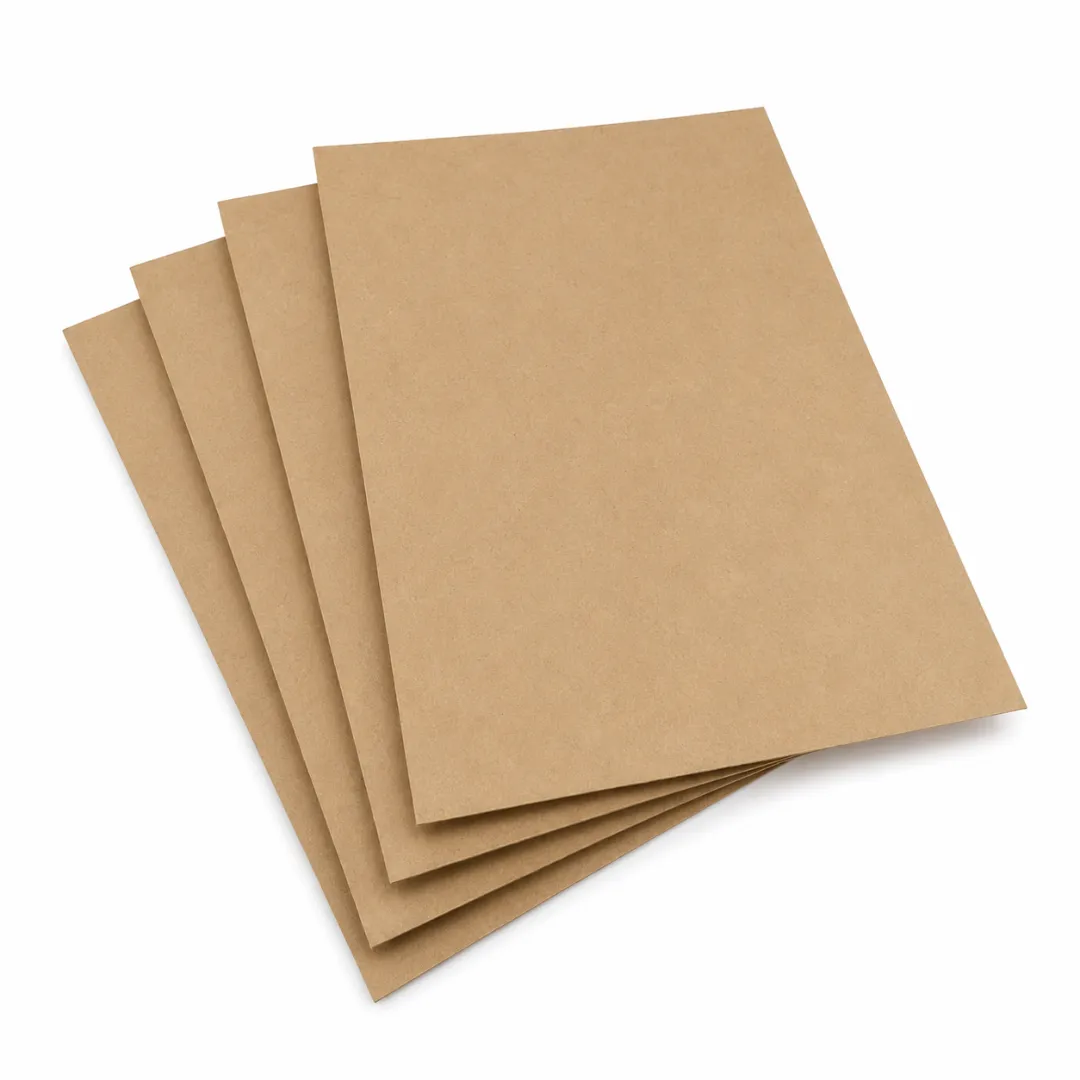
Kraft paper is a strong, durable and reliable material that is widely used across many different industries.
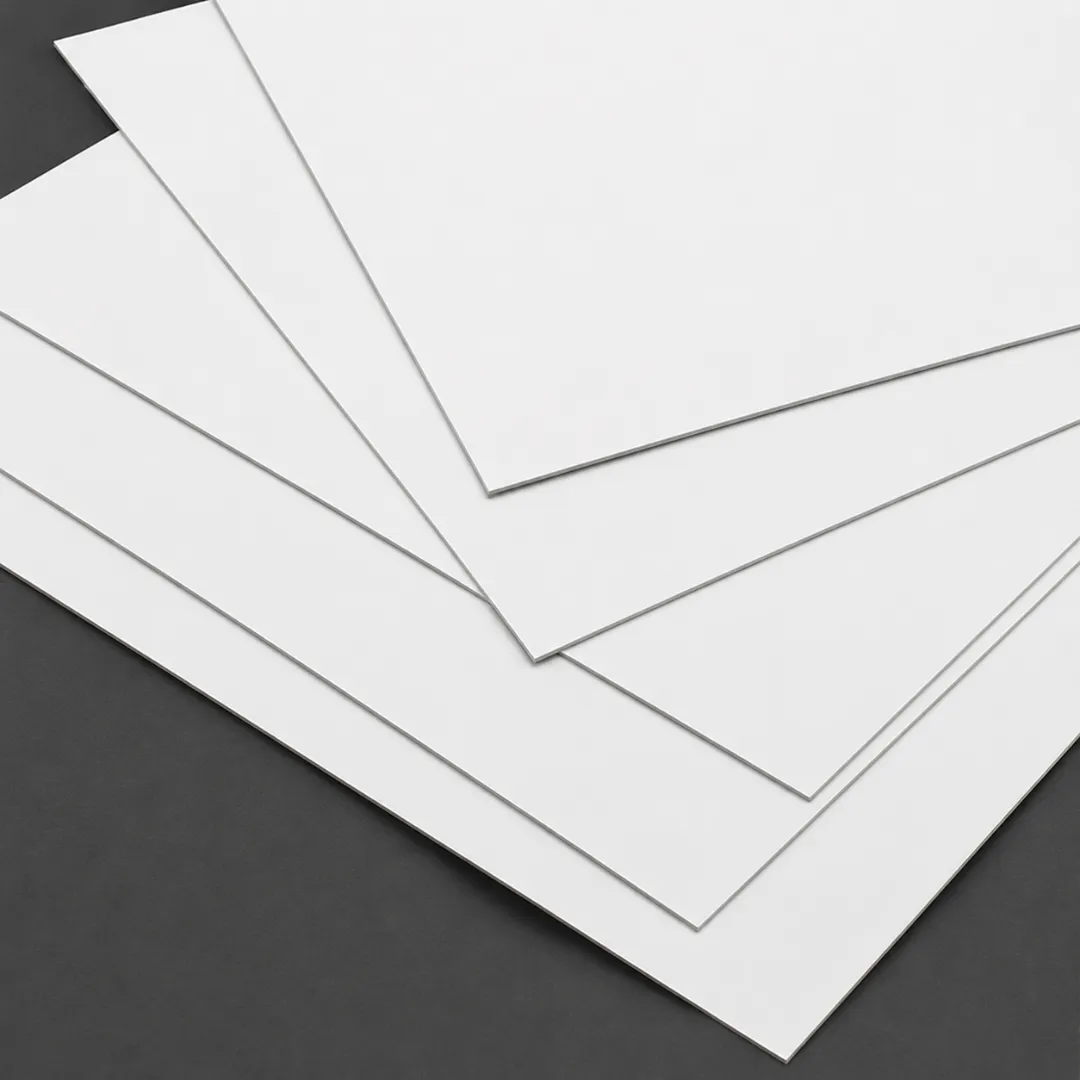
We use cardboard material with the least environmental impact and minimizes waste generation.
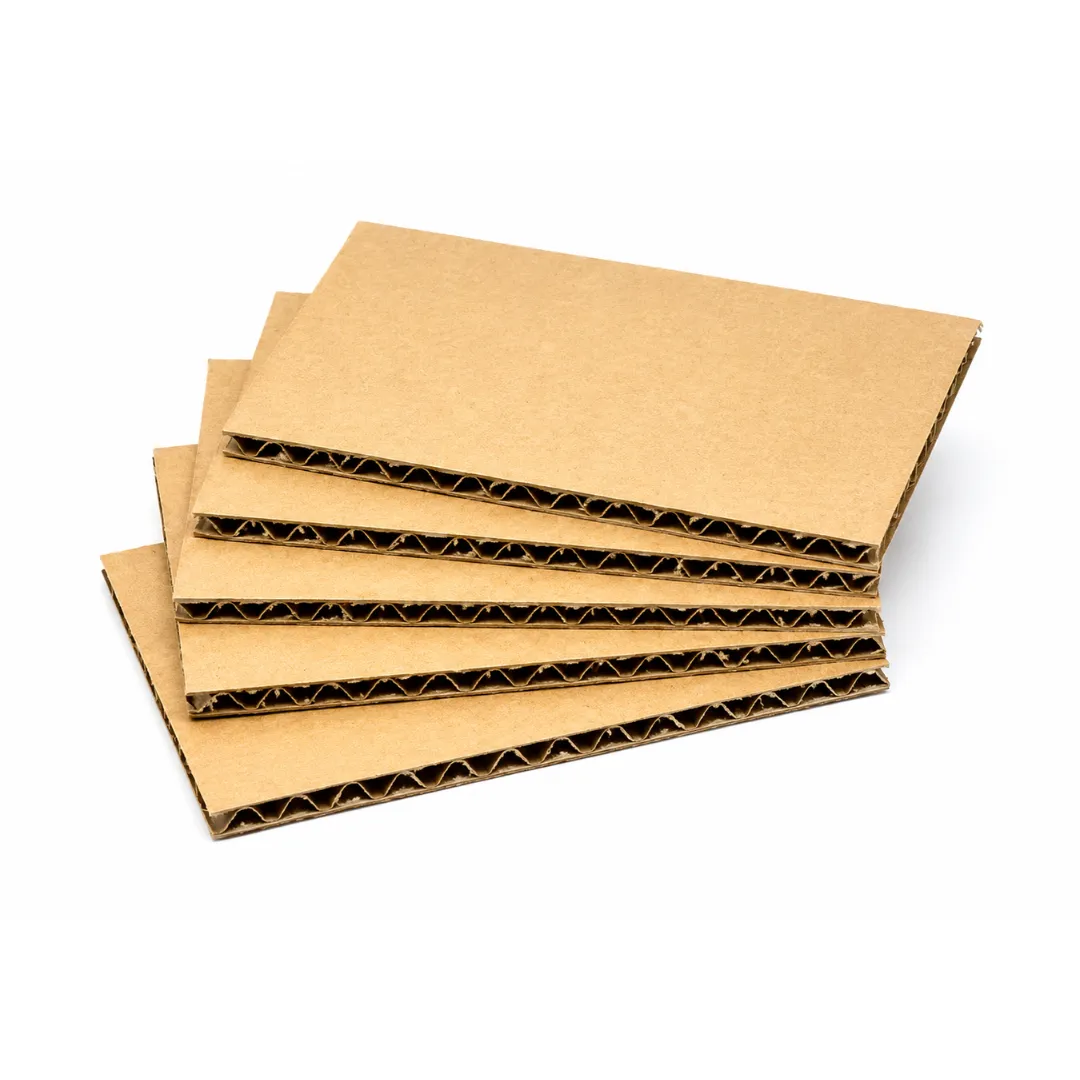
Corrugated material is easy to customize, cost effective and sustainable. It is also great for branding purposes.
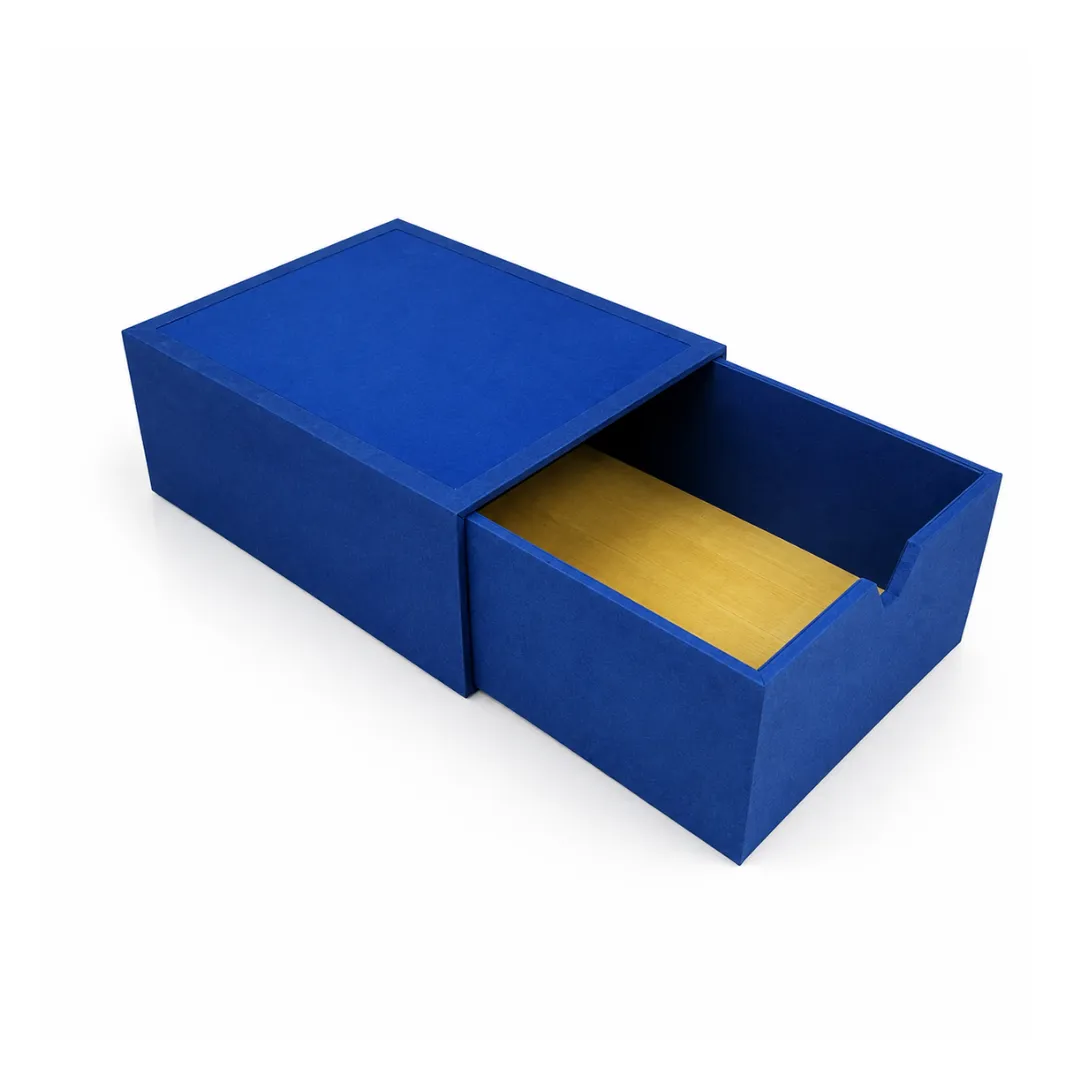
Rigid is highly protective, affordable and recyclable material. These boxes provide maximum protection.
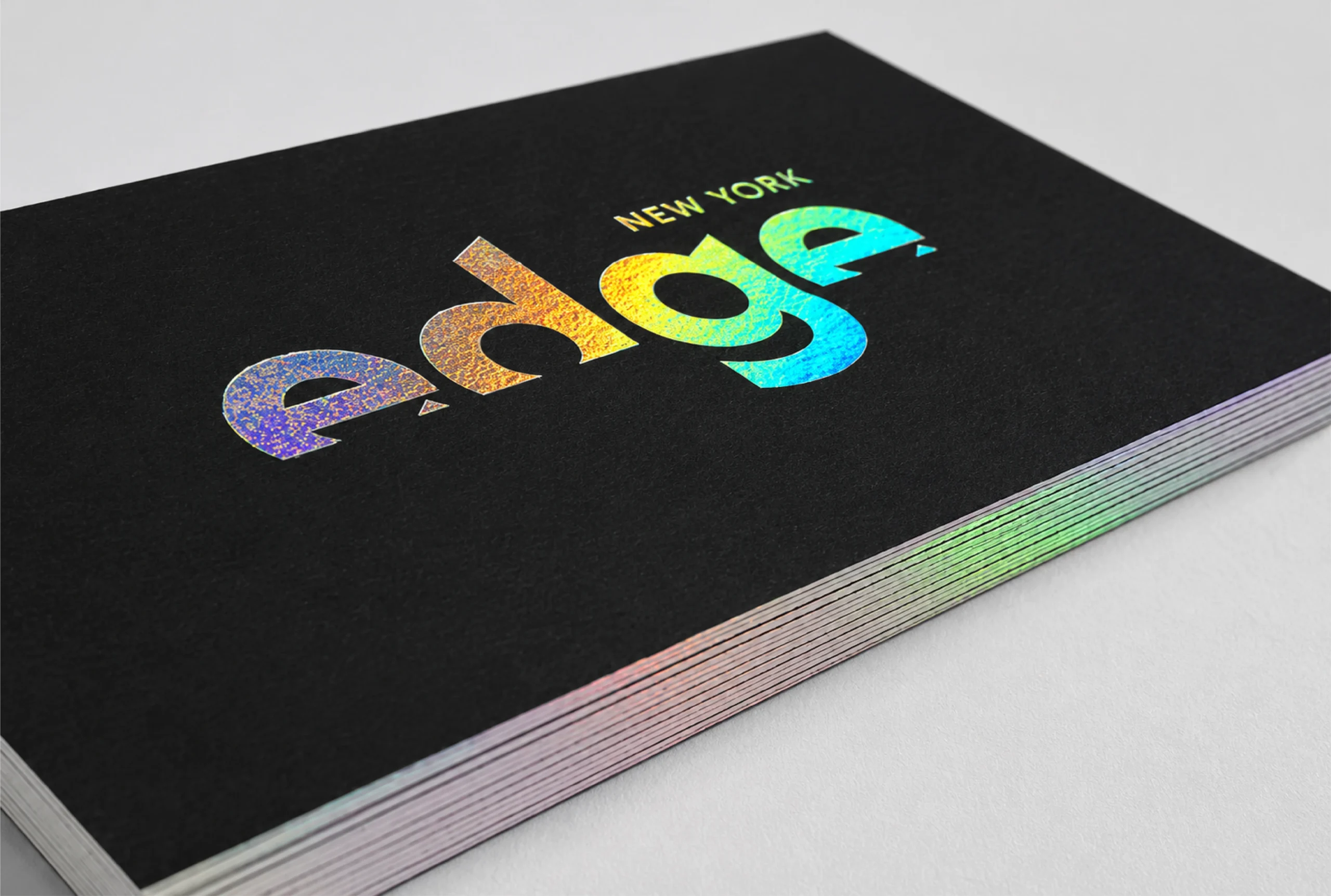
Holographic foil diffracts light and reveals the colors of the rainbow at various angles.
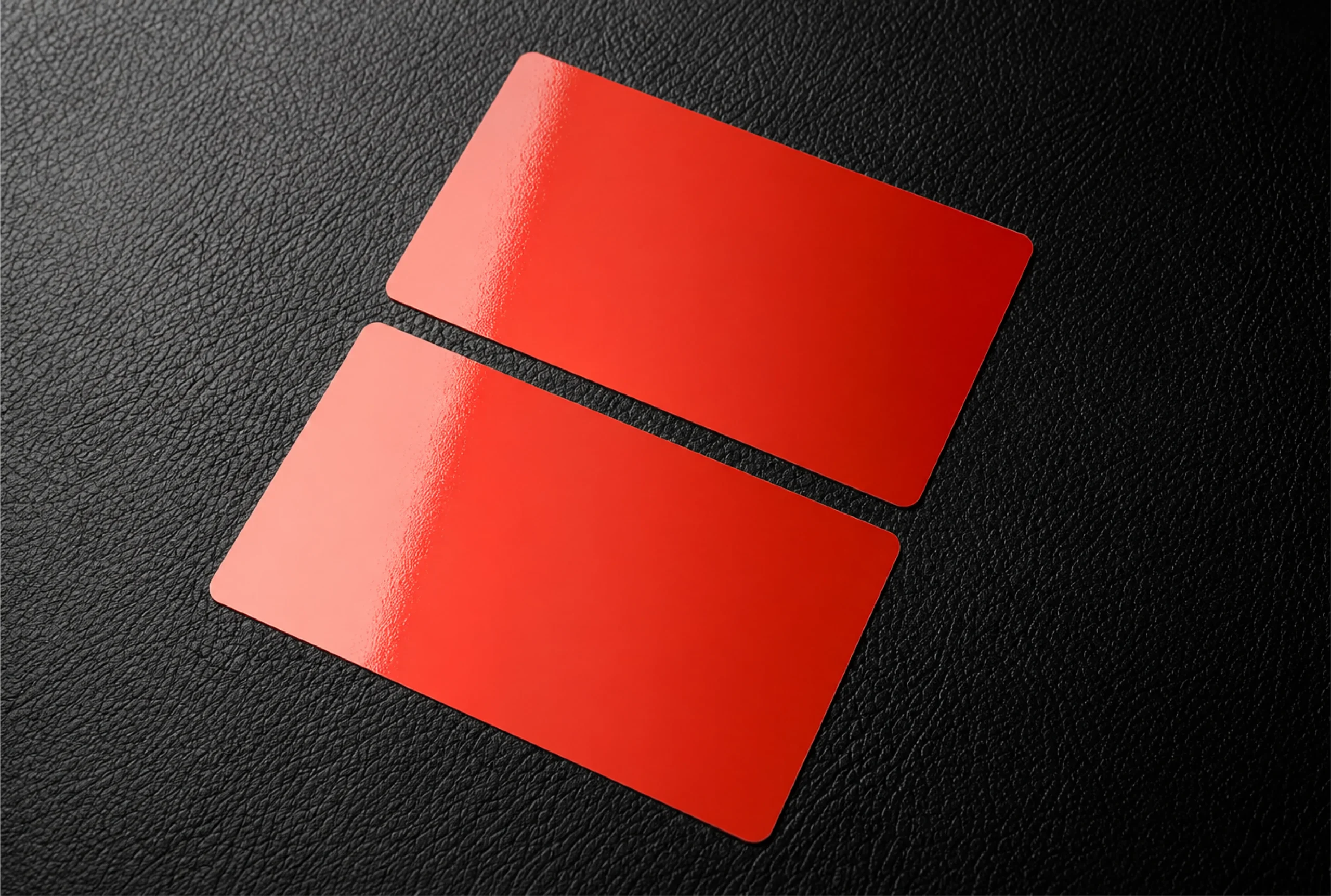
Our glossy finishing gives your packaging an extra layer of shine.
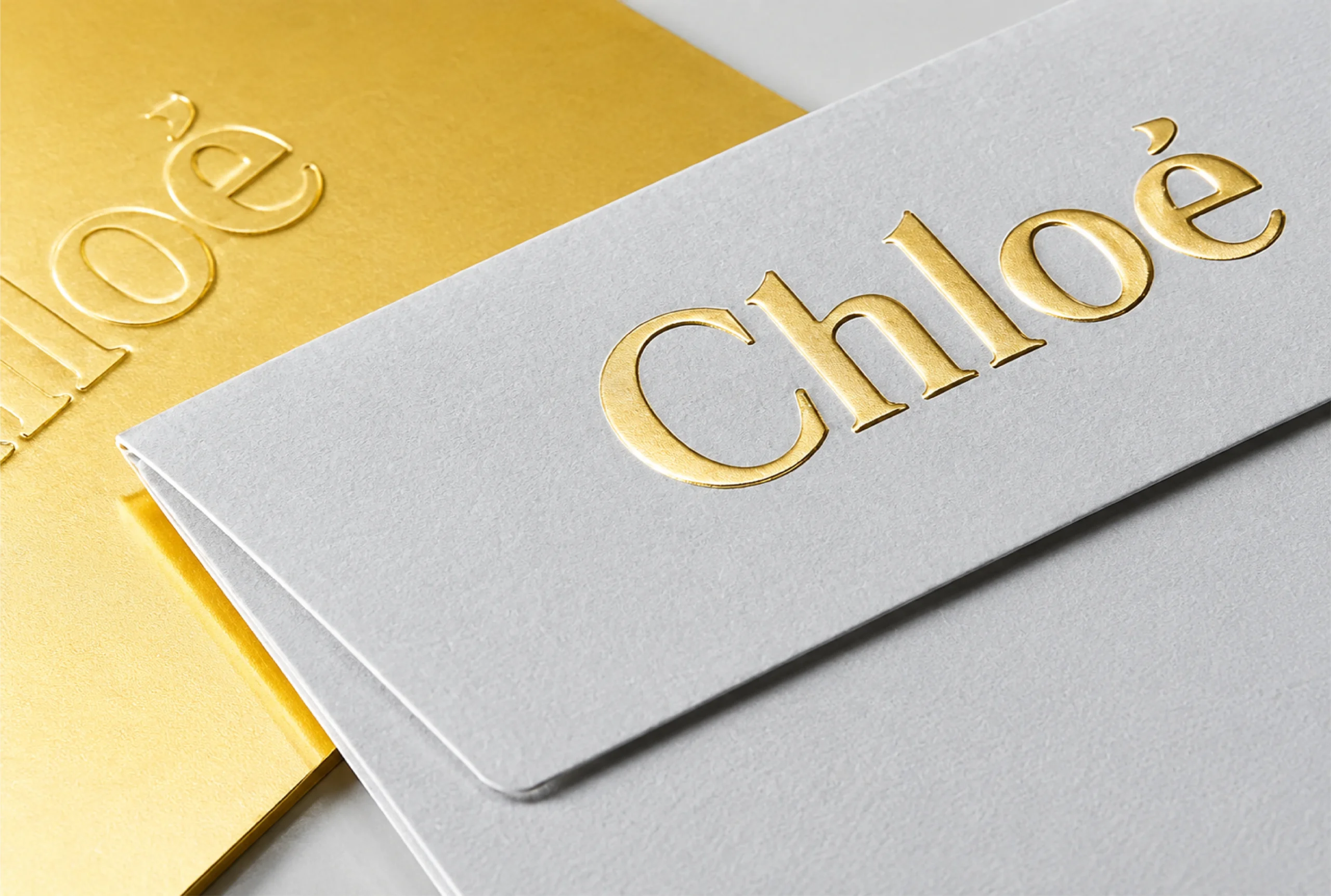
Decorate a wide range of your product packaging with our foil stamping.

With our embossing technique, we transfer the finest details of your product on packaging.
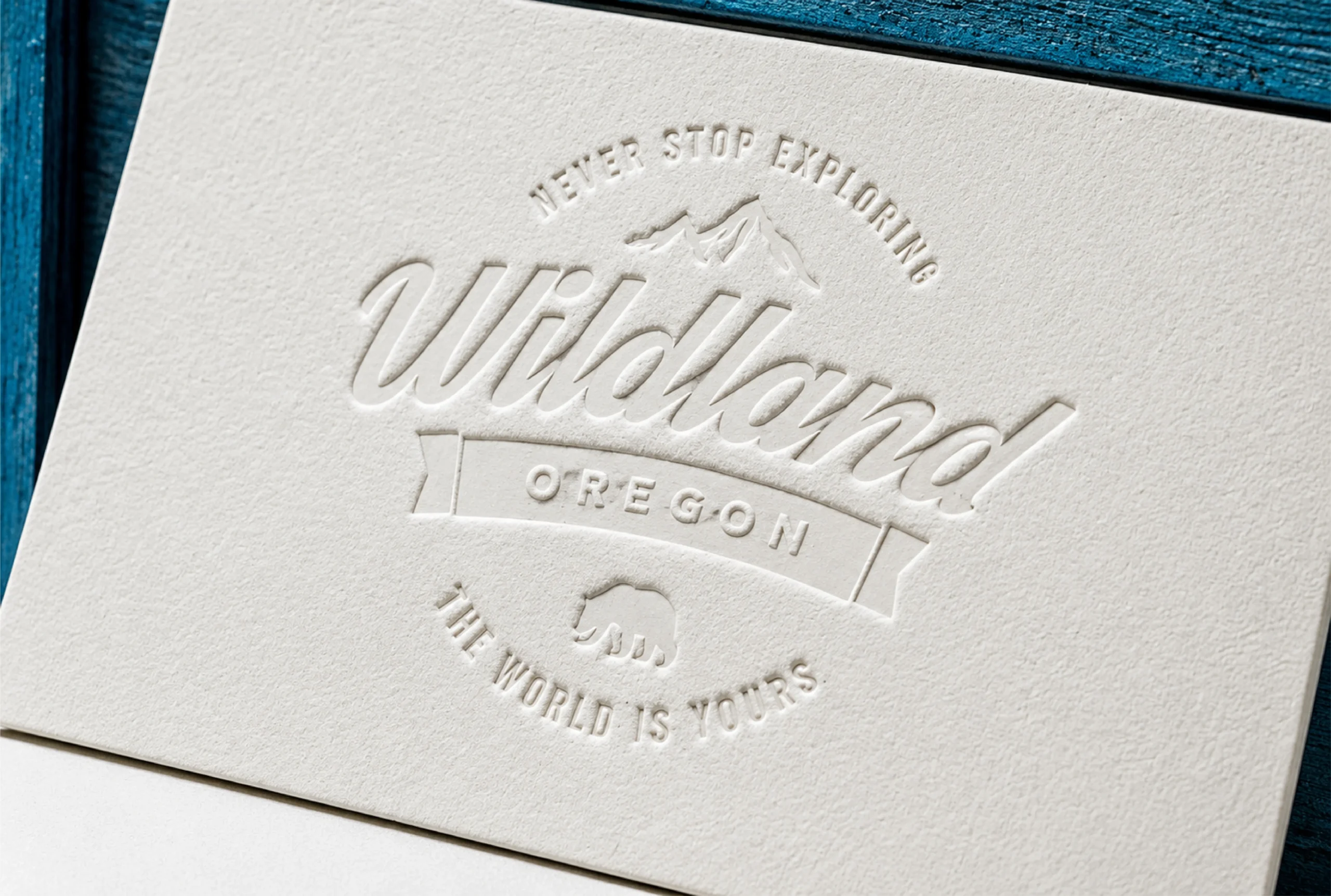
We use debossing technique to add unique graphics into your packaging.
Our high-gloss UV coating gives light and shine to cure the printed material's varnish.
We add additional layer of protection with soft touch lamination from toner chipping.
With our matte finish, fingerprints and smudges will now be less visible on the packaging.
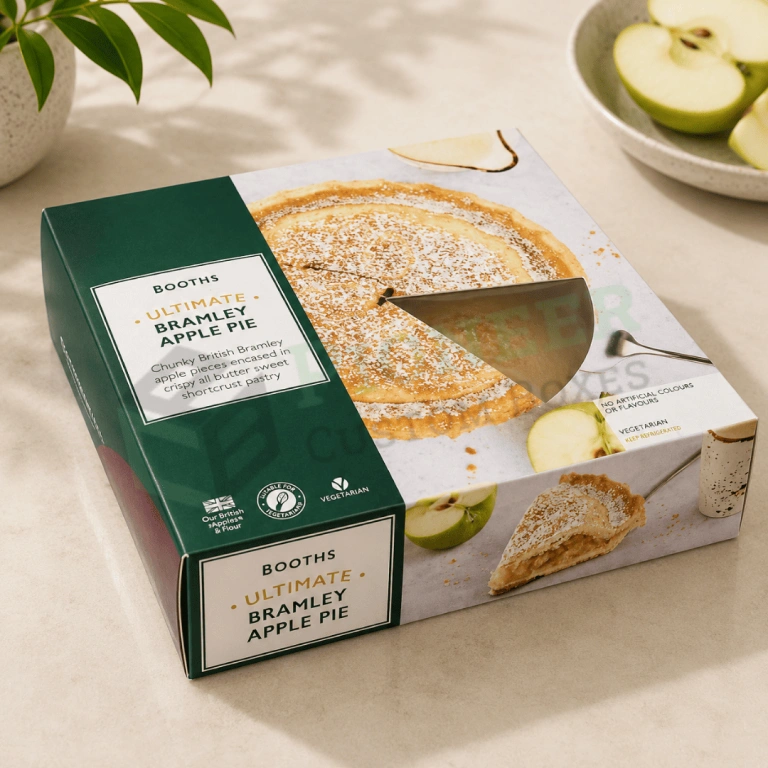
Custom pie boxes are bakery packaging boxes made for whole pies, mini pies, apple pies, cream pies, fruit pies, boxed pie gifts, bakery pie cases, pie shipping box programs, pie gift box packaging, pie selection box sets, and retail pie packaging. Pioneer Custom Boxes can customize pie box size, 9 inch pie boxes, mini pie boxes, mini pie containers, pie boxes with window, mini pie boxes with window, cardboard pie boxes, personalized pie boxes, inserts, handles, kraft paperboard, SBS board, corrugated support, printed branding, label panels, grease-aware direction, and bulk packaging for bakeries, cafés, dessert brands, grocery suppliers, farmers market sellers, and wholesale pie businesses.
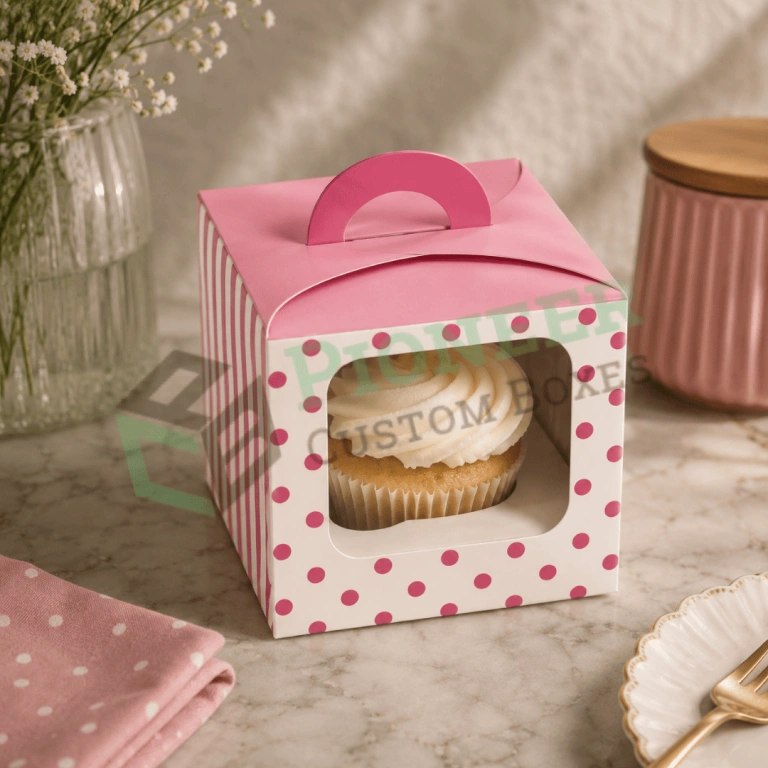
Custom small cake boxes from Pioneer Custom Boxes help bakeries, dessert shops, home bakers, cafes, event planners, and ecommerce bakery brands package mini cakes, single-serving cakes, cake slices, small box cakes, individual desserts, and gift-ready bakery items with custom sizing, inserts, windows, food-safe material planning, printed branding, and free shipping across the USA.
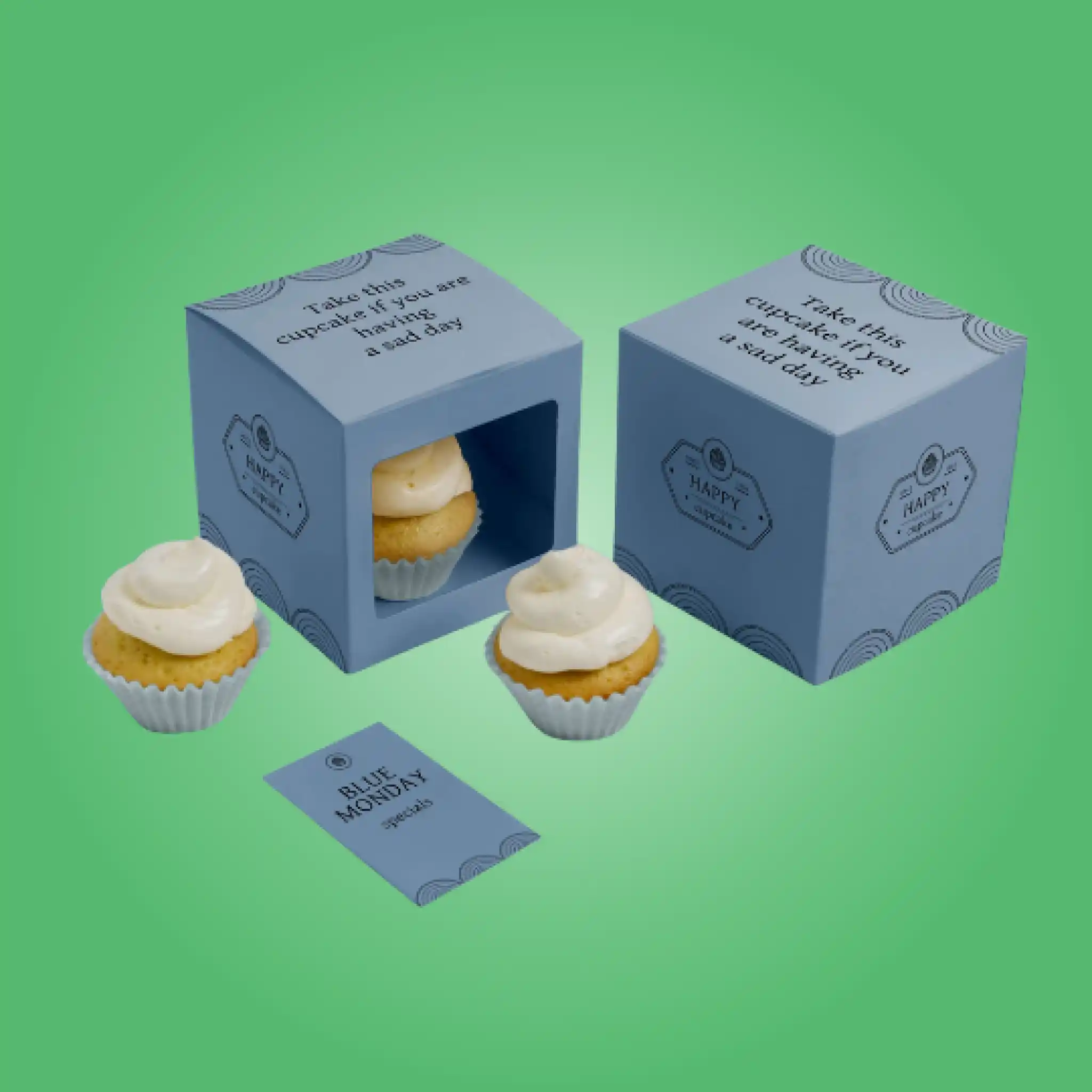
Custom cupcake boxes from Pioneer Custom Boxes hold each cake upright and keep frosting untouched for retail bakeries, home bakers, wedding suppliers, grocery bakeries and dessert delivery brands. Choose one to twenty-four cavity formats in grease-resistant SBS, kraft or E-flute board, with fitted inserts, windows, tall swirl clearance, free design support, zero MOQ and free USA shipping.
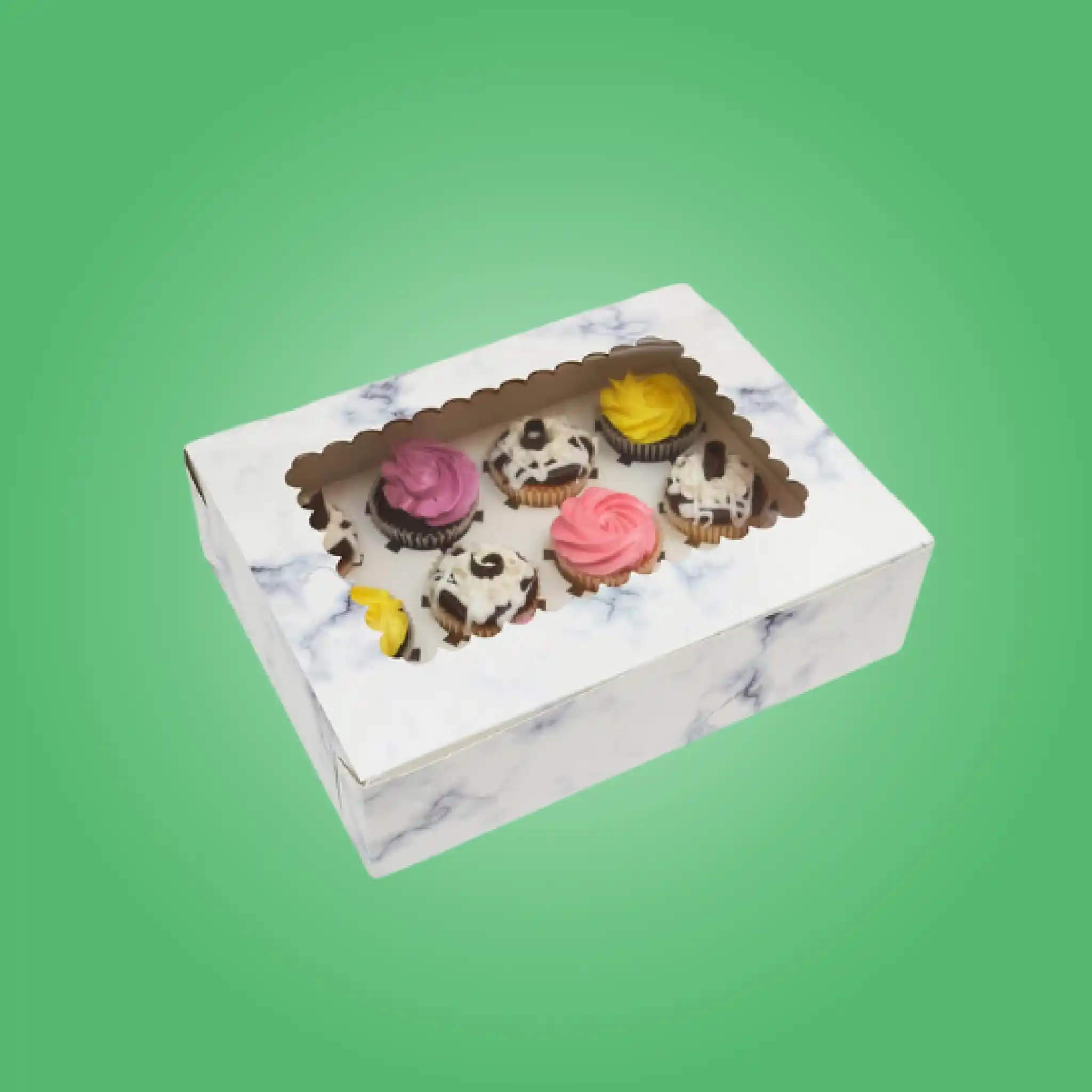
Custom pastry boxes built to your exact product size and count. Choose tuck top, lock corner, auto lock bottom, window front, clamshell, tray and lid, gable handle or corrugated mailer structures. We print on food safe SBS, grease resistant coated board, CCNB, kraft and E-flute in CMYK, PMS or metallic ink. Add vent holes, greaseproof liners, molded pulp trays, dividers, windows and allergen panels. Zero minimum order quantity, free design support and free shipping across the United States. Standard production runs ten to twelve business days, with rush service available. Get a free quote or order now.