

Length width height sounds simple. However, this is one of the most misunderstood topics in packaging.
A small measuring mistake can create three expensive problems at once. First, your product may not fit the box correctly. Second, your shipping cost can rise because oversized packages often trigger higher dimensional-weight charges. Third, the final presentation can look loose, awkward, or cheap.
This guide explains what length, width, and height actually mean, how to measure a box correctly, what dimension order to use, and how those measurements affect custom packaging, shipping cost, and customer experience.
It also covers internal dimensions, external dimensions, cubic inches, girth, DIM weight, common sizing mistakes, and the difference between 2D and 3D dimensions. If you order custom packaging, this is the foundation you need before you request a quote.
What Do Length, Width, and Height Mean?
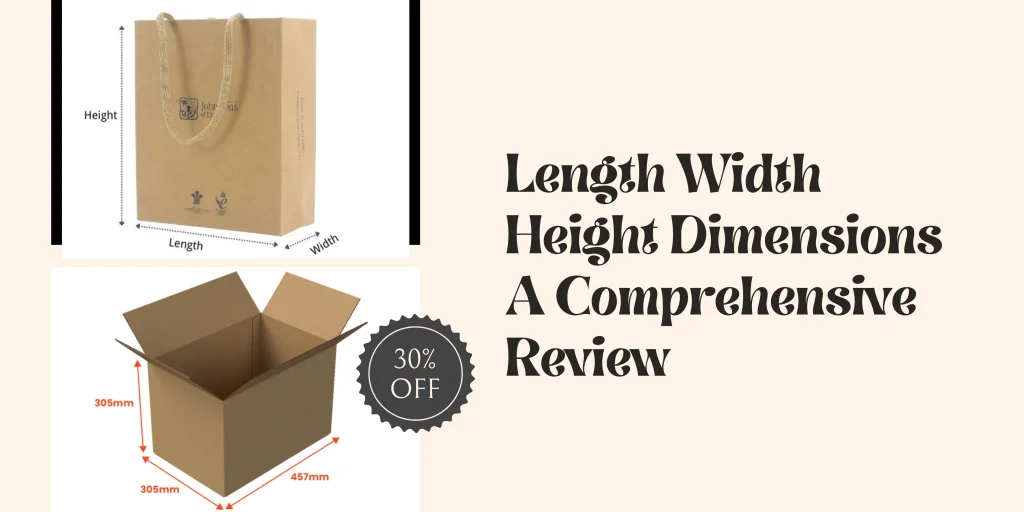
Length, width, and height are the three dimensions that describe the full size of a box or product.
For rectangular packaging, length is usually the longest side. Width is the shorter side that runs perpendicular to the length. Height is the vertical measurement from top to bottom.
Quick Reference
|
Dimension |
Meaning |
Simple Rule |
|
Length |
The longest side |
Measure the longest opening side first |
|
Width |
The shorter side across the opening |
Measure the side perpendicular to length |
|
Height |
The vertical side |
Measure from top to bottom |
The easiest way to identify them is to place the box upright with the opening facing up. Then look at the top panel. The longer side of that opening is length. The shorter side is width. The side running downward is height.
If you regularly work with packaging, learning the dimensions of boxes correctly helps prevent sizing confusion from the start.
Why Does Dimension Order Matter?
The standard way to write box measurements is Length × Width × Height, often shown as L × W × H.
This order matters because manufacturers, warehouses, designers, and carriers need one consistent format. If you reverse the order, you can end up with a completely different box shape. That can affect how the product sits, how inserts fit, how printing panels line up, and how much shipping space the box occupies.
For example, 12 × 10 × 4 is not the same shape as 10 × 12 × 4. The cubic volume may stay similar, but the structure changes. For custom packaging, that structural change can ruin the fit.
Common Order Variations People Search
|
Search Phrase |
Correct Interpretation |
|
height width length order |
Not standard for packaging |
|
height length width order |
Not standard for packaging |
|
length height width order |
Not standard for packaging |
|
length width height order |
Standard packaging format |
People often search for those variations because they are unsure which side comes first. For packaging, stay with length width height unless your manufacturer states otherwise.
How Do You Measure a Box Correctly?
You only need a ruler or tape measure. For smaller items or insert spaces, digital calipers can also help because they provide tighter precision.
Start by placing the box on a flat surface. Keep the box in its natural upright position. Then measure the top opening. Take the longer side first, the shorter side second, and the vertical side last.
Step-by-Step Method
|
Step |
What to Do |
Why It Helps |
|
1 |
Put the box on a flat surface |
Prevents angled measurements |
|
2 |
Face the opening upward |
Makes length and width clear |
|
3 |
Measure the longest opening side |
This gives you length |
|
4 |
Measure the shorter opening side |
This gives you width |
|
5 |
Measure top to bottom |
This gives you height |
If you are measuring for custom packaging, accuracy matters more than rough rounding. A small error can affect product fit, board usage, inserts, and overall presentation.
If you want a more practical guide, this is also the right stage to measure the dimensions of boxes before moving into production or shipping decisions.
CTA: Download your free box sizing checklist and keep a repeatable measurement process for every product line.
What Is the Difference Between Internal and External Dimensions?
This is where many packaging mistakes begin.
External dimensions describe the outside size of the box. Internal dimensions describe the usable space inside the box. Shipping carriers focus on external size, while product fit depends on internal size.
Internal vs External Dimensions
|
Type |
What It Measures |
Best Used For |
|
Internal dimensions |
Usable inside space |
Product fit, inserts, clearance |
|
External dimensions |
Outside box size |
Shipping, storage, shelf planning |
Board thickness affects that difference. A rigid box structure with heavy board or a corrugated mailer with thicker flute can reduce inside space. This is why internal dimensions matter when your product must fit tightly.
If you give only external dimensions to a manufacturer, your final box may end up too small inside. That is especially risky for products with snug inserts or premium presentation layouts.
What Is the Difference Between Length, Width, and Height?
People often confuse these terms because they all describe size, yet each one controls a different direction.
Length vs width is the most common confusion. Both appear across the opening. The simple rule is this: the longer side is length, and the shorter side is width.
Width vs height creates confusion when someone rotates the box mentally. Width stays on the opening plane. Height runs vertically.
Height vs length becomes confusing when someone looks at the front panel instead of the top opening. That is why packaging measurements should start from the opening, not from the front face.
Fast Comparison
|
Comparison |
Practical Answer |
|
Length vs width |
Length is longer |
|
Width vs height |
Width is horizontal on the opening; height is vertical |
|
Height vs length |
Height goes up and down; length runs across the top |
Once you use the opening as your reference point, the confusion usually disappears.
What Are 2D and 3D Dimensions?
This is another semantic area many pages miss.
2D dimensions use only two measurements, such as length and width. They describe a flat shape, like a label, printed sheet, or unfolded dieline panel.
3D dimensions use three measurements: length, width, and height. They describe a physical object with depth, such as a box, carton, or product.
Packaging always becomes a 3D conversation once the structure is formed. That is why a flat dieline alone is not enough when you are quoting a finished box.
How Do You Measure a Product for Packaging?
Measure the product before you choose the box.
Take the product’s longest point, then the shorter side, then the tallest point. If the shape is irregular, measure the extreme points. After that, add reasonable clearance for padding, inserts, tissue, or easy removal.
Product Measurement Logic
|
Product Type |
What to Watch |
|
Fragile products |
Leave room for cushioning |
|
Premium retail products |
Leave room for clean presentation |
|
Multi-piece kits |
Measure the final arranged layout |
|
Tight-fit products |
Add enough tolerance for easy removal |
Tolerance matters here. In packaging, tolerances are small allowances that help real products fit into real boxes without forcing them in. If you size the box too tightly, packing becomes difficult. If you size it too loosely, the product may shift, rattle, or look unprofessional.
How Do You Measure Irregular Products for Custom Boxes?
Not every product is a perfect rectangle.
A bottle with a pump, a jar with a lid, a gift set with multiple parts, or an item with handles will need a different measuring approach. In those cases, measure the widest point, longest point, and tallest point of the assembled product. Then decide how it will sit inside the box.
Orientation matters. A product can fit one way but fail another way. That is especially true for inserts, foam cavities, and compartment-based packaging.
This is also where calipers can help. They are useful for small products, insert depth, closure thickness, or other precise measurements where a tape measure is too rough.
Why Do Accurate Dimensions Matter for Shipping Costs?
Accurate box dimensions affect freight and parcel pricing because carriers often use dimensional weight, also called DIM weight.
Dimensional Weight Formula
DIM weight = (Length × Width × Height) ÷ Divisor
That means cubic inches matter. If your box is larger than necessary, your billable weight can rise even when the actual product is light. One extra inch can matter more than many brands expect.
Example
|
Measurement |
Result |
|
16 × 12 × 12 |
2,304 cubic inches |
|
2,304 ÷ 139 |
about 16.6 DIM pounds |
If the product inside weighs far less, the carrier may still bill by dimensional weight.
Many brands using mailer boxes overlook this and end up paying more because the outer size is larger than necessary.
According to FedEx’s official dimensional weight guidelines, the formula is length × width × height divided by 139 for domestic shipments.
Request a custom quote if you want packaging sized more precisely to reduce wasted space and unnecessary freight cost.
What Is Girth, and Why Does It Matter?
Girth is another shipping term people often overlook.
Girth Formula
|
Formula |
Meaning |
|
Girth = 2H + 2W |
Distance around the thickest part, excluding length |
|
Length + Girth |
Total parcel size used in many carrier rules |
This matters for longer packages, mailing tubes, and oversized cartons. Even if your product fits, the parcel may exceed carrier size rules if the girth becomes too large.
What Are the Most Common Packaging Dimension Mistakes?
Most dimension mistakes are simple, but they can still become expensive.
Some people measure the front face first instead of the top opening. Others use external dimensions when the product fit requires internal dimensions. Some reverse length and width. Others forget to add room for inserts, paper wrap, or product removal.
Common Mistakes
|
Mistake |
What It Causes |
|
Wrong dimension order |
Wrong dieline or wrong box shape |
|
External size used for fit |
Product does not fit inside |
|
No tolerance added |
Product jams or scuffs |
|
Oversized safety margin |
Higher DIM cost and poor presentation |
|
Ignoring board thickness |
Reduced usable inside space |
For corrugated packaging, flute direction and board thickness can influence strength and internal space. For rigid boxes, overhang, lid fit, and shoulder construction can also affect usable dimensions. These are not beginner details, but they matter once you move into custom production.
What Are the Best Tools for Measuring Box Dimensions?
A standard ruler works for small products. A tape measure works for most boxes. Digital calipers help when you need tight tolerances for inserts, cavities, or small premium items.
Measuring Tools
|
Tool |
Best For |
|
Ruler |
Small products and sample parts |
|
Tape measure |
Most cartons and mailers |
|
Digital calipers |
Inserts, cavities, small detailed parts |
|
Fit sample |
Testing real product placement |
For repeated packaging jobs, keep at least a tape measure and calipers on hand. That combination covers most dimensional needs from shipping cartons to small retail packaging.
How Do Length, Width, and Height Apply to Different Packaging Types?
The same dimension order applies across many packaging formats, but the packaging style changes how those dimensions behave.
A corrugated mailer may need more attention to flute direction, crush resistance, and shipping clearance. A rigid box may need better control over presentation, insert spacing, and lid overhang. A folding carton may focus more on efficient board usage and nesting during production.
Packaging Type Comparison
|
Tool |
Best For |
|
Ruler |
Small products and sample parts |
|
Tape measure |
Most cartons and mailers |
|
Digital calipers |
Inserts, cavities, small detailed parts |
|
Fit sample |
Testing real product placement |
|
Tool |
Best For |
For retail-oriented packaging examples, cereal boxes are a simple way to understand how length, width, and height also affect shelf display and front-panel visibility.
Nesting can also matter for storage and fulfillment. Some structures store or stack more efficiently than others. Shrinkage can matter too, especially when paper-based materials or print processes slightly affect finished fit.
How Does Dimension Accuracy Improve Custom Packaging?
Correct dimensions help packaging perform better at every stage.
They reduce wasted board. They improve insert fit. They support better print alignment. They reduce movement during transit. They also help create a more premium unboxing experience because the product sits where it should.
For shipping cartons, accurate dimensions help control dimensional-weight charges and pallet stacking. For premium boxes, they help maintain presentation, protection, and consistency.
This is where packaging moves from simple measurement into structural planning.
How Do You Choose the Right Box Size?
The right box is not just the smallest box. It is the box that balances fit, protection, shipping efficiency, and presentation.
Start with the product size. Add reasonable tolerance. Then account for inserts, tissue, foam, or protective space. After that, check whether the external dimensions still make sense for shipping and storage.
If the product is premium, you may want a little extra breathing room for a better reveal. If the product is purely shipping-driven, you may want a tighter fit to reduce movement and freight cost.
That balance is what good packaging design really means.
A Simple Real-World Packaging Lesson
Brands often focus on product weight first. However, box size can be just as important. A package that is even slightly oversized may look harmless, yet it can reduce presentation quality and create avoidable shipping expense. On the other hand, a box that is too tight may create product scuffing, difficult removal, or damaged corners during packing.
That is why accurate measurement should be treated as a packaging decision, not just a warehouse task. The goal is not to find any box that works. The goal is to find the right box that fits the product properly, protects it during transit, and still presents it well when the customer opens it.
CTA: Ready to test your sizing before production? Offer a free sample box or a sizing checklist on this page so buyers can validate dimensions before placing a larger order.
Final Thoughts
Understanding length width height is essential for custom packaging, shipping, storage, and presentation. If you get the measurement order wrong, the result can affect far more than the box itself. It can affect product fit, shipping fees, dimensional weight, warehouse planning, and customer perception.
The simplest rule is still the best one: measure the longest opening side first, the shorter opening side second, and the vertical side last. Then confirm whether you need internal dimensions or external dimensions.
If you are ordering custom boxes, those details should never be guessed. They should be measured carefully and reviewed with the packaging structure in mind.
At Pioneer Custom Boxes, we help businesses turn product dimensions into packaging that fits correctly, protects well, and presents professionally. If you need help choosing the right box size for your product, you can request a custom quote and share your measurements with our team.
Get a custom quote for packaging that fits your product properly and supports a cleaner shipping and unboxing experience.
Frequently Asked Questions
What is the correct order for box dimensions?
The standard order is length × width × height.
Does length or width come first?
Length comes first because it is the longest side.
What is the difference between height and depth in packaging?
In many packaging contexts, height and depth are used similarly, but height usually refers to the vertical measurement.
Should I use internal or external dimensions for custom packaging?
Use internal dimensions for product fit. Use external dimensions for shipping and storage.
What is the dimensional weight formula?
DIM weight is calculated by multiplying length, width, and height, then dividing by the carrier’s divisor.
What is the girth of a box?
For rectangular parcels, girth is calculated as 2 × height + 2 × width.
What happens if I give the wrong dimension order to a manufacturer?
You may receive a box with the wrong shape, fit, or panel layout, which can force a redesign or reorder.
Do I need calipers to measure a box?
Not always. A tape measure is enough for most boxes, but calipers help with small parts, inserts, and tight tolerances.